
A car rental API can support an attractive search experience while leaving an important question unanswered: can this customer collect and drive the selected car? Evaluate that question separately from inventory, vehicle descriptions, and booking functionality.
Your audience changes the evidence you need. Recently licensed drivers need clear tenure information; international travelers need document and residency distinctions; customers sharing the driving need separate eligibility treatment. The goal is to select an integration whose information you can explain accurately, rather than build reassuring messages around assumptions. These six checks focus on the meaning of the rules and how to demonstrate that meaning before buying.
1. Age: distinguish eligibility from an extra charge
Age evaluation should answer two different questions: is the driver eligible for this rental, and does the driver's age change the applicable charges or conditions? A fee description alone does not answer the eligibility question.
For your evaluation, separate the minimum permitted age, any upper-age condition, age-related charges, and vehicle-category restrictions. These are information requirements to investigate, not assumed fields in any particular API.
Require a demonstration that connects the rule to the selected offer. A broad supplier description is weaker evidence than terms associated with the rental your customer is considering.
Also establish the date used to assess age. If your design calculates age at pickup, the supporting rule must justify that choice. A customer whose birthday falls between booking and collection is a useful boundary test.
The customer-facing result should distinguish an exclusion from an eligible rental with an extra charge. If the information only explains a charge, avoid turning it into a message that the driver is approved.
2. License tenure: separate driving experience from document issue date
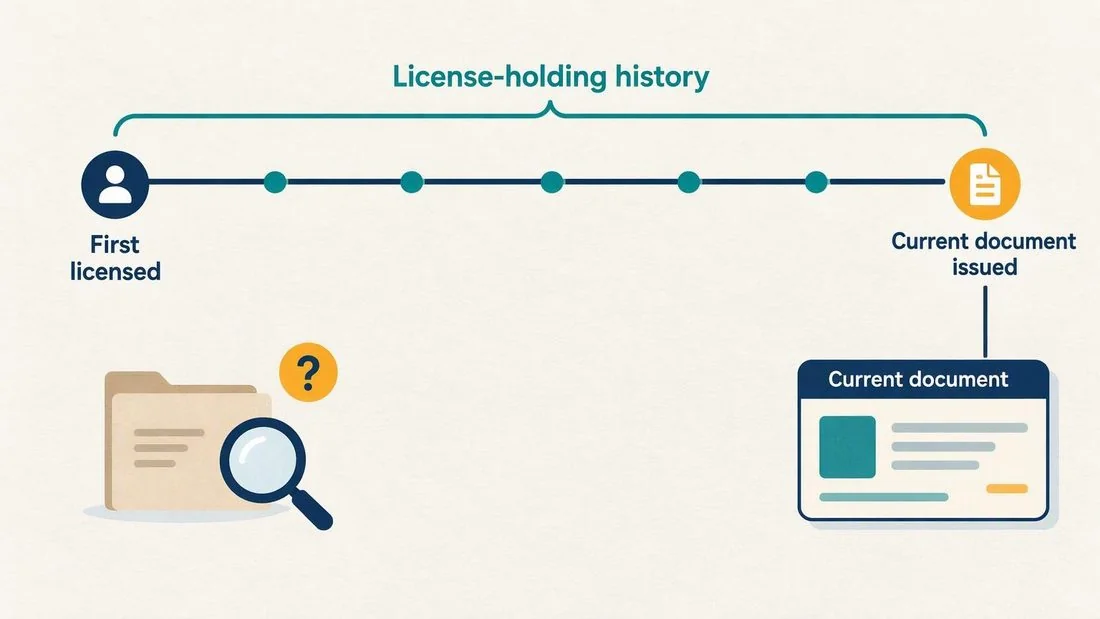
A license expiration date and the length of time someone has held a license answer different questions. Your evaluation should establish whether the rental has a minimum license-holding period and what evidence supports that period.
The technical difficulty is interpreting the date. An issue date printed on the current document does not, by itself, establish when the driver first became licensed. Your product must not silently treat those dates as interchangeable.
Use a renewed or replacement license as a test case. Require the provider to explain how its information distinguishes the current document's issue date from the tenure measure used by the applicable rental rule.
A useful response or accompanying policy should identify the required period, the relevant license category, and acceptable evidence where the document does not establish the full history. If that distinction is unavailable, the honest result is that tenure still needs review.
This check matters independently of age. An older driver can have a recently obtained license, while a younger driver can have a longer driving history. An age input cannot substitute for tenure evidence.
3. License format: evaluate the document the customer will present
Do not reduce license acceptance to a single valid-or-invalid label. For evaluation purposes, distinguish legal validity from the selected rental's acceptance of the document's format, issuing jurisdiction, language, and license category.
Your test set should include the document types your customers actually use, such as physical licenses, digital credentials, temporary documents, and licenses requiring language assistance. Including a document in the test set does not imply that a supplier accepts it.
Where the rental terms mention an international driving permit or translation, preserve the relationship between that document and the underlying license. Do not label a supporting document as a replacement unless the applicable terms explicitly support that interpretation.
The evidence should answer whether the original document must be presented, whether supporting paperwork is required, and whether acceptance differs for the particular rental. Keep those answers attached to the relevant offer.
A technically convenient country-code field may still leave document acceptance unexplained. Review our car rental API response-field guide as a starting point for discussing what each available value means, rather than assuming its name proves eligibility coverage.
4. Residency: keep residence, nationality, and license country separate
Residence, nationality, and license-issuing country describe different facts about a driver. An integration should not substitute one for another when a rental condition refers to a specific attribute.
Say a customer lives in one country and holds a license issued in another. If your form collects only the license country, it cannot reliably answer a condition that depends on residence. Adding nationality would not resolve that mismatch.
Evaluate whether the applicable terms distinguish residents from visitors and whether any supporting address or travel evidence is involved. The important evidence is the precise condition, not a generic international-driver label.
If a request accepts a country value, establish its intended meaning. Then trace that meaning through the response and customer-facing wording so that your interface does not describe a residence condition as a nationality restriction.
This is also a test of scope. Compare the supplied rule with the selected pickup location and offer, rather than applying a general country description to every rental. A blank residency field should remain unknown unless the provider documents a different meaning.
5. Identification: explain documents without implying verification
Identification requirements concern what the customer must present and how those documents relate to the reservation. They are separate from the question of whether the customer holds an acceptable driving license.
For each relevant rental, evaluate the document requirements and any stated name-matching conditions. If passport or other identification requirements apply, preserve the exact relationship between those requirements and the driver's circumstances.
Separate displaying a requirement from verifying a document. An API response containing identification instructions does not establish that identity has been checked, that a document is authentic, or that the customer has completed the supplier's collection requirements.
Test names with spaces, accents, and multiple family names in your own interface. The objective is to preserve the customer's information and applicable instructions, not invent a universal matching rule.
Collect only the information your chosen process needs. If your product explains a document requirement without inspecting the document, avoid adding uploads merely to make the flow look complete. Any collection of sensitive identity data needs a defined purpose, access controls, and a retention decision separate from the eligibility wording.
6. Additional drivers: evaluate each person and the authorization step
The main driver's eligibility does not establish the eligibility of another person who intends to drive. Model each driver's relevant attributes separately, then evaluate what the rental terms say about adding and authorizing that person.
Distinguish an additional-driver charge, permission to add a driver, and completed authorization. A price line does not explain who qualifies, and a name entered during booking does not by itself prove that the person has been authorized.
The useful evidence covers any separate age, license, or identification conditions, plus the procedure for adding the driver. Establish whether the available information explains when that process occurs and whether personal attendance is required.
Test a booking in which the main driver satisfies the known rules but the additional driver's license tenure needs review. Your interface should preserve the distinction rather than reject both people or approve both through a shared status.
Also keep the main driver's booking status separate from the additional driver's status. This allows your product to explain what is ready and what remains to be completed without presenting an unfinished authorization as permission to drive.
Six driver checks: distinctions that matter
| Check | Keep separate | Test case |
|---|---|---|
| Age | Eligibility vs. extra charges | Birthday between booking and pickup |
| License tenure | Driving history vs. document issue date | Renewed or replacement license |
| License format | Legal validity vs. rental acceptance | Physical, digital or temporary document |
| Residency | Residence, nationality, license country | Residence differs from license country |
| Identification | Requirements vs. verified identity | Names with spaces or accents |
| Additional drivers | Charge, permission and authorization | Additional driver's tenure needs review |
Which evidence format fits your customer experience?
After evaluating the six checks, choose how your product will use the available evidence. Structured data, readable rental terms, and assisted review serve different purposes; none should automatically be treated as proof of final collection approval.
Apply this comparison to each eligibility dimension separately. An integration might provide usable structured age information while document acceptance still depends on readable terms. One overall eligibility score would hide that difference.
Choosing how to communicate driver eligibility
| Approach | Useful when | Evidence to require | Trade-off |
|---|---|---|---|
| Structured eligibility data | Your product needs automated evaluation | Defined values, rule scope, date basis, and missing-value behavior | Automation depends on complete and correctly interpreted rules |
| Offer-linked rental terms | Customers can review detailed conditions before committing | Readable terms tied to the selected rental and preserved accurately | Text is harder to evaluate automatically and may require careful presentation |
| Assisted eligibility review | A document or driver case cannot be decided from available information | A defined handoff and a clear record of what was clarified | The customer cannot finish the eligibility decision entirely through self-service |
Work through a mixed-driver example
Say you are building a booking experience for international travelers who sometimes share the driving. The main driver has a renewed license; the additional driver has a recently obtained license. Your demonstration returns vehicle availability and readable rental terms, but no structured tenure result.
Availability does not settle either tenure question. For the main driver, the relevant issue is whether the renewed document establishes the required driving history; for the additional driver, it is whether the actual holding period satisfies the applicable rule.
If your intended experience promises immediate automated eligibility decisions, this evidence is insufficient until the tenure requirement can be evaluated reliably. If your product supports assisted review before the customer commits, readable terms may be workable, provided the open questions and handoff remain clear.
The right choice follows from the uncertainty and your service model, not from the number of reservations or the size of the vehicle catalog.
Define what missing information means
Use distinct internal states for a supported result, an explicit restriction, and information requiring review. These are proposed design states, not claimed API values.
Require documentation before assigning meaning to nulls, omitted fields, or empty text. Preserve the rule's origin and applicable offer so your team can explain a decision without relying on a transformed label alone.

How to evaluate these requirements with Xeni
We provide car rental API resources that give you a relevant starting point for an integration discussion. Use our getting-started guide to frame the technical evaluation, then keep the driver-rule assessment focused on the information your product needs.
Supplier selection is part of that assessment. Our guide to car rental suppliers is relevant context for deciding which rental cases to include in your demonstration. Do not infer uniform driver requirements across suppliers from their inclusion in an integration.
Bring representative driver profiles and a selected rental example to the discussion. Request a walkthrough showing which of the six eligibility dimensions can be communicated, whether they arrive as structured values or terms, and which decisions require a separate review.
This makes the evaluation concrete without assuming that a documentation category or supplier listing proves support for a particular rule. The buying decision is whether the demonstrated information fits the experience you intend to deliver.
Use Contact Us to discuss the driver eligibility details available for your proposed integration.
Make driver eligibility part of the integration evaluation
Review our car rental API resources, then discuss the information your intended customers need.
Explore more from Xeni
Frequently Asked Questions
Buy for the driver decisions your product must explain
Before committing, use a representative rental and driver profile to demonstrate the eligibility information from end to end. Proceed when your product can distinguish a documented permission, an explicit restriction, and a question requiring review without filling gaps with assumptions.