

Before assigning developers to a Xeni integration, decide what their work must establish. Reading a product overview, testing a documented request, and implementing a customer-facing workflow require different levels of evidence.
The useful question is whether the documentation removes the uncertainties that could change your design or estimate. For a travel product, that means following information through the intended customer journey rather than stopping at a category name or a successful response example. Evaluate the materials available to you against that journey, and approve only the next step they can support.
What commitment does the documentation support?
Approve work according to the evidence available, not the confidence of a presentation. A clear explanation of the product may justify discovery, while a usable technical reference may justify testing a specific operation.
Implementation requires more: the team must understand how the required operations fit together and what happens when they fail. A successful request establishes something narrower than a complete customer journey.
Use the following comparison to distinguish the next useful step. These are evaluation choices, not descriptions of Xeni access arrangements.
Match the engineering commitment to the available evidence
| Commitment | Evidence that supports it | Useful output | What it does not establish |
|---|---|---|---|
| Discovery | Product scope and a defined customer need | A workflow map and focused technical questions | That the workflow can be implemented |
| Technical evaluation | Documented operations, usable examples, and an agreed testing route | Observed behavior for a bounded part of the workflow | Production readiness or complete lifecycle coverage |
| Implementation | Workflow coverage, data definitions, recovery rules, and understood dependencies | A design and estimate with explicit assumptions | Commercial approval or production access by itself |
Make the stopping point explicit
An evaluation should end with a decision, not simply a list of requests that worked. Define the question developers must answer, the evidence they should retain, and what result would stop further work.
For example, a test might establish whether returned identifiers and data fields can support your intended results screen. That is valuable, but it should not be reported as proof that booking, changes, or cancellation are supported.
Does the endpoint reference cover your customer workflow?
Begin with the customer's intended action and trace the information needed to complete it. Category coverage and operation coverage are different: a hotel-related API page does not, by its title alone, establish every action your product needs.
The Xeni API collection is an orientation point for the evaluation. Use the relevant category to frame your questions, then examine the technical materials for the actual operations and their relationships.
For each required action, locate the operation description, inputs, outputs, and conditions under which it can be used. The evidence should distinguish an operation that retrieves information from one that creates or changes a persistent record.
Follow identifiers between operations
A workflow is documented well enough to reason about when you can trace the identifier returned by one operation into the next operation that needs it. Read the description of what the identifier represents, its valid context, and whether its lifetime is limited.
A hotel identifier, an offer identifier, and a reservation identifier could represent different things. Do not treat similarly named values as interchangeable unless the reference explains that relationship.
Separate required coverage from later expansion
Mark each customer action as necessary for the initial product or deferred to later work. Then attach documentation evidence to the necessary actions; a large catalog of unrelated operations does not compensate for a missing dependency.
This keeps the review specific. If your first release only displays information, evaluate that information flow rather than requiring proof for every possible transaction. If it completes a purchase, the transaction lifecycle belongs in the evidence review.
Can authentication and prerequisites support a meaningful test?
The authentication section should make it possible to identify how a request is authorized and what access that authorization permits. Look for the credential type, where it belongs in the request, and how failures are represented.
Do not infer the mechanism from a familiar-looking sample. API keys, access tokens, and signed requests require different handling; the applicable reference should specify the mechanism rather than leave the developer to guess.
For evaluation, the practical issue is whether the team can make an authorized request under conditions whose effects it understands. A working credential does not by itself explain which operations are permitted or whether an action affects real records.
Distinguish credentials from access scope
Read credential issuance and permission scope separately. Your team needs to know both how access is obtained and whether that access covers the operation being evaluated.
The reference should also explain relevant credential lifecycle behavior, such as replacement or expiration where applicable. Record any assumption about access boundaries before it becomes part of the application design.
Identify prerequisites that change the test
Evaluate documentation for environment selection, required account configuration, prerequisite data, and any approval needed before the intended operation can run. These details determine whether a failed request tests the operation or merely exposes incomplete setup.
Keep this review proportionate: the aim is to establish the conditions for a meaningful technical test, not to turn documentation evaluation into a full security audit. Never use real traveler information or trigger consequential actions without an approved testing procedure.
Do sample payloads explain the data contract?
A sample payload illustrates one exchange. Field definitions explain what your application can rely on across exchanges.
Read the example and the schema together. The documentation should explain required and optional fields, allowed values, formats, and the meaning of an omitted or empty value. A polished example with every field populated can hide decisions your interface still has to make.
For travel-related data, examine monetary values, currencies, dates, and time zones wherever they appear. A number alone does not tell your application what the amount includes, and a timestamp alone does not explain how it relates to the customer's local date.
Translate fields into interface behavior
Take a customer-visible field and identify the rule your interface would use to display it. If a result includes a price, for example, the documentation must explain enough about that value to avoid presenting it as something it is not.
Next, examine incomplete and empty results. The team should be able to distinguish no matching results from an unusable response, and an optional missing field from a violation of the expected data contract.
Read collections and state changes carefully
Where results are paginated, the reference should explain how to continue retrieval and recognize its end. Where records have statuses, it should define those statuses and the transitions relevant to your workflow.
Check version information as well. If examples and field definitions refer to different versions, they cannot safely be combined into a single implementation assumption without clarification.
Can the error definitions support safe recovery?
Error documentation should tell the team what happened and what action is appropriate next. An HTTP status without a meaningful response definition may identify a failure category while leaving the application unable to guide the customer.
Look for distinctions between invalid input, missing authorization, an unavailable result, and a temporary service failure where those conditions apply. The application should not respond to every failure with the same message or retry policy.
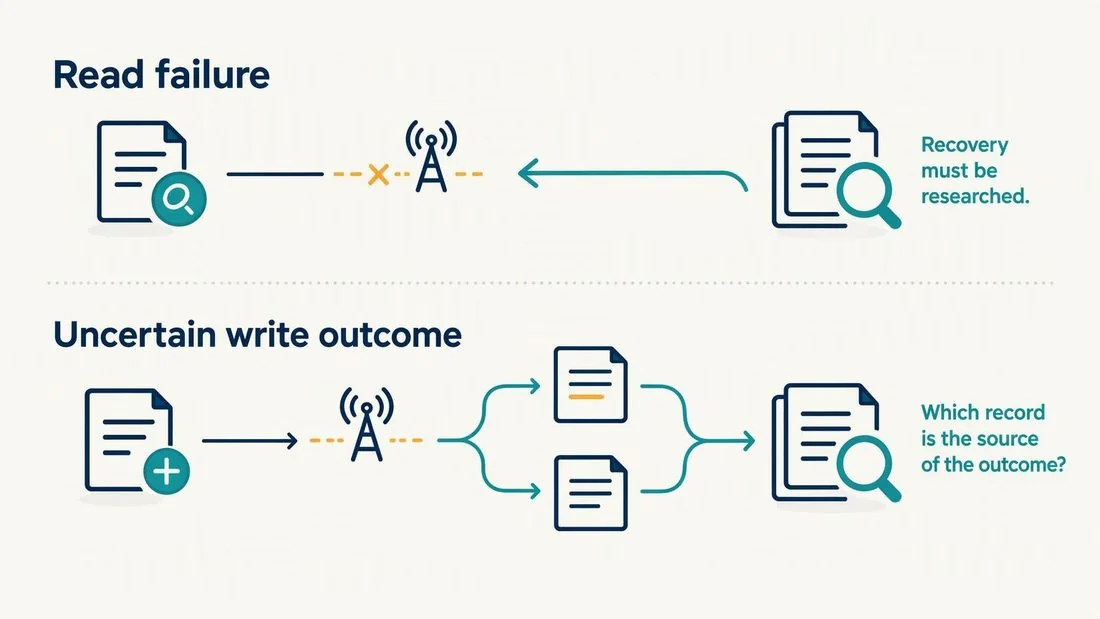
For operations that change records, pay particular attention to uncertain outcomes. If the connection ends before a response arrives, the team needs a documented way to reason about whether the action occurred before sending it again.
Separate retryable failures from uncertain outcomes
A temporary failure and an unknown transaction outcome pose different questions. Retrying a read may be acceptable under the documented rules; repeating a write requires an understanding of duplicate prevention or another supported recovery mechanism.
Do not assume that Xeni uses a particular idempotency mechanism, status lookup, or retry interval. Evaluate whichever mechanism the applicable materials describe and determine whether it closes the failure path your product must handle.
Connect technical errors to customer actions
For each consequential failure, write the action the customer would see: correct an input, select another result, wait, or seek assistance. Then trace that action back to the documented error meaning.
Also identify what diagnostic information the application can retain without exposing sensitive data. A useful recovery design needs enough context to distinguish a customer's input problem from a failed service interaction.
A hotel evaluation: when is a narrow test the better choice?
Say you are considering a hotel experience inside an existing application. The intended journey lets a customer find a result, review its details, and complete a reservation.
The Hotels API category gives that review a relevant starting point. It does not replace evidence for the operations your journey requires.
Suppose the evaluation materials explain retrieval and result fields, but your team still needs a clear explanation of the transaction outcome after an interrupted connection. Approving the full build would make the estimate depend on an unanswered recovery question.
A narrow retrieval test may still be worthwhile. It can establish whether the returned data supports your interface and whether your application can preserve the documented identifiers, without claiming that the reservation workflow is ready.
The choice follows from the dependency: the customer journey requires a reliable way to handle a reservation outcome. Adding more developers does not resolve that question; obtaining and evaluating the relevant behavior does.
There is a downside to staged evaluation. Some early code may need revision once the full workflow is understood. Keep the test isolated, retain its findings, and avoid building the surrounding product as though the remaining design decisions were settled.

Turn the review into an evidence-based handoff
Give the engineering lead a short evidence record that connects each required customer action to the relevant reference. Include the operation, version, important data meanings, and the documented recovery path.
Separate what the team has read from what it has observed in a test. A documented example establishes intended usage; a test establishes behavior under the conditions tested. Neither should silently stand in for the other.
The handoff should state the next commitment and why it is justified. Useful outcomes include proceeding with a defined technical evaluation, approving implementation for a documented scope, or pausing because a dependency could change the design.
For business context, read the Xeni overview alongside the technical review. Product fit and documentation readiness answer different questions, and both matter before a broader commitment.
When the next decision depends on technical materials, use Contact Us to request the available evaluation documentation. Describe the customer workflow and the behavior you need to understand, rather than asking only for a general API introduction.
Evidence-based engineering handoff
- Link each required customer action to its reference
- Record the operation and version
- Include important data meanings
- Include the documented recovery path
- Separate documented behavior from test observations
- State the next commitment and why it is justified
Make the next technical conversation specific
Request available evaluation materials for your intended workflow, including the relevant operation definitions, examples, errors, and access prerequisites.
Explore more from Xeni
Frequently Asked Questions
Approve the work the evidence supports
A useful documentation review ends with a clear boundary around the next engineering commitment. Keep required workflow evidence attached to the decision, and leave assumptions visible until the team can evaluate them. That makes a narrow test useful without mistaking it for approval of the full build.