
A branded booking screen can answer a design question while leaving an inventory question open. Seeing a hotel, flight, or other travel product does not establish that your business will have access to it under the agreement you are considering.
For a white label travel launch, separate what the platform can demonstrate, what your account will include, and what a traveler can actually complete. These five mistakes address different gaps in that chain. The goal is to choose a launch promise your evidence supports, without discarding a useful platform merely because it does not cover every future ambition.
Mistake 1: Treating the demo as an inventory commitment
A demonstration shows what happened in the environment you saw. It does not, by itself, establish the inventory rights or production configuration attached to your proposed agreement.
The useful question is whether the demonstration used the same access your business would receive. Ask the presenter to distinguish sample content, test results, and production results, then identify which parts belong to your proposed launch.
Keep a record of the claim you are evaluating, rather than collecting screenshots without context. A screenshot of a search page can support a discussion about presentation. It cannot establish the terms under which your account may sell the displayed product.
If the supplier cannot demonstrate the proposed configuration yet, distinguish a future acceptance test from a completed test. You may still choose to proceed, but do not describe the untested inventory as launch-ready in customer materials.
Make the demonstration match the promise
If your planned promise is that travelers can book a particular type of trip, request a walkthrough using the relevant dates, traveler details, and product selection. Follow the result far enough to understand what the demonstration actually establishes.
A polished presentation can be useful for evaluating navigation and branding. Inventory entitlement needs separate evidence tied to your business. Keep those decisions separate so a good design does not accidentally become proof of access.
Mistake 2: Assuming category names define your scope
A category label describes a kind of travel product. It is not a complete description of what your launch includes.
Separate the platform's overall category range from the categories in your proposed agreement and the categories enabled for your launch. If those scopes differ, your customer-facing language should follow the launch scope, not the broadest presentation.
Within a category, define the coverage that matters to your audience. For lodging, for example, an audience may care about a particular accommodation type or occupancy requirement rather than the presence of a hotel search tab.
Do not assume that choosing an integration route resolves the supply question. Evaluate how you will build the customer experience separately from what inventory you will be entitled to sell through it.
Choose scope by customer need, not menu length
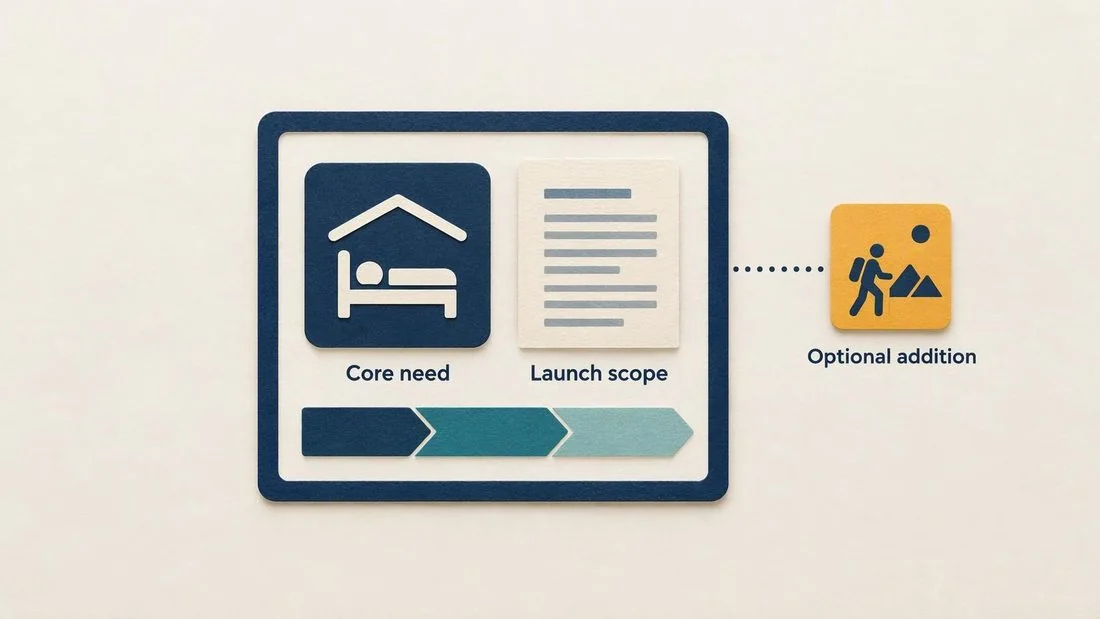
Write down the travel need that makes your launch worthwhile. Then identify which category is essential to satisfying it and which categories are additions you could introduce later.
A category you do not need immediately can remain outside the initial launch without undermining the whole project. A missing category that defines the reason customers would use your business is a different issue and deserves a purchase decision before signing.
Do not let the word “travel” imply a bundled transaction. If you intend to promise a combined trip, establish how its components relate during purchase and afterward, rather than inferring that relationship from adjacent category tabs.
Mistake 3: Ignoring exclusions that matter to your audience
An exclusion matters when it prevents your intended customer from completing the trip your brand is promising. Evaluate it against that need, rather than treating every exclusion as equally damaging.
Areas to examine include applicable markets, product types, traveler eligibility, and rate or purchase conditions. These are review dimensions, not claims that any particular supplier imposes them.
Turn each exclusion into a customer consequence. If a product is outside scope, does your traveler have a suitable alternative inside the service, need to make a separate purchase, or lose the main reason to use your platform?
A large catalog does not answer that question. The relevant test is whether the available inventory supports the journeys your audience is likely to seek, including requirements that a broad category count cannot express.
Choose a response based on the effect of an inventory exclusion
| Effect on the intended trip | Reasonable launch response | Trade-off |
|---|---|---|
| The exclusion does not affect the core travel need | Launch within the documented scope | Some future customer needs remain outside the service |
| The excluded product is useful but optional | Launch without it and describe the narrower service | Customers may need a separate purchase |
| The excluded product is essential to the brand's promise | Resolve access before committing or choose another scope | The launch decision may take longer |
| The importance of the excluded product is unclear | Learn more about audience needs before expanding scope | Less breadth initially, but less unsupported commitment |
Put material limits where they affect the choice
If a limitation changes whether a traveler should use the service, explain it before the traveler invests effort in the wrong purchase path. Do not rely on a broad headline and a distant qualification to communicate opposing messages.
You do not need to reproduce a supplier agreement in marketing copy. You do need the headline, category descriptions, and booking experience to describe the same service.
Mistake 4: Confusing searchability with bookability
A search result establishes that an item was returned for a particular query. It does not establish that the traveler completed a reservation or received the confirmation your brand intends to promise.
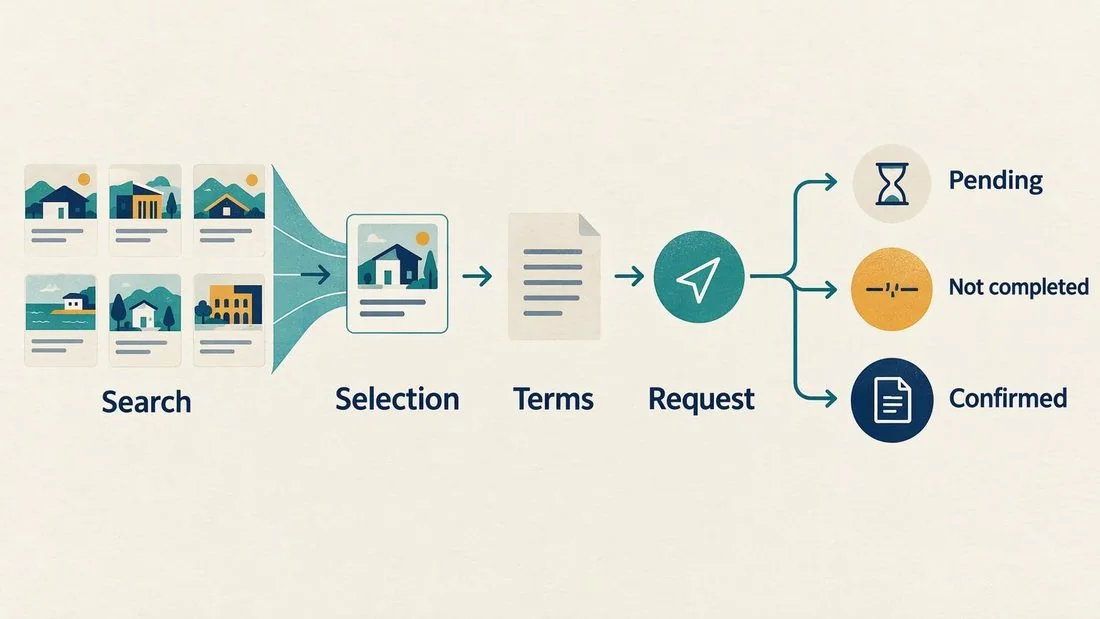
Test the transaction path, not only the result list. Observe selection, the final terms presented before purchase, the booking request, and the confirmation state.
For an API evaluation, distinguish a search response from the response used to determine booking status. For a hosted or no-code evaluation, follow the customer-visible screens to the same decision point. Neither route should receive credit for a completed booking merely because it displays inventory.
Arrange testing with the provider so you understand whether a demonstration can create a real reservation or payment obligation. Do not initiate a live purchase simply to explore the interface without knowing the consequences.
Test an unsuccessful path as well
Choose a test that shows how the service behaves when the selected item cannot be booked or the transaction does not complete. The traveler should be able to distinguish a failed attempt, a pending status, and a confirmed reservation.
That distinction affects your promise. If the actual process requires further confirmation, describe that process rather than calling every submission an instant booking.
A successful test supports the tested path under its recorded conditions. It does not justify a claim that every future search result will remain available, so preserve the difference between access to a booking service and guaranteed availability of a particular item.
Test beyond the search result
- SelectionSelect the item returned by the search.
- Final termsReview the terms presented before purchase.
- Booking requestObserve the booking request.
- ConfirmationDistinguish failed, pending, and confirmed outcomes.
Mistake 5: Publishing promises broader than your evidence
The final mistake happens when a qualified inventory statement becomes an absolute marketing claim. Words such as “every,” “guaranteed,” “unlimited,” and “lowest” create commitments that a category list or successful demonstration does not establish.
Evaluate each phrase on its own. Evidence of category access does not prove price superiority; evidence of a successful booking does not prove universal availability.
Use language that describes the action a traveler can take and the scope in which it is available. If the service supports searching and booking eligible lodging, describe that service instead of promising every property or the best price.
The wording should remain useful and concrete. Removing unsupported absolutes does not require replacing a clear product description with vague language about possibilities.
Examples of wording to evaluate against the actual launch evidence
| Proposed promise | Evidence it would require | Narrower wording if supported |
|---|---|---|
| Book every hotel | Evidence supporting the universal coverage claim | Search and book available hotels |
| Guaranteed availability | A defined guarantee and the obligations behind it | Check availability for your travel dates |
| Instant confirmation | A booking flow that supports the stated confirmation timing | Review your booking status after submission |
| Lowest travel prices | A supportable comparison covering the stated market and conditions | Compare the displayed options and booking terms |
Keep inventory and support promises separate
A promise about inventory access does not explain who handles a change, cancellation, or booking question. Those responsibilities need their own service description.
For a Xeni evaluation, use the white label customer support scope as a separate review topic. Do not infer support responsibilities, languages, or response times from the products shown in a demonstration.
Work through a launch decision
Say you are planning a branded service for travelers who primarily need accommodation. You would also like to sell activities, but accommodation is the reason your intended audience would use the service.
During evaluation, you see both categories in a demonstration. You have a written scope and a relevant booking test for accommodation, while activity access still needs confirmation.
Launching with accommodation can be a reasonable choice if it meets the core customer need. Keep activities out of the initial promise and make any later addition depend on its own access and booking evidence.
Waiting for activity confirmation is also reasonable if your campaign specifically promises accommodation and activities together. In that case, the missing category affects the proposition itself, not merely the length of the product menu.
The decision changes again if accommodation access is documented but a booking cannot reach a clear confirmation state. That is a transaction issue within the essential category, so adding more categories would not resolve it.
The downside of a narrower launch is that some customers may need to buy elsewhere. Accept that trade-off only when the remaining service still solves a worthwhile need, and describe the boundary plainly.
Launch now or resolve the gap?
| Launch situation | Response |
|---|---|
| Activities optional; accommodation tested | Launch with accommodation only |
| Campaign promises both categories | Wait for activity access confirmation |
| Accommodation confirmation unclear | Resolve the transaction issue |
Apply the distinction to your Xeni evaluation
For your Xeni evaluation, start at Xeni to discuss your preferred implementation approach and required inventory scope with our team. Keep the choice of how to build your customer experience separate from the evidence of what inventory your launch would include.
Bring the customer promise you intend to launch, the essential travel category, and the booking outcome your customer must be able to reach. Those details give the discussion a concrete purpose without presuming that every desired category is supplied.
Compare the proposed scope with that customer need before signing. A satisfactory evaluation should leave you able to explain what you plan to sell, which limits affect that offer, and which evidence supports the wording you will publish.
Define the promise before choosing the launch scope
Discuss your essential inventory claims and proposed launch scope with our team at Xeni.
Explore more from Xeni
Frequently Asked Questions
Make the launch promise match the service
Before signing, connect your essential customer promise to the agreed scope and a meaningful booking test. Resolve any gap that prevents the service from meeting its core purpose; leave optional additions outside the launch promise until their evidence is ready.