

A hotel booking engine can look right in a demonstration and still belong to the wrong software category. A branded search form, room photos, and a checkout screen tell you little about whether the product supports your travel resale business.
You need to evaluate the reservation behind that screen: the supplier rate, the customer price, the booking record, and the responsibilities after purchase. Start by separating property-direct reservations from inventory resale. Then compare implementation choices and test the operational handoffs that determine whether your team can actually use the system.
Is the system built for a property or a reseller?
The deciding question is whose rooms you are selling. If you operate a hotel and sell its own accommodation, a property-direct engine may fit. If you sell accommodation supplied by other businesses, evaluate the product as a reseller system, even if the customer-facing screen looks similar.
Do not reject a system simply because it supports hotels, or accept it because it supports multiple properties. A hotel group can sell rooms across its own portfolio without supporting an independent reseller's supplier relationships, margins, or customer servicing.
The best hotel booking engine for your business is the one that matches your transaction model. Have the provider demonstrate where a rate originates, how your business participates in the sale, and where the resulting reservation is managed.
Separate the software categories before building a shortlist
| Category | Primary job | What establishes fit |
|---|---|---|
| Property-direct engine | Accept reservations for a property's own accommodation | Connection to the property's rates, room inventory, and reservation workflow |
| Reseller booking engine | Sell supplier accommodation through a reseller workflow | Usable supplier access, permitted sales model, pricing controls, and booking servicing |
| Search or referral interface | Help users discover accommodation and continue elsewhere | A referral model that matches your business, rather than an assumed booking capability |
Where other hotel systems fit
A central reservation system manages reservation and availability information centrally. A property management system supports hotel operations, while a channel manager handles distribution updates between connected channels.
These functions matter to hotels, but their presence does not answer your reseller question. Trace how your business accesses inventory and creates a reservation instead of treating a list of hotel integrations as proof of fit.
Does the inventory match what you intend to sell?
Evaluate inventory against actual searches your customers make. A large catalog is less useful if the relevant properties, occupancy combinations, or rate conditions do not fit your market.
Use representative destinations, travel dates, and guest compositions in the demonstration. Inspect room descriptions and rate conditions rather than stopping at a list of hotel names.
For a Xeni evaluation, hotel supplier information is a relevant starting point. Treat supplier coverage and usable inventory as separate questions: the booking terms and commercial arrangement still need to fit your business.
Separate access from resale permission
A technical connection tells you how information moves. It does not, by itself, establish permission to sell every returned rate through every channel.
Keep a clear commercial requirement alongside the technical one: your intended customer type, sales channel, and pricing model must be supported by the applicable agreement. A consumer storefront and an agent-only portal should not be treated as interchangeable without that agreement.
Inspect the rate, not just the property
Compare room category, meal inclusion, occupancy, payment conditions, and cancellation terms. Similar room labels can conceal different products, so your display must give customers enough information to choose correctly.
Also distinguish property discovery from bookable availability. Xeni's location-based hotel search guidance provides relevant context for that search task, while availability needs its own evaluation.
Which implementation approach can your team own?
An API is an interface through which software systems exchange requests and responses. In a hotel workflow, it can connect an application to search or reservation functions, depending on the operations the provider supports.
An API is not a finished storefront. No-code tools, meanwhile, can reduce the need to write application code, but they do not remove commercial setup, operational decisions, or testing.
Choose based on the work your team can maintain after launch. Custom development makes sense when your required customer experience or internal workflow cannot be delivered through the available configuration. It is a poor fit if nobody will own integration changes and production failures.
Compare implementation choices by ownership and trade-off
| Approach | When to evaluate it | What your team must own | Trade-off to examine |
|---|---|---|---|
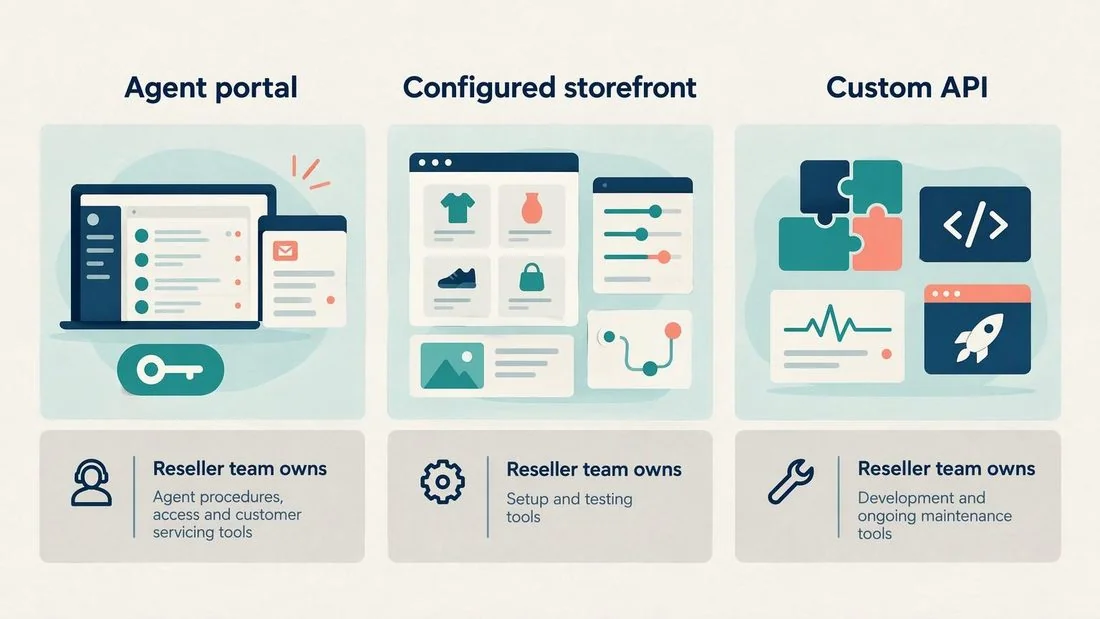
| Agent-facing portal | Your staff will make bookings for customers | Agent procedures, access, and customer servicing | Whether customers need a separate self-service experience |
| Configured or no-code storefront | Available settings can support your customer journey | Configuration, content, commercial setup, and testing | Limits on workflows, design, and integration options |
| Custom API integration | You need application behavior beyond available configuration | Development, monitoring, releases, and operational recovery | Engineering and maintenance effort alongside software access |
Define the owner before choosing the technology
Name who will manage the storefront, respond to failed bookings, and coordinate technical changes. Those responsibilities may sit with different people, but none should disappear between the provider and your team.
For a configured experience, examine which choices are settings and which require additional work. Xeni's Quick Builder hotel filter guidance is relevant to evaluating search configuration without assuming that every requested workflow is available.
Can the workflow carry a search through to a reliable booking?
Request a demonstration that continues beyond checkout. The useful evidence is a reservation your staff can retrieve, understand, and service, with a clear relationship between the customer-facing order and the supplier booking.
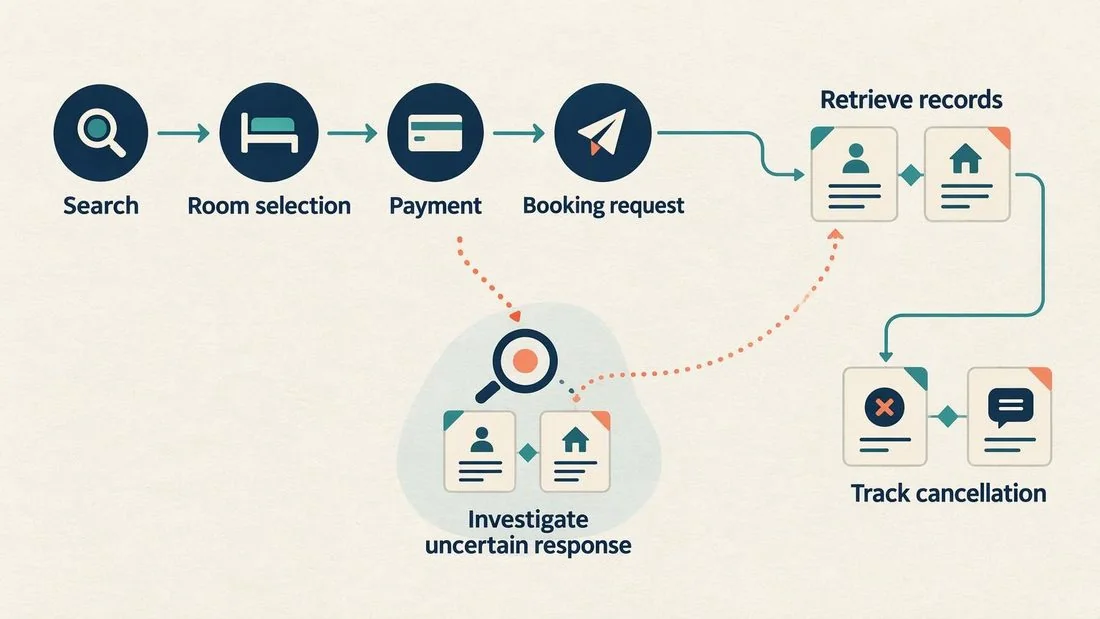
Walk through search, room selection, availability validation, payment, and confirmation. At each handoff, identify the information that changes and what the customer sees if the process cannot continue.
Xeni's hotel details and room availability guidance is relevant to the step between finding a property and choosing a bookable room. Evaluate that step separately from the final reservation response.
Test uncertain outcomes
Ask what happens if the connection fails after a booking request is submitted. Your team needs a way to determine whether a reservation exists before anyone submits another request or tells the traveler to try again.
Demonstrate a price change and a room becoming unavailable before completion. The customer should receive a clear choice, and the system should not silently substitute different terms.
Test post-booking work
Follow a cancellation request from the customer action to the supplier response and the financial record. Identify whether the software completes the task or passes it to a person, and how staff can see its status.
Amendments deserve separate attention. A system may require cancellation and rebooking rather than an in-place change, so your customer messaging and servicing process must reflect the supported method.
Booking workflow tests to request
- Trace search, room selection, payment, and confirmation
- Retrieve the reservation and match it to the customer order
- Check whether a booking exists after a connection failure
- Test price changes and unavailable rooms before completion
- Trace cancellation through supplier and financial records
- Confirm whether amendments require cancellation and rebooking
Do pricing and payment responsibilities fit your business?
Compare the financial workflow, not just the subscription quote. Identify who charges the traveler, who receives the supplier payment, and who handles refunds or payment disputes under the proposed arrangement.
Keep supplier cost, customer selling price, and retained earnings separate. If you require markups or commissions, have the provider demonstrate how those are configured, recorded, and affected by a cancellation.
Ask for a proposal that separates software charges, implementation work, transaction-related charges, and any supplier or payment costs that apply. Do not assume that a low entry price includes every function required for your operating model.
Have an operator reconcile a sample customer order against its reservation and payment records. The demonstration should make any difference between what the customer paid and what your business retains understandable.
Permissions and customer information
Evaluate access by role. An agent may need to create and service bookings without seeing every administrative setting or another team's financial information.
Map where traveler and payment information is collected, stored, and accessible. Request the applicable security documentation and contractual responsibilities rather than treating a security badge or a payment integration as a complete answer.
How does the choice change for a small reseller?
Say you run a small travel business whose agents recommend hotels and complete reservations for customers. You want travelers to book independently later, but the immediate need is an agent workflow with clear rate terms and manageable cancellations.
A property-direct engine would not fit merely because it has an attractive checkout. Your business needs supplier accommodation rather than a hotel's own room inventory.
An agent-facing portal is worth evaluating first if it supports the required supplier and servicing model. A configured storefront becomes relevant when customers need to complete bookings themselves and the available settings can support that journey.
A custom API integration makes sense if a required workflow, such as connecting reservations to your existing application, cannot be achieved another way. The reason to choose it is that dependency, not the ambition to grow or the number of bookings you hope to make.
Now change the example: you already have a customer application with an engineering owner, and hotel reservations must sit inside it. API integration may then be the better starting point, even for modest booking activity.
The downside of choosing the simplest interface too early is discovering that essential work still happens outside it. The downside of building too early is maintaining custom software for a workflow that configuration could have handled.
What should a useful Xeni evaluation cover?
Bring your operating model to the discussion: who searches, who books, whose inventory is sold, and who services the traveler. Use that model to compare API integration and no-code options rather than starting with a preferred technology label.
The hotel supplier, location search, room availability, and Quick Builder resources linked above give you distinct evaluation topics. Connect them into a complete customer journey, then use the commercial and operational tests in this article to assess fit.
Through Xeni's contact page, explain the intended reseller model and request a discussion of the relevant implementation options. Include the workflow that must work at launch and any existing application it must connect to.
Compare the response with other hotel booking engine providers using the same requirements. A useful proposal identifies what is included, what needs configuration or development, and which responsibilities remain with your business.
Discuss the reseller workflow before choosing an implementation
Use the linked contact page to explain your sales model and explore the relevant API integration or no-code options.
Explore more from Xeni
Frequently Asked Questions
Choose the transaction model before the interface
Shortlist a system only after it passes the reseller test: appropriate inventory, a permitted sales model, a workable booking lifecycle, and clear operating responsibilities. Then choose the implementation your team can maintain. A polished screen is useful, but the reservation and servicing workflow determines whether the product fits your business.