
A hotel booking API price becomes useful when you can connect it to the reservations your platform expects to confirm. A charge per request, a recurring access charge, and a charge tied to booking outcomes cannot be compared by their headline amounts alone.
The practical comparison starts with your booking funnel and the actual commercial proposal. Keep room prices separate from API charges, count the activity each supplier bills, and use the same definition of a confirmed booking throughout. That gives product, engineering, and finance a shared calculation instead of competing interpretations of what a low price means.
Compare the same booking outcome before comparing price
Start with proposals that can support the booking outcome your product needs. Data access that returns hotel prices is not, by itself, evidence that you can create and retrieve a reservation through that integration.
If your product needs a hotel booking engine API, define the endpoint of the comparison as a confirmed reservation your system can identify. A price response, a booking attempt, and a successful payment are different events. Counting any of them as a confirmed booking can make an apparently economical proposal look better than it is.
Use a consistent reporting unit as well. If one workflow creates several reservation records for a customer's purchase, decide whether your denominator is the purchase or each reservation. Keep that analytical definition separate from the supplier's billing definition.
A hotel booking affiliate API may require a different analysis when the traveler completes the purchase elsewhere. Use the agreement's attribution and outcome reporting, rather than treating an outbound click as a booking. Do not assume that a referral arrangement and an in-product booking integration have equivalent responsibilities.
The point is to avoid a false winner: an inexpensive offer that measures a different outcome. Once the proposals meet the required workflow, their economics can be compared on the same basis.
Translate the proposal into billable activity
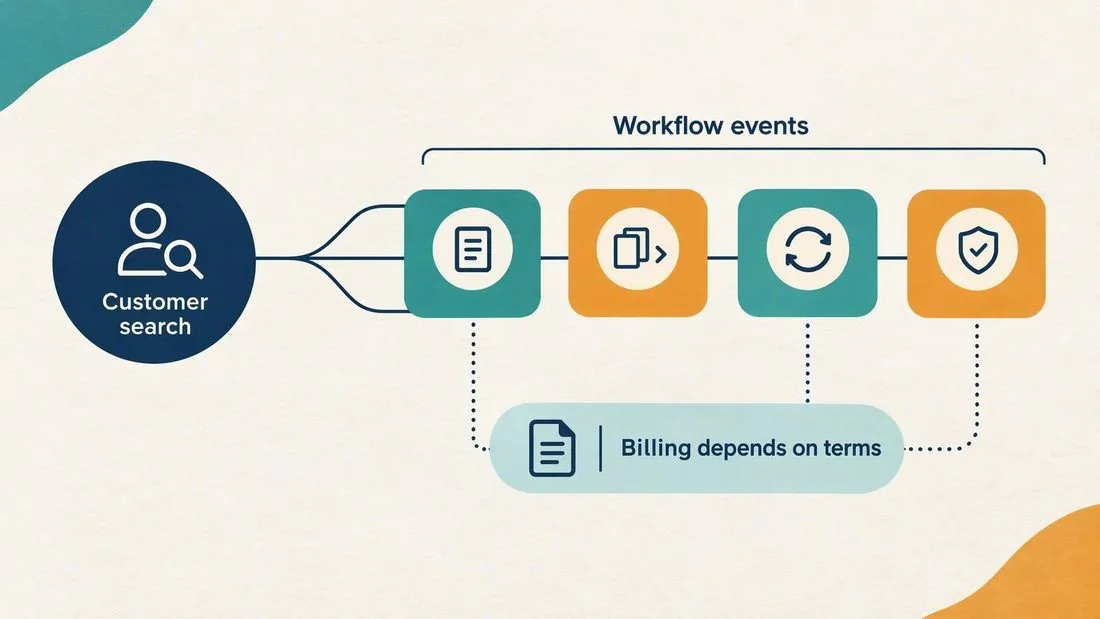
A customer search is a product event. A billable API event is whatever the commercial agreement says it is. Those quantities match only when the workflow and the charging definition make them match.
For each disclosed charge, record its unit, trigger, billing period, and treatment of unsuccessful activity. Do not add a fee category merely because another supplier uses it. Conversely, do not enter an undisclosed item as zero: an unanswered pricing term is not a waived charge.
The following distinctions help you translate an actual proposal. They are possible charging bases to recognize, not claims about Xeni's terms or any particular supplier.
How a disclosed charging basis enters the comparison
| If the proposal charges for | Quantity to model | Important distinction |
|---|---|---|
| Recurring access | Applicable charge for the comparison period | Included usage may change the separate usage charge |
| Requests or searches | Billable events under the stated definition | Customer search sessions may not equal requests |
| Returned hotel records | Billable records returned | Result count matters as well as request count |
| Booking outcomes | Events that meet the stated booking trigger | An attempt, confirmation, and completed stay differ |
| Revenue or transaction value | The contractually defined monetary base | Gross value and retained revenue are not interchangeable |
Connect engineering events to the billing definition
Map the intended workflow from search to confirmation. Include pagination, refreshed searches, availability checks, and retries where your implementation uses them, but count them as paid activity only when the terms make them billable.
For technical context on our integration, start with searching for hotels. Use your intended request pattern alongside the commercial definition, rather than treating a search workflow as proof of a particular fee.
Build a cost-per-confirmed-booking model
Use the same comparison period for costs and outcomes. Define S as customer searches, B as confirmed bookings, and c as the search-to-booking conversion rate. With a consistent search definition, c = B / S.
Next, define C as the total supplier charges applicable to that period. The core calculation is:
Cost per confirmed booking = C / B.
Build C from the proposal's actual terms. For a proposal that explicitly has an access charge F, a billable-event price p, billable-event volume Q, and a confirmation charge q, the calculation would be:
C = F + p × Q + q × B.
Therefore, cost per confirmed booking = F / B + p × Q / B + q.
This expression is a model, not a supplier price list. Use each term only when it exists in the proposal; replace it with the agreement's actual calculation when the charging structure differs.
If the agreement has included usage, calculate chargeable excess before multiplying by the unit price. If it has tiers, calculate usage through the applicable tiers. A minimum that replaces a lower usage total is different from a charge added to that total, so those structures need different formulas.
Keep implementation costs visible but separate
Maintain a supplier-charge view and a broader operating-cost view. The latter can include your estimated engineering, infrastructure, payment, and support costs, provided you label their scope and avoid counting the same expense twice.
This separation explains whether a proposal wins because of commercial terms or because it fits your existing system. Use our hotel API getting-started guidance as technical context for that integration assessment, not as a substitute for a quote.
How does search-to-booking conversion change the result?
For a usage-priced proposal, conversion determines how much search activity each confirmed booking must support. Define k as billable events per customer search for the measured workload. Then Q = k × S.
Because B = c × S, the usage component per confirmed booking becomes:
Usage cost per confirmed booking = p × k / c.
Holding the unit price and billable events per search constant, lower conversion raises this component. A small request price can still produce a material booking cost when many paid requests lead to few confirmations.
Conversion alone is not enough to forecast the bill. A browsing session that generates many requests can cost more than a short path to checkout, even when both groups have the same share of searches ending in bookings. Measure k alongside c rather than assuming it stays constant across your traffic.
Use conversion cases grounded in your own funnel: expected performance, weaker performance, and stronger performance. Calculate the bill independently for each case because an allowance, minimum, or tier may change which charges apply.
Also distinguish conversion changes from volume changes. Fewer searches at unchanged conversion reduce both activity and bookings, but spread a recurring access charge across fewer confirmations. More browsing at unchanged booking volume increases exposure to billable usage. These are different commercial risks and should not be represented by one blended growth forecast.
Work through the break-even decision
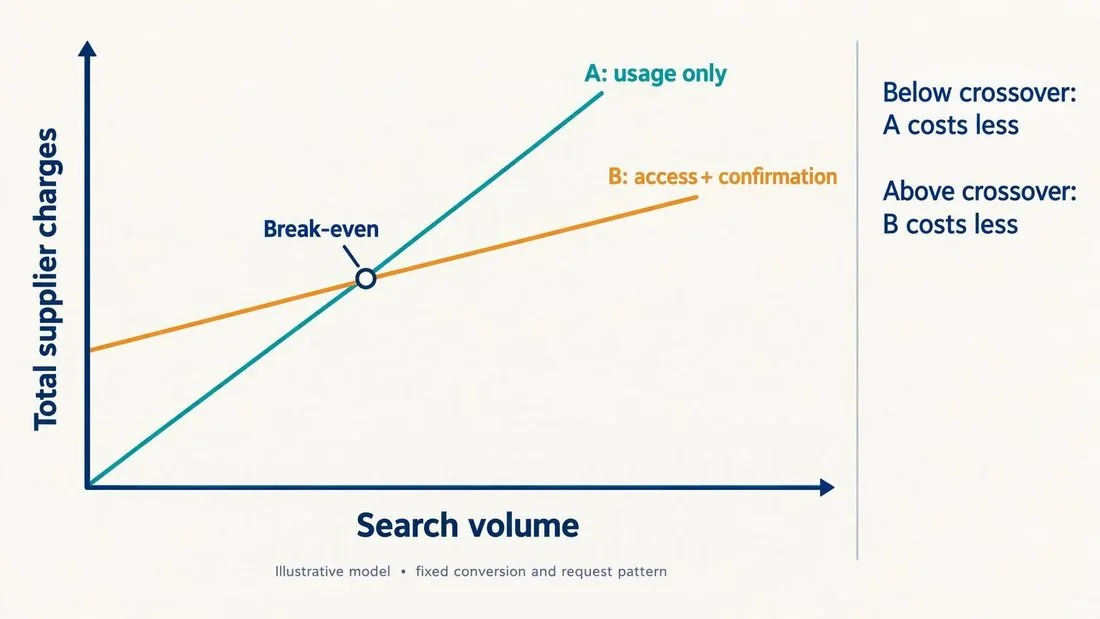
Say you are comparing two proposals that meet the same booking requirements. Proposal A discloses only a price p per billable event. Proposal B discloses a recurring access charge F and a charge q per confirmation, with no additional usage charge for the workload being compared.
Those terms are the inputs to this example, not advertised supplier offers. For your planned Q billable events and B confirmations, the totals are:
Proposal A total = p × Q.
Proposal B total = F + q × B.
A is less expensive when p × Q is less than F + q × B. B is less expensive when the inequality reverses. Dividing both totals by the same positive B gives the same winner on cost per confirmed booking.
Now substitute Q = k × S and B = c × S. The booking costs become p × k / c for A, and F / (c × S) + q for B.
Find the point where the winner changes
The totals are equal when S × (p × k - q × c) = F. If p × k is greater than q × c, the break-even search volume is F / (p × k - q × c).
Below that volume, A has the lower total in this model; above it, B has the lower total. If p × k is less than or equal to q × c and F is positive, B cannot recover its access charge through the proposed variable-cost difference.
For a browsing-heavy launch with uncertain booking volume, A may therefore be the economical choice below the crossover. For a workload above it, B may be cheaper despite its access charge. Apply this reasoning only within each proposal's stated allowances and limits; crossing a pricing tier requires a fresh calculation.
Illustrative proposals, not supplier offers
| Metric | Proposal A | Proposal B |
|---|---|---|
| Charging basis | Per billable event only | Access + per confirmation |
| Total charges | p × Q | F + q × B |
| Cost per booking | p × k / c | F / (c × S) + q |
Separate confirmation economics from cancellation economics
Cost per confirmed booking measures the expense of producing confirmations. It does not tell you how much expense remains after cancellations or how much revenue the confirmed bookings retain.
Keep the original confirmation count for that metric. Then calculate a separate retained-booking or completed-stay measure if it fits your business. Relabeling the denominator silently makes comparisons unreliable, especially if one proposal recognizes a charge at confirmation and another uses a later outcome.
Apply the agreement's cancellation treatment to the numerator. A customer refund does not establish whether an API charge is credited. Likewise, a failed booking attempt should enter billed activity only according to the disclosed charging trigger.
Compare costs with their related outcomes rather than unrelated calendar totals. A period's charges may relate to bookings whose cancellations or stays occur later. For outcome analysis, track a booking cohort through the relevant stage; for cash planning, separately track when invoices and credits become payable.
The trade-off is that confirmation cost is available earlier, while retained-outcome economics require more time to observe. Use the earlier measure for funnel monitoring and the later measure for profitability decisions. Neither should replace the other without a clear change in purpose.
Use the model to evaluate Xeni's applicable proposal
At Xeni, our hotel API integration is a relevant option for buyers evaluating a travel booking workflow. Pair the technical fit with a commercial calculation instead of selecting an integration on a headline access amount.
Our hotel API guidance provides a starting point for the technical discussion. For the financial comparison, use an applicable proposal covering your intended workload, then enter its stated charges and triggers into the same model used for other eligible offers.
Send your expected customer searches, estimated billable request pattern, and confirmed bookings together. Include the comparison period and your booking definition so the pricing discussion refers to the same quantities your team will evaluate.
A useful comparison output contains the supplier total, cost per confirmation, and the condition that changes the winner. It should also distinguish a calculated charge from a term still awaiting agreement, rather than filling the latter with an assumed zero.
The best hotel booking API for your economics is not automatically the one with the smallest recurring charge. Choose the eligible proposal that wins under the workload you can defend, and understand how far that workload can move before the result changes.
To compare our applicable terms against your planned searches and bookings, contact Xeni for the pricing basis.
Prepare an actionable pricing comparison
- Provide expected customer searches and confirmed bookings
- Include the estimated billable request pattern
- Specify the comparison period and booking definition
- Calculate supplier total and cost per confirmation
- Identify the condition that changes the winner
- Flag unanswered pricing terms; do not assume zero
Bring your booking funnel to the pricing discussion
Request the applicable pricing basis for your planned searches, billable activity, and confirmed bookings.
Explore more from Xeni
Frequently Asked Questions
Choose on the workload you expect to operate
Keep the model tied to disclosed charges, measured or labeled activity assumptions, and a consistent confirmation count. The final decision should identify both the lower-cost proposal and the traffic or conversion change that would reverse that choice.