
A traveler can collect and return a vehicle at the same location while driving across a border during the rental. Pickup and drop-off inputs alone will not describe that trip.
Your car rental booking API evaluation therefore needs a route-permission test alongside the inventory test. The useful question is whether your integration can communicate the supplier's decision for the chosen rental and intended countries, with enough detail to explain any conditions. That separates a cross-border booking flow from an ordinary search flow with international inventory.
Does international inventory establish cross-border permission?
No. Finding vehicles in different countries answers where rentals are available. It does not establish whether the supplier authorizes a particular booked vehicle to travel between those countries.
Keep three questions separate in your evaluation: can the vehicle be booked, can it follow the intended driving route, and can it be returned at the selected location? A successful availability response should answer only the questions its documented meaning supports.
For cross-border use, require evidence tied to the rental being selected. A country name in a destination menu, a supplier's international presence, or a generic travel description is not a substitute for applicable permission.
This distinction also changes your shortlist. An API with broad inventory can still require substantial policy review. A narrower integration may suit your launch better if it gives your team a dependable way to establish permission for the routes you intend to sell.
Judge coverage and route suitability separately. Otherwise, a strong inventory demonstration can conceal the most consequential unanswered booking question.
What route information should your booking flow capture?
Capture the intended countries of travel, not just the rental endpoints. Include countries the traveler plans to pass through even if there is no overnight stay there.
Ask about border travel early enough to influence selection. If the question appears only after payment, your team may have accepted a rental without knowing whether it fits the traveler's plan.
The route question should also distinguish driving abroad and returning to the original location from returning the vehicle in another country. Those are separate permission questions; do not use one answer to infer the other.
Tie the route to the selected rental
Your evaluation should establish how route information relates to the pickup location, return location, dates, supplier, and selected vehicle category or rate. These are proposed validation inputs, not a claim that every API evaluates them.
Ask the provider to demonstrate which inputs its policy decision actually considers. If an input is ignored, your team needs to understand whether a separate review is necessary before acceptance.
Make later changes visible
Give travelers a way to report a changed route. Preserve the original route and treat the revised plan as a new permission question rather than carrying forward the old answer automatically.
The same principle applies when your team substitutes a rental. Authorization tied to one selection should not silently become authorization for another.

Which policy-handling approach fits your operation?
Compare how each candidate handles permission information, not whether it uses an API. The approaches below are evaluation models, not verified descriptions of particular providers.
A combined workflow can be sensible: structured evaluation for supported rentals, supplier-text review for exceptions, and assisted authorization when a decision is required. The important boundary is where automatic acceptance ends and human review begins.
Ways to handle cross-border permission
| Approach | Evidence to request | Useful fit | Trade-off |
|---|---|---|---|
| Structured policy evaluation | Documented decision fields, applicable rental scope, and representative responses | Automatic acceptance where permission is established | Your team must validate field meaning, completeness, and updates |
| Supplier terms with interpretation | Applicable policy text, retrieval method, and rules for ambiguous wording | Flows that can accommodate policy review | Text interpretation creates maintenance and exception work |
| Assisted supplier authorization | A request process, identifiable decision, and booking-linked approval record | Rentals requiring an individual permission decision | Booking acceptance depends on the approval workflow |
Do not confuse tidy data with complete permission
A structured yes-or-no value is useful only when its scope is clear. You need to know whether it covers the entire proposed route and whether additional conditions remain.
Supplier text can carry detail that a short field omits, but your application still needs a defensible interpretation. Preserve the applicable wording alongside any summary your interface displays.
Include review effort in the buying decision
Assisted authorization is a valid choice when the permission decision cannot be automated reliably. Its downside is operational dependence: someone must obtain the answer and communicate it before your flow presents the route as approved.
Compare the effort to resolve exceptions, maintain interpretations, and handle changed itineraries. API access cost alone will not describe the work involved.
What policy information is useful before accepting a booking?
Ask for enough information to answer a traveler plainly: whether the intended route is permitted, what conditions apply, and what remains to be completed. Avoid accepting a general permission label without its qualifying terms.
Use these categories to assess completeness. They describe information to evaluate where applicable, not universal rental requirements or confirmed Xeni response fields.
Permission, exclusions, and applicability
Look for the permitted territory, explicit exclusions, and the rental details to which the policy applies. Distinguish a positive permission decision from the absence of a prohibition.
Missing information should stay unknown in your application. A blank country list should not become permission to travel anywhere unless the provider's documented semantics explicitly support that interpretation.
Authorization steps and documents
If supplier approval or documentation is required, establish who requests it, who issues it, and what evidence shows completion. A request sent successfully is different from permission granted.
Your traveler-facing message should separate completed requirements from actions still needed. Avoid language such as "approved" when your integration has only recorded an intention to cross the border.
Charges and territorial coverage terms
Where a cross-border charge applies, require its amount, currency, charging basis, and payment point before presenting a complete route price. Keep an unknown amount distinct from a confirmed zero charge.
Review the applicable territorial terms for insurance and assistance separately from driving permission. Do not infer that permission establishes every coverage detail, or that buying an extra product establishes permission.
A policy record your team can explain
Retain a reference to the applicable terms, their retrieval time, and the selected rental. If you produce a plain-language summary, keep the underlying wording available for review.
That record lets support explain the basis of the decision without reconstructing it from the latest search result.
How should acceptance handle permission that is not yet confirmed?
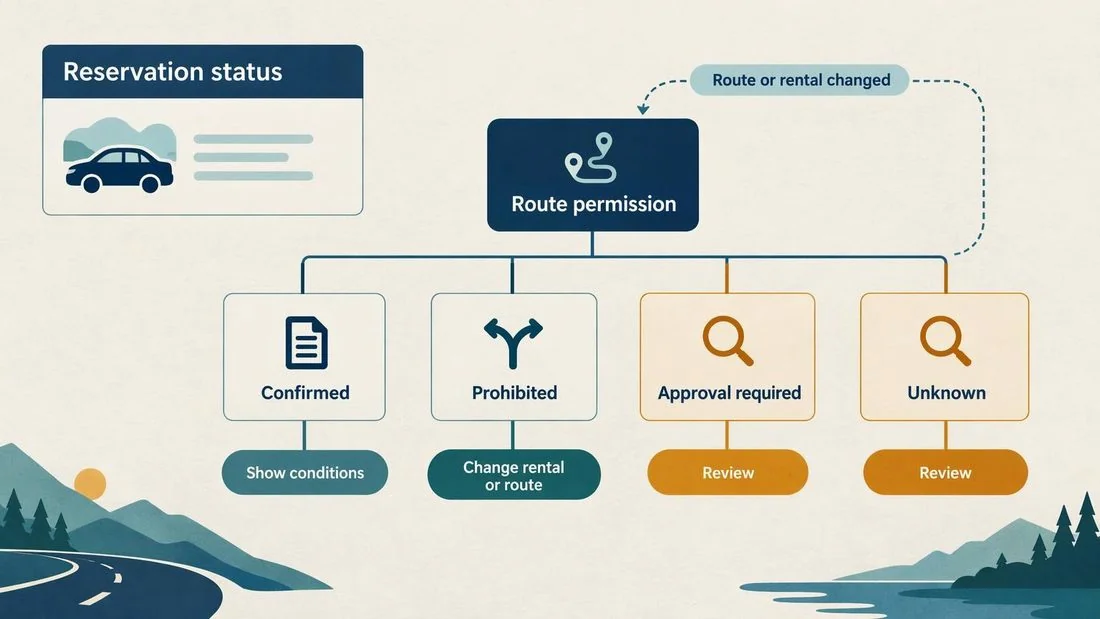
Keep reservation status and route-authorization status separate. A booking confirmation should not automatically set border permission to confirmed.
Define explicit states for confirmed permission, prohibited travel, approval still required, and insufficient policy information. Map each state to a customer message and a permitted next action.
For confirmed permission, display the applicable conditions before acceptance. For prohibited travel, explain that the selected rental does not support the proposed route and let the traveler change the selection or itinerary.
For an approval request or insufficient information, route the case to review. If your business allows a reservation to proceed during that review, make its status unmistakable and explain the applicable booking terms before the traveler commits.
Also decide when to re-evaluate permission. A changed destination country, substituted rental, or revised return location should trigger a review of whether the existing decision still applies.
The practical acceptance rule is simple: your interface must not communicate more certainty than the available evidence supports. This can mean a less immediate booking experience, but it avoids presenting an unanswered route question as settled.
Keep route permission separate from booking status
| Permission state | Next action |
|---|---|
| Confirmed permission | Display conditions before acceptance |
| Prohibited travel | Change the rental selection or itinerary |
| Approval still required | Route to review; do not imply approval |
| Insufficient policy information | Route to review; keep permission unknown |
A buyer example: choosing between automation and assisted approval
Say you are building a flow for travelers who collect and return a rental at the same location but may drive into another country. Your priority is to let travelers know whether their route is authorized before they commit.
One candidate returns structured permission information for the selected rental and intended countries. Another supplies applicable policy text, while a third relies on an individual supplier decision.
If the structured response explicitly covers the route and communicates all applicable conditions, it is the stronger fit for automatic acceptance. Your evaluation still needs to test exclusions, missing values, and rental changes.
If the text-only candidate gives a general permission statement with exceptions elsewhere in the terms, your application needs a reliable interpretation process. It is not ready for automatic acceptance merely because the first sentence sounds permissive.
If individual authorization is necessary, choose an assisted flow with a clear decision record. The reservation can be straightforward while the route question still requires help; complexity comes from the dependency, not the number of vehicles being booked.
For a launch centered on immediate confirmation, favor routes with demonstrable permission data and keep other routes outside automatic acceptance. For an operation built around reviewed itineraries, assisted authorization may fit better than forcing every rental through a binary rule.
What should you test before choosing an integration?
Use a route-focused acceptance test, not just a successful search and booking demonstration. Ask each candidate to show how its proposed workflow behaves when permission information is incomplete or changes.
- A same-location return includes intended travel abroad.
- The route includes a transit country as well as the destination country.
- A policy response contains no permission value.
- A summary field and applicable policy text disagree.
- Supplier authorization is requested but not yet granted.
- The traveler changes the route after selection.
- The selected rental is replaced and the prior decision needs review.
For each test, inspect what the traveler sees, whether acceptance is allowed, and what evidence is retained. Require an explanation of the expected behavior rather than treating a technically successful response as a passed permission test.
How to frame the Xeni discussion
Use our car rental API getting-started guide for the integration review and our response-field guide when examining data meaning. Keep route permission as a separate evaluation requirement.
Bring the intended pickup and return locations, countries of travel, and your preferred acceptance behavior. The central question is how applicable restrictions, missing information, and any required supplier authorization would be represented for those rentals.
Use Xeni's Contact Us page to discuss that representation. Request a route-specific explanation rather than assuming that an inventory response also supplies a permission decision.
Have a route-permission requirement to evaluate?
Ask how cross-border restrictions and any required authorization would be represented for your intended booking routes.
Explore more from Xeni
Frequently Asked Questions
Choose on permission evidence, then inventory fit
Before enabling automatic cross-border acceptance, your team should be able to explain which route was evaluated, which rental it applies to, and what establishes permission. Keep rentals that need an individual decision in a clearly identified review flow.