
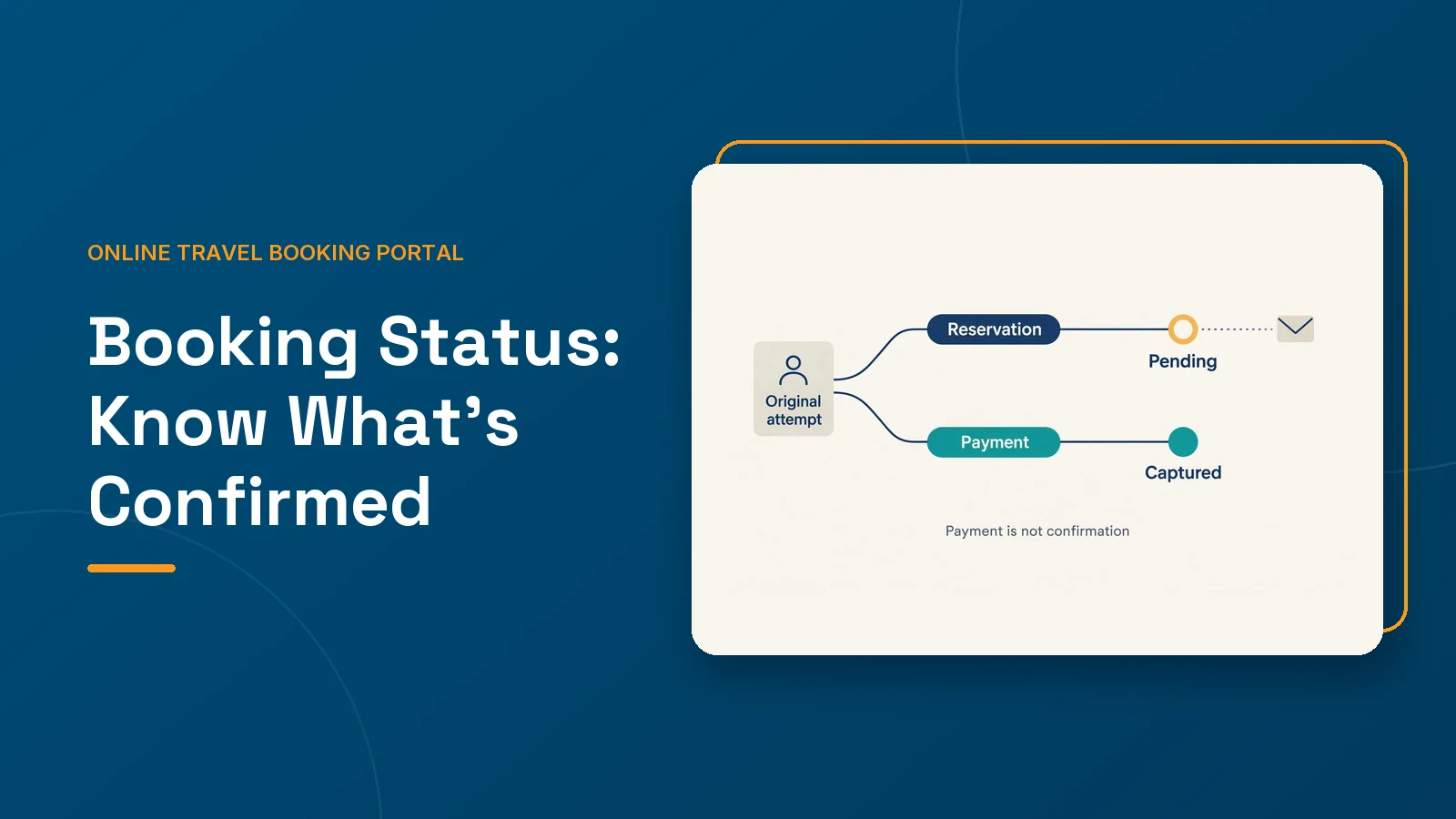
A booking marked successful is useful only if you know what succeeded. Did the portal receive the request, did the payment complete, or did the supplier confirm the reservation?
When evaluating an online travel booking portal, focus on those distinctions before accepting a polished confirmation screen. The recommendations below give you a buyer's definition of each state, the records that should support it, and a practical way to evaluate conflicting results. They are requirements to discuss with a platform provider, not a claim that every travel supplier uses identical labels or follows the same sequence.
What should pending, confirmed, failed, and expired mean?
Require a written definition of each reservation state. The exact wording can vary, but the distinction between an incomplete result and a known outcome should remain clear.
Use the following model as a starting point for evaluating a proposed platform. A provider may use different labels; what matters is whether those labels preserve the same distinctions and lead to safe next actions.
Recommended meanings for the core reservation states
| State | Meaning to require | Evidence to display | Next action |
|---|---|---|---|
| Pending | The booking attempt has no established final outcome. | Attempt reference, latest known event, and outstanding step. | Wait or request review; do not imply that retrying is safe. |
| Confirmed | The supplier has accepted the reservation under the applicable product process. | Supplier reference and confirmation details matched to the booking. | Review the reservation and any remaining fulfillment steps. |
| Failed | The attempt is known not to have produced the requested reservation. | Failure reason and the evidence supporting that outcome. | Resolve any payment issue before a controlled new attempt. |
| Expired | A defined offer, hold, or completion window has ended. | What expired, its deadline, and the latest reservation and payment results. | Recheck availability or obtain assistance as appropriate. |
Pending needs an explanation
A bare pending label leaves the reader guessing. Require a short description such as awaiting supplier response or awaiting payment completion, provided that description reflects the actual record.
The detail view should show when the attempt started and when the information was last updated. Those timestamps help distinguish a recent request from an old record that needs attention; they do not establish a promised completion time.
Failed needs a known outcome
Make the provider explain the difference between an explicit rejection and a missing response. A request that stopped returning information should not be treated as a known failure unless another record establishes that result.
This distinction matters because the next action differs. A proven rejection may support a new attempt, while an unknown result calls for checking the original attempt first.
Keep payment status separate from reservation status
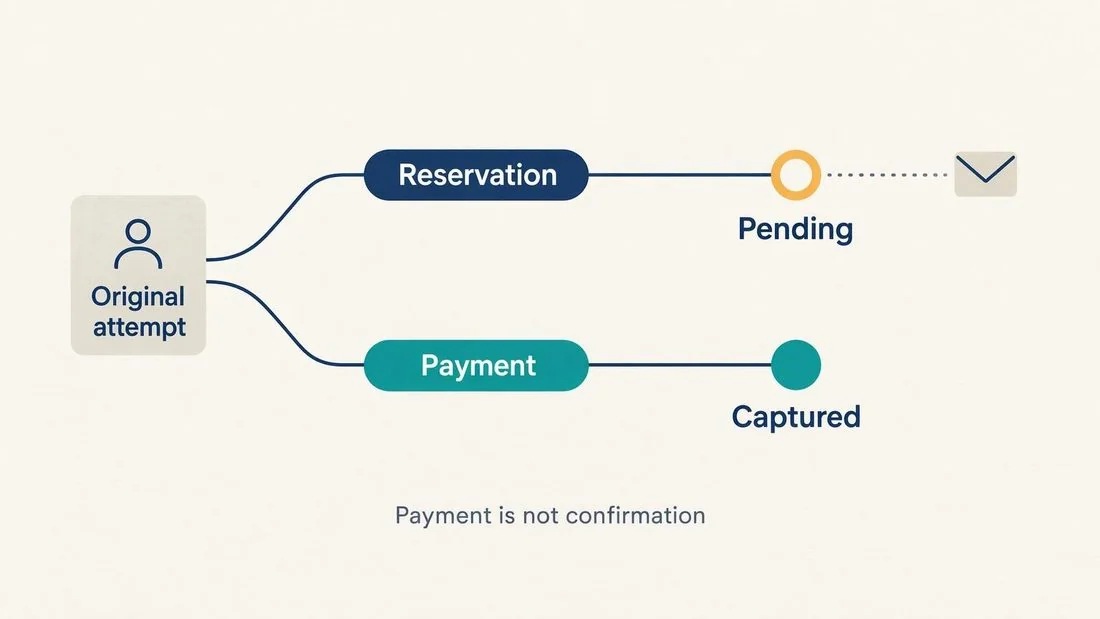
Require separate answers to two questions: what happened to the reservation, and what happened to the money? A payment receipt should not substitute for supplier confirmation in your acceptance criteria.
The interface should distinguish payment events according to the payment process it actually uses. Useful distinctions may include authorization, capture, reversal, and refund, but the provider must explain its terminology rather than rely on a generic paid badge.
For each displayed payment result, request a transaction reference, amount, currency, and event timestamp. For the reservation, request its own reference and state. Linking the records makes it possible to examine a disagreement without assuming they are the same event.
Do not let paid become the overall booking label
If the payment record shows a completed charge while the reservation remains pending, the customer-facing message should describe both facts. It should not tell the traveler that the trip is confirmed solely because money moved.
The reverse deserves attention too. If supplier confirmation is present but payment is incomplete, require a distinct payment exception and a defined review path rather than silently hiding the reservation.
Keep refunds visible after booking failure
A failed reservation and a finished refund are different outcomes. Require the portal to retain the payment record after a booking attempt fails so that your team can see whether financial follow-up remains open.
Do not accept a universal refund deadline without applicable terms. For software evaluation, the useful requirement is visibility into the latest payment result and responsibility for the next step, not an invented promise about when funds will arrive.
What evidence should support a confirmed booking?
Require confirmation evidence that matches the reservation being displayed. A reference number without context is less useful than a reference connected to the correct traveler, service, dates, and current supplier result.
Your acceptance criteria should distinguish the portal's internal attempt identifier from any supplier reservation identifier. Both can help trace a booking, but the interface should explain which system issued each one.
- A supplier reference, where the supplier process provides one.
- The traveler and booked service details needed to identify the reservation.
- The supplier result on which the confirmation label depends.
- The time that result was received or last checked.
- Any separate fulfillment step still required for that product.
The purpose is traceability, not displaying raw technical messages to travelers. A concise confirmation view can remain readable while allowing your team to inspect the supporting detail.
Separate reservation confirmation from product fulfillment
Ask the provider to define what confirmed means for each travel product you plan to sell. If a process separates reservation acceptance from ticket issuance or another fulfillment step, your requirements should preserve that distinction.
A general confirmed label can be acceptable if the detail view clearly identifies what is complete and what remains. It is not acceptable if the label leads a traveler to believe a required document or fulfillment step is finished when it is not.
Treat integrations as inputs, not proof by themselves
A connection to a supplier system does not explain which returned event changes a booking's status. If you are also comparing distribution methods, the distinction between a travel API and a GDS provides related context, but this evaluation still needs an explicit mapping from supplier results to visible labels.
Require the provider to show that mapping for the product types in your intended operation. Avoid accepting a demonstration of one product as proof of every other product's behavior.
Evidence to require behind a confirmed label
- Supplier reference, where the process provides one
- Matching traveler and booked service details
- Supplier result supporting the confirmation label
- Time the result was received or last checked
- Any separate fulfillment step still required
How should the portal handle conflicting records?
When records disagree, require the portal to show the disagreement and a safe next action. It should not select the most reassuring event and hide the others.
The useful comparison is between evidence-backed reconciliation and a screen that merely displays the last message received. A later event may add information, but your requirements should explain which evidence establishes the outcome and how earlier events remain visible.
The travel blog Frequent Miler recommends direct airline booking partly because getting assistance through an intermediary can be harder when problems arise. For a platform buyer, that concern makes an understandable exception record valuable: the person assisting should not have to reconstruct the booking from scattered messages.
Evidence requirements when payment and booking results disagree
| Observed result | What the record should preserve | What should happen before a new attempt |
|---|---|---|
| Charge shown, no supplier confirmation | Payment evidence, original attempt identifier, and latest supplier result. | Establish whether the original reservation exists. |
| Supplier confirmation, incomplete payment | Confirmation details and the separate payment exception. | Review the payment issue without discarding the reservation. |
| Request timeout, supplier outcome unknown | The timeout and the absence of a known final result. | Check the original attempt rather than assuming failure. |
| Failure displayed, confirmation arrives later | Both events with timestamps and the resulting state change. | Reconcile the original attempt and examine any later attempt. |
Make retry behavior part of the decision
Require the provider to demonstrate what happens when someone refreshes the page, clicks again, or returns after losing the connection. The acceptance goal is that these actions do not silently create another reservation or payment attempt.
You do not need to prescribe the implementation. You do need to see how the system identifies the original attempt, checks its outcome, and communicates whether another attempt is safe.
Give pending exceptions an owner
An uncertain result needs a visible next step even when immediate automation is not available. Require the operational view to identify the reason for review and how the case reaches the responsible team.
The trade-off is straightforward: keeping a booking pending may feel less satisfying than showing an instant answer, but it is more useful than showing an answer the available evidence cannot support.
Define what expires and what can change afterward
Expired should name the object that ended. An offer, a reservation hold, and a browser session are not interchangeable, so your requirements should not treat their expiration as the same booking outcome.
Require any deadline to include an understandable timestamp and time zone. The detail view should explain whether the traveler must obtain a new offer, whether a reservation was ever accepted, and whether a payment event still needs attention.
A session ending should not, by itself, serve as evidence that the supplier rejected the reservation. Likewise, an expired offer should not erase the history of an associated booking attempt.
Preserve later changes without rewriting history
Require the current status and the event history to serve different purposes. The current status should help the reader act now; the history should explain how the record reached that point.
If confirmation arrives after a timeout or a cancellation completes after a request, the record should retain the earlier event. This makes it possible to understand what the traveler saw at the time rather than replacing the past with the latest answer.
Keep cancellation requests distinct from completed cancellations
Extend the same principle beyond the initial booking. A request to cancel should not be displayed as a completed cancellation until the applicable process establishes that outcome.
Any associated refund should remain a separate payment state. This gives the reader an accurate picture when the reservation has ended but the financial process is still in progress.
Compare the choices in a delayed booking example
Say you are evaluating a portal for your travel business. During a test booking, the payment record shows a completed charge, but the supplier request stops returning information before the portal receives a final result.
A success screen would be unjustified without confirmation evidence. A failure screen with a book again button would also be unjustified if the original reservation's outcome remains unknown. Neither choice follows from the payment record alone.
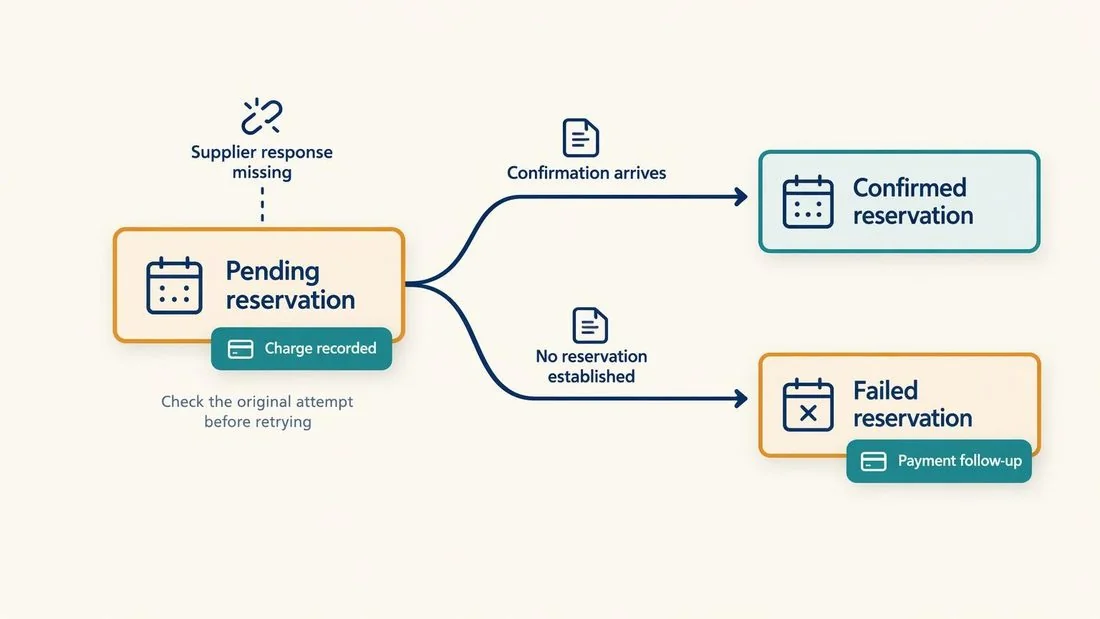
The better result is a pending reservation paired with the actual payment status. The record should retain the original attempt identifier, explain that the supplier outcome needs checking, and avoid inviting a fresh purchase while that question is open.
Now have the provider continue the demonstration. If supplier confirmation arrives, the same attempt should gain the corresponding evidence and become confirmed. If the supplier establishes that no reservation was created, the attempt can become failed while any payment recovery remains visible separately.
This example helps you choose between platforms without rewarding the fastest success animation. Prefer the system whose displayed outcome follows the evidence and whose recovery path you can understand.
Charge complete, supplier outcome unknown
| Screen | Evidence fit | Next action |
|---|---|---|
| Success | Unjustified without confirmation evidence | Check the original supplier outcome |
| Failure + book again | Unknown outcome is not proven failure | Check the original attempt before retrying |
| Pending + payment status | Preserves the known uncertainty | Check supplier outcome; avoid repurchase |
Use a Xeni walkthrough to evaluate the state model
If Xeni is on your shortlist, make booking-state handling a defined part of the evaluation. Broader online travel agency software considerations provide context, but they should not replace a demonstration of the reservation outcomes your business needs.
Bring the definitions and disagreement cases above to the walkthrough. Compare the traveler view with the operational record, then follow an incomplete attempt through to its final result rather than stopping at checkout.
Record the labels shown, the evidence behind them, and the safe next action. Distinguish demonstrated behavior from behavior that requires additional work or a different operating process. A manual review path may be workable, but its workload and limitations belong in your decision.
You can request a Xeni walkthrough of these booking-state cases through the Contact Us page. The purpose is to establish how the proposed setup meets your requirements, not to assume that a particular label or recovery behavior is already available.
Evaluate the uncertain result before committing
Request a walkthrough covering pending, confirmed, failed, and expired bookings, including a disagreement between payment and supplier records.
Explore more from Xeni
Frequently Asked Questions
Choose labels that lead to safe actions
A booking-state model is useful when it tells the reader what is known and what to do next. Before committing, follow an incomplete attempt to its outcome and verify that reservation evidence, payment activity, and event history remain distinguishable throughout.