
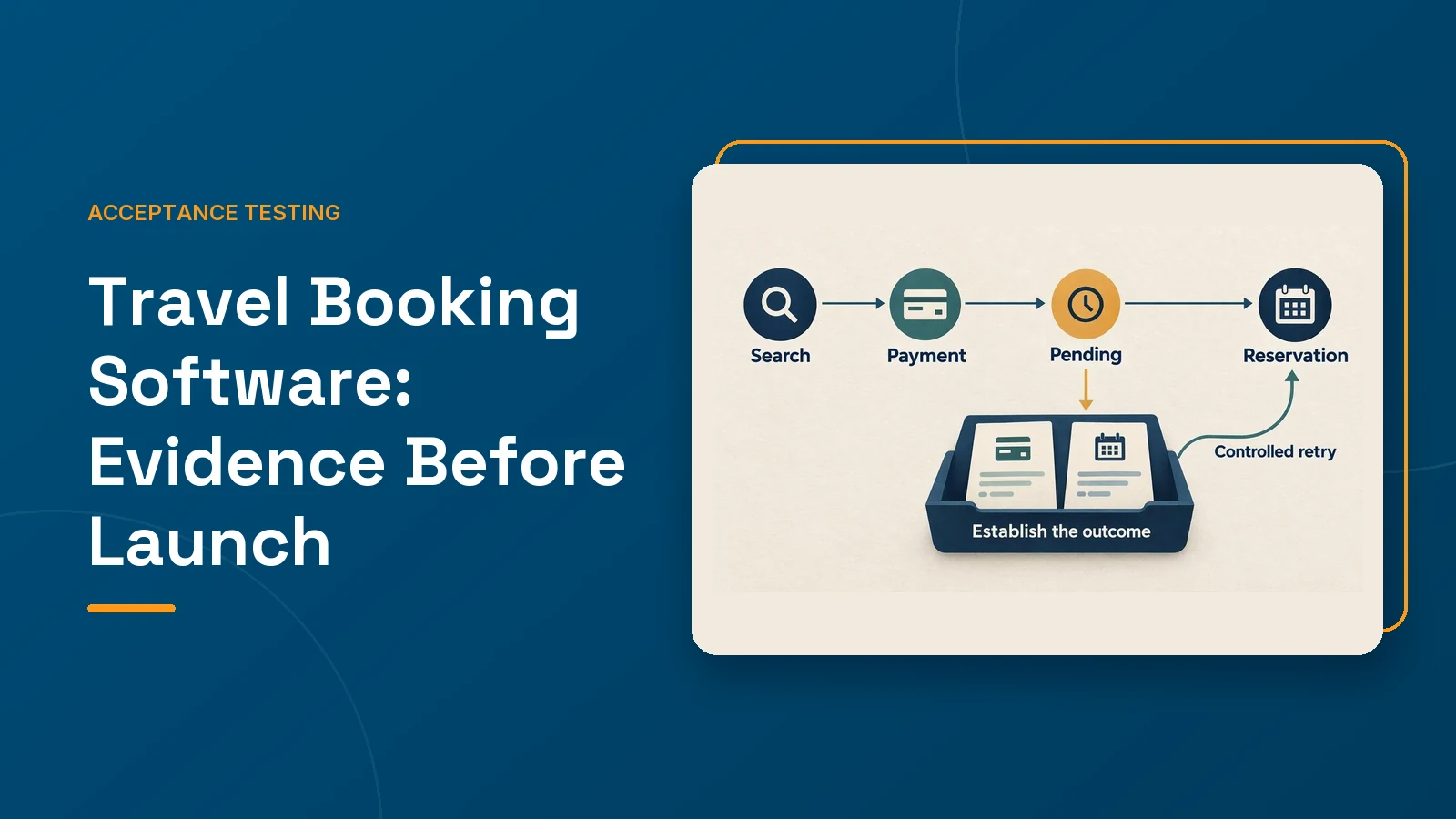
A successful checkout is useful evidence, but it does not answer every acceptance question. What happens when availability changes, payment succeeds without a booking confirmation, or an agent needs to cancel a reservation?
Before purchasing travel booking software, agree on what your business must be able to do, who will prove it, and who can approve the result. The best travel booking software for your operation is the one that meets those requirements, including the awkward cases. Use the sequence below to turn a demonstration into an acceptance plan that procurement, operations, and technical stakeholders can evaluate together.
What exactly are you accepting?
Write an acceptance statement that names the product scope, connected systems, user roles, and business outcomes. Separate capabilities needed for the initial release from later additions, and distinguish supplier-provided functionality from work your business or implementation partner must complete.
For example, replace "booking management works" with "an authorized agent can retrieve a confirmed reservation, see its applicable cancellation terms, and initiate the agreed cancellation process." That creates an observable result without assuming every supplier supports the same servicing workflow.
Record exclusions too. If changes require an external servicing process, acceptance should prove that handoff rather than imply that changes happen inside the platform.
Separate purchase fit from deployment readiness
Purchase evaluation asks whether the proposed solution can meet your needs under agreed terms. Deployment acceptance asks whether the configured implementation, connected services, and operating procedures are ready for actual use.
A demonstration can support the first decision without settling the second. Put any remaining implementation obligations into the purchase scope instead of treating them as already completed.
Define evidence before anyone runs the tests
For each requirement, record the starting conditions, user action, expected outcome, and proof needed to pass. Identify the configuration and environment so a later reviewer can tell what was actually tested.
A screenshot may prove that a message appeared. Booking references, payment status, and a matching operational record are stronger evidence that the underlying transaction reached the intended state.
Which acceptance milestones should come before sign-off?
Use evidence gates rather than dates alone. Each milestone should have an entry condition, a named reviewer, and a documented outcome; the next stage begins when the required evidence is available.
The sequence below is a recommended acceptance structure, not a vendor delivery promise. Agree on any purchase obligations or payment conditions separately in writing.
A buyer's acceptance sequence
| Milestone | Evidence to review | Suggested approval owner |
|---|---|---|
| Scope agreement | Requirements, exclusions, environments, and responsibility boundaries | Business sponsor |
| Technical readiness | Configured connections, test access, and documented technical results | Technical lead |
| Business acceptance | Completed booking and servicing cases with supporting records | Operations lead |
| Defect closure | Retest results and explicitly accepted remaining risks | Acceptance owner |
| Release approval | Signed scope, operating procedures, and recovery arrangements | Business sponsor |
Do not treat unavailable tests as passed
If a supplier environment cannot reproduce a cancellation or delayed confirmation, label that case as not tested. Agree on another way to obtain evidence, or exclude the affected workflow from the release until it is proved.
Restricted test access may explain a gap, but it does not remove the business risk. Keep the gap visible in the acceptance record.
Keep the tested configuration identifiable
Record the application version, relevant settings, integration version, and test environment. When these change, identify which acceptance results need to be repeated.
This prevents a team from signing off based on evidence gathered before a payment setting, permission rule, or supplier connection changed.
Which business outcomes must the tests prove?
Build the test pack around the reservation lifecycle in your agreed scope. Include both successful transactions and cases where the system must stop, explain a problem, or hand work to an agent.
Use permitted test identities and approved payment test methods. Do not create live reservations merely to make a demonstration look complete.
Search, price, and consent
Verify that the selected travel dates, traveler details, product conditions, and payable total remain consistent through checkout. Where your scope includes currencies, taxes, fees, or markups, reconcile them against the agreed calculation rules.
Then change an input or make the selected inventory unavailable. Acceptance should show how the customer receives the revised terms and whether they must consent again before proceeding.
Payment and reservation status
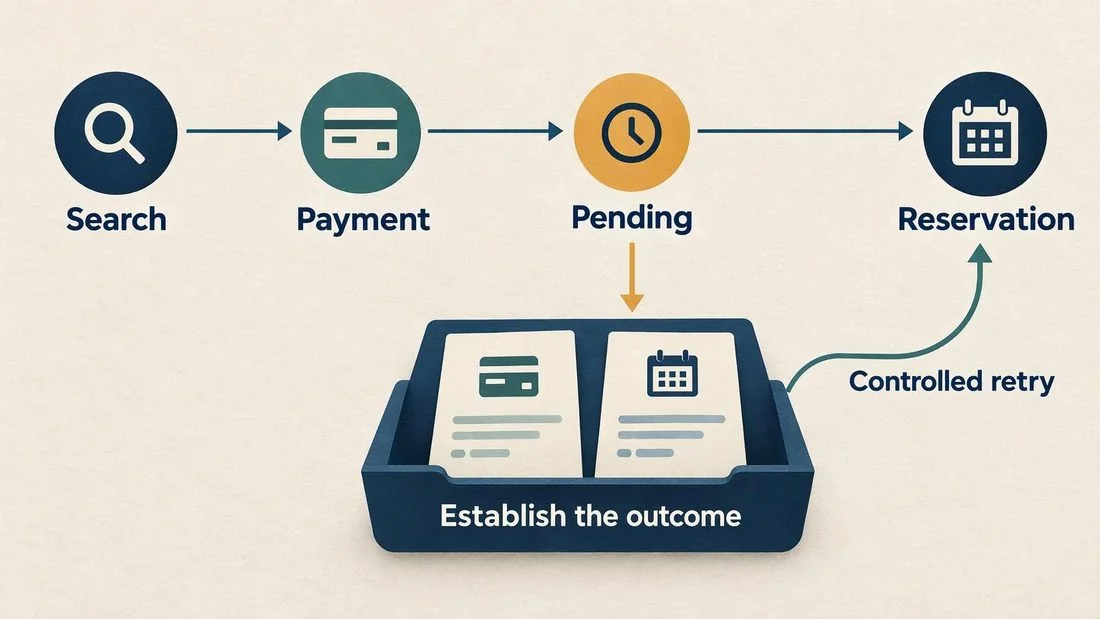
Test payment failure, booking failure after payment authorization, and delayed supplier responses. Check the customer message and the agent's record, rather than judging success only by the checkout screen.
For a pending transaction, require a defined route to establish whether the reservation exists. A retry should not create an unintended duplicate charge or booking.
Confirmation, cancellation, and operational handoff
Compare the confirmation with the reservation record: traveler information, product, dates, terms, and reference should agree. If notifications are part of scope, test unsuccessful delivery and the agent's route to retrieve the information.
For cancellation or refund handling, distinguish request submission, supplier acceptance, and financial completion. Where external servicing is required, prove that the responsible person receives enough information to complete the work.
What technical evidence belongs alongside user acceptance?
User acceptance testing proves that your staff can complete the agreed business work. It should sit alongside technical evidence, not replace it.
Require the implementation team to identify which checks cover component behavior, connected systems, security, and performance. Your role is to agree on the business requirement and review the relevant results, not to reproduce every engineering test yourself.
Integration and failure recovery
For connected services, request evidence for request mapping, response handling, timeouts, and duplicate prevention. A system can display the right product while passing incorrect traveler or booking data downstream.
In an API-led evaluation, use our travel API integration guide as related context, then keep the acceptance evidence specific to the proposed connections. A simulated supplier response proves a controlled test case, not live supplier behavior.
Access, data protection, and usability
Test permissions by attempting actions each role should not be allowed to perform. Check that sensitive traveler and payment information is not exposed in customer screens, exports, or diagnostic records.
Also require evidence for the supported device and browser scope, keyboard use, form validation, and error messages. A technically completed transaction still fails operational acceptance if the intended user cannot understand its status.
Performance under an agreed workload
Define response expectations using your anticipated search and checkout activity, including supplier delays. Ask for measured results with the workload, environment, and error behavior documented.
Do not accept an unspecified "fast" result, or borrow another agency's threshold. The useful question is whether your proposed operating workload meets the requirements you agreed on.
Who owns defects, and what counts as a successful retest?
Give each defect a coordination owner even when its cause crosses company boundaries. That person keeps the issue moving; the technical team still needs evidence to identify whether the cause is application code, configuration, supplier behavior, or an operating procedure.
Include reproduction steps, expected and actual results, environment details, related transaction references, and business impact. Mask sensitive information before sharing diagnostic material.
Prioritize by business consequence
Agree on release-blocking conditions before testing starts. Examples include unintended duplicate charges, incorrect reservation details, unauthorized access, and booking failures with no reliable recovery route.
A display defect may be acceptable for a limited release if it does not change meaning or prevent use. Record who accepts that risk, the affected scope, and the correction plan rather than closing it as fixed.
Retest the failure and its neighboring workflows
A fix is ready for acceptance when the original failure can be repeated under comparable conditions and now produces the expected result. Attach the new evidence to the same defect record.
Also repeat the related workflows that the change could affect. A retry fix, for example, should be checked against successful checkout, payment refusal, delayed confirmation, and repeated submission.
The buyer's acceptance owner closes the issue after reviewing the results. A developer's report that a fix has been deployed is an input to that decision, not the decision itself.
How should the evidence change a release decision?
Say you are evaluating a platform for agent-assisted bookings. Successful reservations appear correctly, but a supplier timeout leaves the agent unsure whether a booking exists; retrying may create another reservation.
The deciding issue is the uncertain transaction state, not how many bookings your agency handles. Even occasional use can expose customers to duplicated reservations if staff cannot establish the outcome.
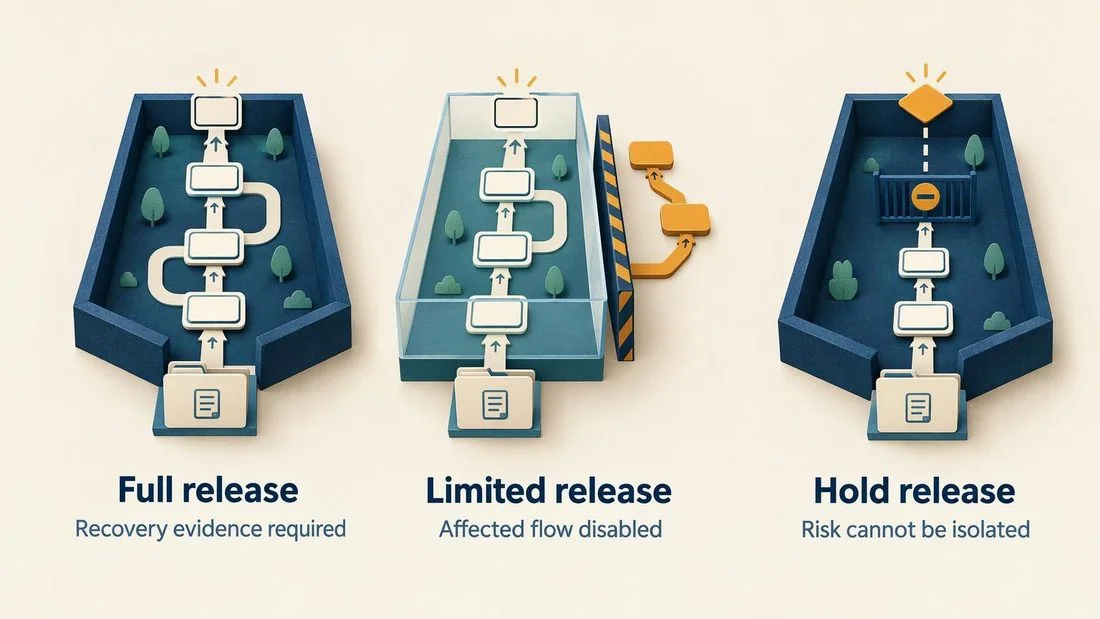
Release choices for an uncertain booking outcome
| Choice | When it is defensible | Trade-off |
|---|---|---|
| Full release | Recovery and duplicate prevention have passed retesting | Waits for sufficient evidence before broader use |
| Limited release | The affected flow is disabled and the remaining scope has passed | Reduces available functionality and requires clear boundaries |
| Hold release | The risky flow cannot be isolated or recovered reliably | Delays use while protecting transaction integrity |
What belongs in the final sign-off record?
Prepare a short decision record that points to the detailed evidence. Name the approved scope and configuration, the decision-maker, and whether the outcome is full approval, limited approval, or a hold.
- Accepted requirements and links to completed test evidence.
- Open defects, accepted risks, and any disabled workflows.
- Operations, finance, and technical approvals relevant to the scope.
- Support handoffs, recovery procedures, and the person authorized to stop use.
Keep completed tests distinct from accepted risks. Otherwise, a later team may mistake permission to proceed with a known limitation for proof that the limitation was corrected.
Define what triggers a pause after release, such as an unexplained payment discrepancy or a failure to establish reservation status. If rollback is part of the plan, verify its limits: reverting software does not necessarily reverse transactions already sent to suppliers or payment services.
Before you sign off
- Name the approved scope, configuration, and decision-maker
- Link accepted requirements to completed test evidence
- Record open defects, accepted risks, and disabled workflows
- Include operations, finance, and technical approvals
- Name support handoffs, recovery steps, and stop-use authority
- Keep completed tests separate from accepted risks
- Define post-release pause triggers and verify rollback limits
How does this checklist apply to a Xeni evaluation?
For a proposed Xeni implementation, use the acceptance pack to define which outcomes the purchase must cover and which responsibilities belong to your business. Keep the implementation approach explicit rather than assuming every part of a booking workflow has the same owner.
If your proposal uses an API-led approach, distinguish your interface and business logic from the connected booking services. If it uses a no-code approach, identify the settings, user roles, and operating workflows that still require acceptance.
The business outcomes remain the same across those approaches: accurate reservations, understandable transaction status, and a workable servicing process. What changes is the evidence each party must provide and the work included in the proposal.
Send your acceptance checklist through our Contact Us page to discuss evaluation steps for the proposed implementation. Include the must-pass booking cases, intended implementation approach, and named sign-off roles so the discussion starts with a defined scope.
Bring your acceptance requirements into the evaluation
Share the checklist to discuss scope and evaluation steps for your proposed Xeni implementation.
Explore more from Xeni
Frequently Asked Questions
Make approval traceable to evidence
Before signing off, make sure another stakeholder can see what passed, what remains restricted, and who accepted the decision. That record is the basis for a defensible purchase and deployment approval.