

A booking message can arrive successfully while the operational problem remains untouched. The traveler may know something changed, but the agent who can resolve it may never receive an assigned task.
For travel booking management, the useful buying question is whether an event reaches the right person with enough context and authority to act. A booking confirmation, approval request, and cancellation update require different responses. Start with those differences, then evaluate channels and implementation. The comparisons below are requirements you can use to assess a proposed solution, not promises about any platform's features.
Which booking events need action, and who should receive them?
Separate informational messages from operational work. A traveler receiving a confirmed itinerary needs information; an agent receiving a failed booking needs to investigate and decide what happens next. Sending both people the same message does not assign that work.
Build an event-to-recipient matrix before comparing products. Describe the business event, not merely the software label: “supplier confirmation received” is more useful than “booking updated.” It tells the buyer what evidence must exist before the alert fires.
The example below is a starting design. Adapt it to your services and responsibility model; it does not establish that a particular supplier or platform exposes these events.
Example alert requirements by event
| Event | Primary recipient | Required action | Delivery requirement | Escalation requirement |
|---|---|---|---|---|
| Confirmed reservation | Traveler; assigned agent gets visibility | Review details and retain confirmation | Readable itinerary with booking reference | Investigate failed delivery if traveler communication is required |
| Booking failure or uncertain result | Booking operations owner | Establish current status before retrying | Assigned task with error context | Backup owner if investigation remains unclaimed |
| Approval required | Authorized approver | Approve or reject under the applicable policy | Actionable request linked to current details | Delegate if the decision remains pending |
| Supplier change received | Servicing agent; traveler as appropriate | Assess impact and communicate next steps | Changed details with current booking state | Escalate based on departure timing and impact |
| Cancellation or refund update | Servicing or finance owner | Reconcile the relevant reservation or payment state | State-specific task and reference | Escalate unfinished follow-up, not every status update |
Give every actionable event a completion condition
“Email sent” is a delivery result, not a business outcome. For an approval request, completion means an authorized decision was recorded. For a booking exception, it means the current reservation status was established and the next action documented.
This distinction makes competing proposals easier to assess. A platform may meet the communication requirement but leave assignment and completion tracking to another system.
What does the alert actually know about the booking?
Keep payment status, reservation status, and ticketing status distinct where they apply. Do not design a customer confirmation around a payment event alone if your workflow requires separate reservation evidence. Likewise, a cancellation request should not be worded as a completed cancellation.
For each alert, identify the upstream event that supports its wording. Decide how the workflow handles a pending result, an error, or a status that cannot yet be established. Honest state labels let an operator investigate without telling the traveler more than the system knows.
Timing also has separate stages: the supplier changes something, the platform learns about it, the message is dispatched, and the recipient acts. Fast dispatch cannot compensate for an event that arrives late or never arrives.
Check update order and booking identity
Require a stable booking reference and enough event context to connect successive updates. A delayed confirmation should not overwrite a later cancellation simply because it was processed afterward. Ask the proposed solution to demonstrate how it handles repeated events and updates received out of order.
Event time and receipt time answer different questions. The former helps establish what happened; the latter helps locate a delay in the communication path. Preserve both when the originating system supplies them.
Which delivery channel fits the action?
Choose a channel around the recipient's work, not a feature count. A traveler needs understandable information and a safe way to respond. An operations owner needs an assigned item connected to the current booking.
A webhook is a system-to-system event message, not a traveler notification. If your application receives one, another part of the workflow must interpret it, route the work, and deliver any human-facing message.
Delivery choices and their operational trade-offs
| Channel | Useful role | Trade-off | Evidence to request |
|---|---|---|---|
| Detailed confirmations and nonurgent updates | Receipt does not establish ownership or action | Delivery failures, current booking links, and response handling | |
| SMS | Brief time-sensitive prompts when appropriate | Limited context; requires suitable contact and messaging permissions | Destination validation, failure handling, and secure next step |
| In-app notification | Updates within the user's active workflow | Recipients may not be using the app | Unread state and fallback behavior |
| Operations queue | Assigned exceptions and tracked follow-up | Useful only if someone monitors and owns the queue | Assignment, acknowledgment, reassignment, and closure |
| Webhook | Sending booking events into another application | Requires receiving logic and operational maintenance | Event definitions, authentication, retries, and recovery |
How should acknowledgment and escalation work?
Assign a primary owner to actionable work and define who takes over when that owner is unavailable. A shared inbox gives people visibility, but it does not necessarily establish who accepted the task. The routing design should make that distinction visible.
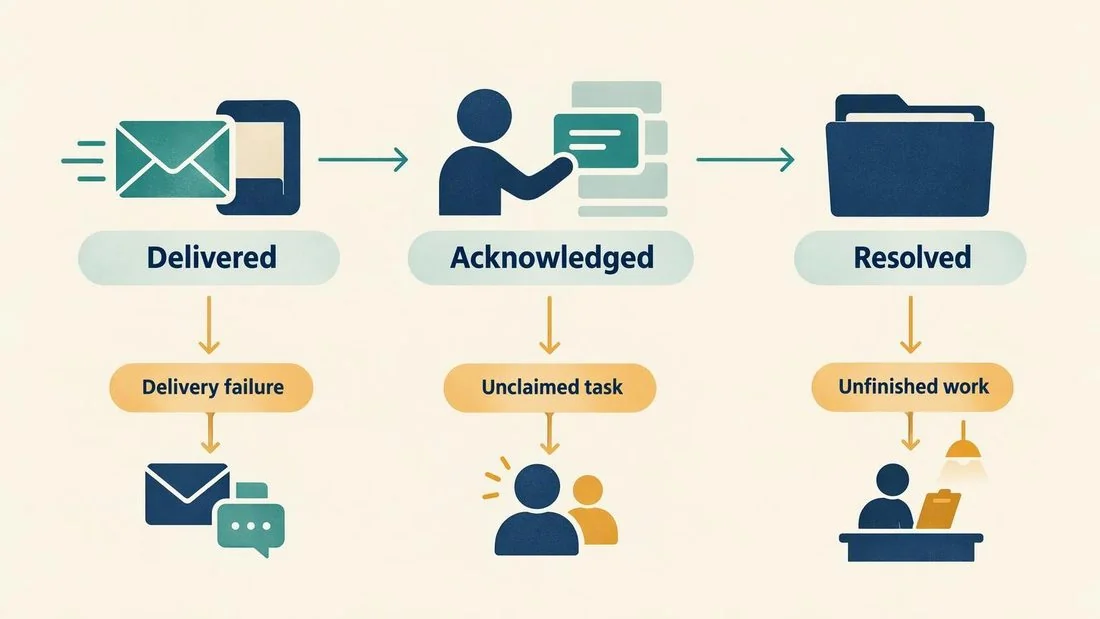
Separate message delivery, acknowledgment, and resolution. Delivery reports whether a channel accepted or delivered the message, subject to that channel's definitions. Acknowledgment records that someone accepted responsibility; resolution records that the required work is finished.
Escalation should respond to a specific failure. An undeliverable message needs a communication fallback. An unclaimed task needs another owner. A claimed but unfinished task needs an operational review, possibly with different urgency as departure approaches.
Set response rules around consequences
A pending approval for travel well ahead of departure does not need the same response rule as a change affecting an imminent trip. Define urgency using the applicable deadline, trip impact, and available alternatives. Put the actual response targets into your requirements rather than accepting an unexplained “instant alerts” claim.
Also define what stops the reminders. A resolved issue should leave the active escalation path, while a newly material change may need a fresh task. Otherwise, repeated messages can keep demanding attention after the useful work is done.
Should you use built-in alerts or integrate another workflow?
Choose the implementation that fits where your team already accepts and completes work. If the booking platform can handle your event map directly, built-in routing may avoid another integration. If operational ownership lives elsewhere, notifications alone may leave your team duplicating assignments.
The decision is about supported behavior, not labels such as “automated” or “no-code.” Configuration can be sufficient for a straightforward rule, while a custom receiving application gives you more responsibility for event processing and failure recovery. Use our travel API integration guide for related implementation context.
Approaches to implementing your alert requirements
| Approach | Choose it when | Responsibility you retain | Main trade-off |
|---|---|---|---|
| Built-in platform notifications | Supported rules match the event map and working environment | Recipient setup, operating procedures, and monitoring | Less integration work, but routing depends on available controls |
| Configured workflow connector | Available triggers and actions connect booking events to your existing tools | Mapping, credentials, connector monitoring, and exception handling | Avoids some custom code, but inherits connector limits |
| Custom API or webhook integration | Your event handling or ownership rules require application logic | Development, security, recovery, testing, and maintenance | More control, with more engineering and operational responsibility |
Keep one authoritative place for task ownership
If booking records live in one application and tasks in another, define which system owns assignment and closure. A traveler-facing booking page can show status without becoming the operations task manager. Avoid a design where separate tools silently disagree about whether follow-up is complete.
A booking exception shows why routing matters
Say you manage bookings through a portal, but your team handles exceptions in an existing service queue. A traveler submits a reservation request, and the result remains uncertain after payment processing. The immediate job is to establish the reservation state, not send a confident confirmation or retry blindly.
A generic email to the traveler provides little help. An email to every agent creates visibility but leaves ownership open. A routed task gives a designated operator the booking reference, known payment state, and missing reservation evidence.
The operator can investigate the existing request before deciding whether another attempt is appropriate. Meanwhile, the traveler receives a status message that reflects what is known, with a clear next step. Internal technical details stay in the operational record.
If built-in alerts can assign that work and track completion in the environment your team uses, they may be enough. If they only send messages, a connector or custom integration into the service queue may fit better. The dependency changes the choice: someone must resolve the uncertain result before further booking action.
Finish the example by testing the fallback. If the assigned operator does not acknowledge the task, it should reach the designated backup under your response rule. If a later confirmation arrives, the workflow should update the task and prevent obsolete reminders.

What should a proposal demonstrate before you accept it?
Evaluate a proposal against your event map with sample booking records. A polished confirmation message proves only that a message can be rendered. A useful demonstration follows an event through assignment, delivery, acknowledgment, and the required completion condition.
- Repeat an event and inspect whether it creates duplicate work.
- Make the destination unavailable and observe failure detection and fallback.
- Leave a task unacknowledged and follow the escalation path.
- Process a later state change, then inspect an older delayed update.
- Close the task and check that obsolete reminders stop.
Record which layer handles each behavior: booking platform, connector, your application, or a manual operating procedure. This is how you distinguish an included capability from work your team must build or perform.
Budget for the complete workflow
Compare costs by the components required for your event map. Depending on the proposal, these can include configuration, message delivery, connector services, development, and ongoing monitoring. Separate initial implementation from recurring charges, and ask what happens to charges when failed messages or events are retried.
A lower-cost notification option may still fit if your existing process reliably handles ownership. A more elaborate integration is worth considering only when its additional behavior solves a defined operational need.
Bring the requirements to Xeni
For a discussion with us at Xeni, use the matrix to describe the booking events you need, where your team works, and who can act. Include your preferred channels, response rules, and any existing application that must remain responsible for tasks.
Share that matrix through our Contact Us page to review the proposed solution's scope. The useful outcome is a clear division between included behavior, configuration, integration work, and responsibilities your team retains.
Acceptance tests before you buy
- Repeat an event; inspect for duplicate work.
- Make a destination unavailable; check failure and fallback.
- Leave a task unacknowledged; follow its escalation path.
- Process a later state, then inspect an older delayed update.
- Close the task; check that obsolete reminders stop.
Turn your alert requirements into a scope discussion
Share your event-to-recipient matrix with Xeni, including the workflow your team already uses.
Explore more from Xeni
Frequently Asked Questions
Buy the workflow, not the message count
A useful alert design connects a supported event to an owner, an action, and a verifiable outcome. Use the event matrix to compare proposals, then test the cases where messages fail or work remains unfinished. That evidence tells you whether the proposed approach fits your booking operation.