
A hotel API response that says breakfast included still leaves a buying question: included for whom, on which mornings, and under which rate? Your checkout wording needs those answers before it turns a short label into a promise.
Evaluate representative rates against what you intend to sell. A platform selling adult room-only stays has different meal-data needs from one selling family packages with dinner. The best hotel API for your business is the one whose evidence supports that product. These eight checks separate useful meal-plan data from labels that need qualification, with a worked buying example at the end.
1. Are meal inclusions attached to the selected rate?
Start with the relationship between the meal information and the bookable offer. A hotel description about its breakfast service is not evidence that breakfast is included in every rate. Your integration should be able to distinguish a property amenity from a purchased entitlement.
Request examples where the same room has different board options. Follow the meal description back to the selected rate identifier, rather than accepting a hotel-level badge that remains unchanged when the customer selects another offer.
The useful outcome is a rate-specific statement: this offer includes the documented meal benefit. If the response only describes the hotel's dining facilities, use that information in property content, not in the rate's inclusion summary.
Also test rate comparisons. Combining offers solely because their room descriptions match can hide a meaningful meal difference. Preserve the board distinction wherever the customer chooses between otherwise similar offers.
2. What does each board label actually mean?
A board label is a starting category, not a complete service description. Common terms describe broad meal arrangements, but the terms attached to the selected offer should determine your customer-facing wording.
Ask for a mapping that separates the supplier's original label from your normalized category and any additional description. Abbreviations need documented meanings; an unfamiliar code should not become breakfast included because it resembles another supplier's code.
Use the distinctions below to evaluate what your interface would need to explain. These are ordinary category meanings, not guaranteed inclusions for a particular hotel.
Common board labels and the detail needed before checkout
| Board label | General meaning | Detail still needed |
|---|---|---|
| Room only | Accommodation without included meals | An explicit statement that meals are excluded |
| Bed and breakfast | Accommodation with breakfast | Covered guests, service mornings, and restrictions |
| Half board | Accommodation with breakfast and another main meal | Whether that meal is lunch or dinner and whether a choice is allowed |
| Full board | Accommodation with breakfast, lunch, and dinner | Service dates, covered guests, and beverage terms |
| All-inclusive | Accommodation with a broader package of meals and other inclusions | The exact package scope, exclusions, venues, and service periods |
Keep the label shorter than the promise
Display a concise category for scanning, with the relevant terms beside it. Do not expand half board into breakfast and dinner unless the rate evidence supports dinner specifically, and do not turn all-inclusive into all food and drinks without a package definition.
3. Which booked guests receive the meals?
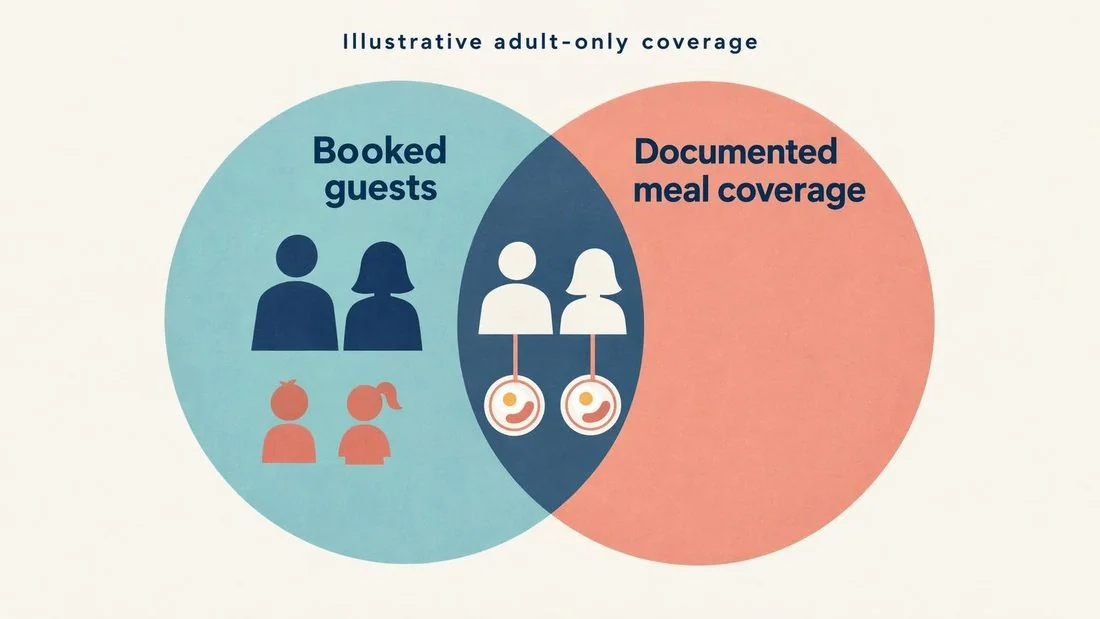
Evaluate the entitlement against the actual occupancy you submit. Room capacity and meal coverage answer different questions: a room may accommodate the requested party without the meal description establishing coverage for every guest.
For family sales, use requests containing the child ages your product accepts. Look for an answer about meal applicability, not merely confirmation that children can stay in the room.
Where coverage is expressed as a guest count, determine how that count relates to the booked party. Where it uses age categories, retain the applicable age rules with the offer. Do not derive a meal entitlement from an accommodation policy alone.
A useful acceptance test is whether your checkout can say who receives the benefit without guessing. If breakfast is documented only for the adults, the display should preserve that limitation rather than saying breakfast included for the whole family.
For multi-room purchases, keep the coverage attached to each room's selected offer. A meal-inclusive rate in one room should not create a booking-wide inclusion for another room.
4. Are exclusions and dining restrictions usable?
Evaluate whether the data can carry the qualifications that change a customer's choice. Relevant examples include beverages, specialty restaurants, room service, dining credits, and advance reservation requirements. These are categories to test, not assumptions about any hotel's policy.
Distinguish an included meal from a credit toward a meal. A credit may leave an additional amount payable, so rewriting it as dinner included changes the meaning even if both benefits belong in a dining section.
Structured information is helpful for filters, but readable rate terms can still carry necessary detail. Evaluate whether those terms are available early enough to inform selection, rather than only after payment.
Preserve a material limitation near the inclusion it qualifies. A package name at the top of checkout and an exclusion buried elsewhere do not give the customer an easy comparison.
The trade-off is real: a richer description takes more interface space. Use a short summary with accessible details, but keep limitations that affect cost or eligibility visible before purchase.
5. Which dates and service periods are covered?
A meal plan needs a time basis as well as a label. Determine whether the offer explains which meals are available on arrival and departure dates, and whether any service periods differ during the stay.
Do not calculate an entitlement solely by multiplying nights by meals. That calculation cannot establish whether dinner is included on arrival or lunch is included on departure. Use the documented service rule when your product displays a meal count.
Arrival timing also matters to the traveler. If an offer gives a meal service window, preserve it; a late arrival may make that information material even though the rate still includes the meal. Avoid promising a replacement meal or refund unless the applicable terms support it.
For stays spanning different dining arrangements, test whether the API preserves date-specific detail. If your platform sells packages with named meals on named days, a stay-wide board label alone may not support the itinerary you intend to present.
6. Does the data distinguish inclusions from paid extras?
Breakfast available and breakfast included should produce different checkout outcomes. The first describes access to a service; the second describes a benefit in the selected price.
Evaluate how optional meals appear in the response. Your platform needs to know whether an option is informational, payable separately, or selectable as part of the booking. A description of an extra does not establish that your API can purchase it.
Where an extra is priced, keep its charging basis with the amount. A charge per guest per service day is different from a charge for the room or the stay. Taxes, currency, covered dates, and guest applicability also belong to that decision if they are supplied.
Do not advertise an upgrade amount by subtracting unrelated offers. Comparing a room-only rate with a breakfast rate does not isolate the meal price if other terms differ.
Approve separate displays for included meals and optional dining. This prevents an available paid service from receiving the same inclusion badge as a benefit already purchased.
7. Can supplier terminology be normalized without losing meaning?
Normalization should make comparable offers easier to understand while preserving differences that matter. Keep the original supplier wording alongside the normalized value so a reviewer can trace the customer label to its evidence.
Evaluate ambiguous labels separately from explicit exclusions. A missing meal value is not proof of room-only terms, and an unknown code is not proof of breakfast. Those states need different treatment in your display and filters.
Also request examples where a structured field and a description disagree. Your team needs a documented decision rule for those conflicts, including when to withhold an inclusion claim instead of silently selecting the more attractive interpretation.
Do not resolve conflicting offers by taking the richest description from another supplier. Even for the same property and room type, that description may belong to a different purchased benefit.
Make uncertainty visible without overstating it
Prefer a specific statement such as meal inclusion not specified over a room-only label when the data is absent. If breakfast is supported but beverage terms are not, preserve the breakfast statement without adding a beverage promise.
8. Does the meal evidence survive the booking journey?
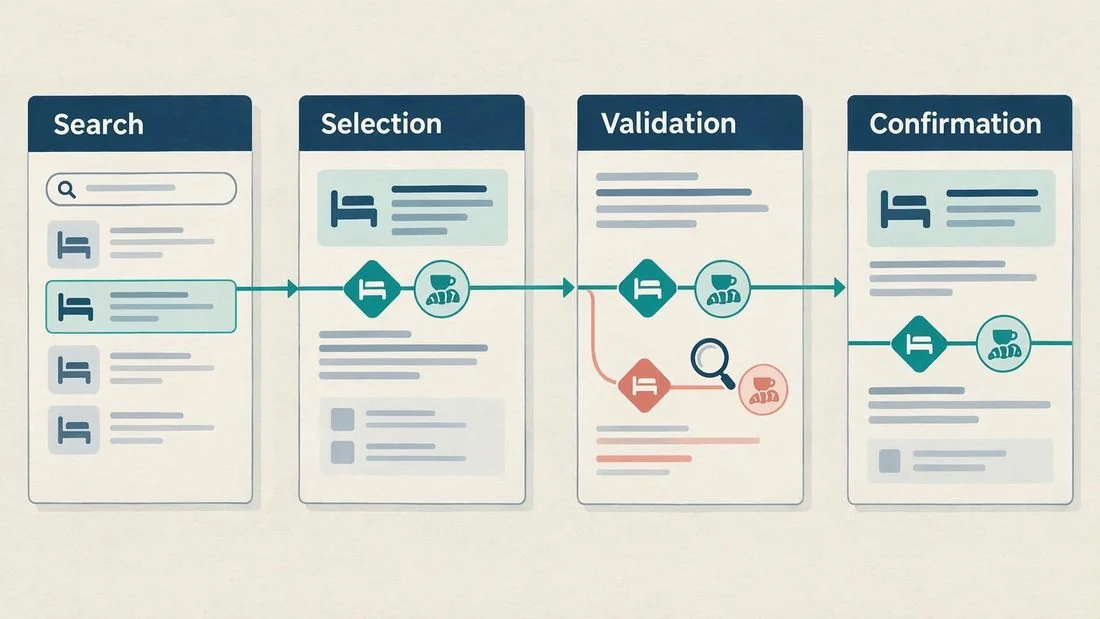
Trace a representative offer through search, selection, any rate-validation step, and booking confirmation. Evaluate whether the meal terms remain attached to the offer the customer actually purchases.
If a selected rate changes or becomes unavailable, the replacement should be evaluated on its own meal terms. Keeping the earlier breakfast badge while substituting another offer creates a promise that the replacement data may not support.
Retain the inclusion wording shown at purchase and its relationship to the booked rate. This gives your customer service team something more useful than a current property description when a traveler questions what was included.
Compare demonstration behavior with the environment and access level you will use. A neat sample proves that your team can read that sample; it does not establish coverage across the rates you plan to sell.
Your acceptance decision should cover both interpretation and traceability: can you explain the meal entitlement, and can you identify the evidence behind the purchased promise?
Trace meal evidence through booking
- SearchIdentify the representative offer's meal terms.
- SelectionKeep meal terms attached to the selected rate.
- Rate validationIf present, check any replacement's own meal terms.
- ConfirmationRetain purchase wording linked to the booked rate.
Apply the checks to a buying decision
Say you are building a family hotel checkout. You want to display whether breakfast covers the whole party before customers choose a rate, rather than leaving child meal costs for them to discover later.
Compare the following possible data arrangements. These are evaluation examples, not descriptions of named providers.
Choosing data that supports a family breakfast promise
| Available evidence | What you can support | Buying implication |
|---|---|---|
| Breakfast label only | A board category, but not confirmed family coverage | Insufficient for a whole-party breakfast promise |
| Breakfast label with rate-specific terms covering the booked party | A family inclusion statement after interpreting the terms | Potentially suitable if the terms remain accessible through purchase |
| Structured guest coverage plus matching rate-specific terms | A family inclusion statement and machine-readable eligibility | Better aligned with automated filters, subject to booking-flow tests |
Choose for the product you will launch
The second arrangement may be enough if your team can reliably present the terms and your launch does not require automated eligibility filters. The third has more value when the product must determine coverage programmatically. Structure is useful because it supports a specific task, not because more fields automatically mean better data.
If your immediate product sells explicit room-only offers, limited breakfast detail need not disqualify an integration. But if family breakfast coverage is central to your proposition, a label-only feed leaves the central buying requirement unmet.
Discuss your meal-plan requirements with Xeni
You can reference the API integration page in your inquiry while asking what data and integration support are available for your intended product. Treat meal-plan support as a concrete requirement rather than assuming every entitlement field is available.
Bring representative occupancy requests, board labels, and the exact inclusion wording you want to display. Include a straightforward offer and an offer where guest coverage or dining exclusions change the choice, then ask what supporting data can be provided.
Send those requirements through our Contact Us page. Use the response to assess which checkout statements any available data can support, where interpretation would be required, and which sales promises would need a different approach.
Turn your checkout promises into data requirements
Share representative meal-plan cases with Xeni and ask what supporting hotel data can be provided.
Explore more from Xeni
Frequently Asked Questions
Approve the promise, not just the field
A useful meal-plan integration lets you explain what the customer is buying and retain the evidence behind that explanation. Base your purchase decision on the offers your product will sell, including the guest eligibility and exclusions that change their value.