
A booking demonstration can show a successful payment without explaining which system received the card number. That difference matters when you buy travel payment processing software: the checkout, your booking application, an integration, and an agent's support tools may each have different roles.
PCI DSS, the Payment Card Industry Data Security Standard, concerns payment-card data security. For a purchase decision, start by separating the vendor's service from your own implementation and working practices. The seven mistakes below help you compare configurations, understand the trade-offs, and recognize when a payment-security specialist should review the design before you commit.
1. Buying before identifying every card-data collection point
The first mistake is treating the visible checkout as the entire payment flow. Your purchase review should also cover any proposed agent-assisted payment route, customer service process, and integration that receives payment information.
Begin with the moment a traveler enters or provides card details. Follow that information through the browser, any application server, the payment component, and the response returned to the booking system. Distinguish full card details from a transaction reference or a limited display value.
Include departures from the normal path. If a traveler cannot complete checkout, does the agent send another payment link, enter details into a separate screen, or invite the customer to email them? Each route deserves its own review rather than an assumption that the original checkout design covers it.
- Identify who operates every screen that accepts card details.
- Record which systems receive those details, even temporarily.
- Separate traveler-entered payments from agent-assisted payments.
- Keep card details out of free-text booking notes and ordinary support messages.
The useful buying evidence is a readable data-flow diagram tied to the proposed setup. If nobody can explain a collection point, leave that part of the purchase decision open until the design is clear.
2. Treating every hosted payment component as equivalent
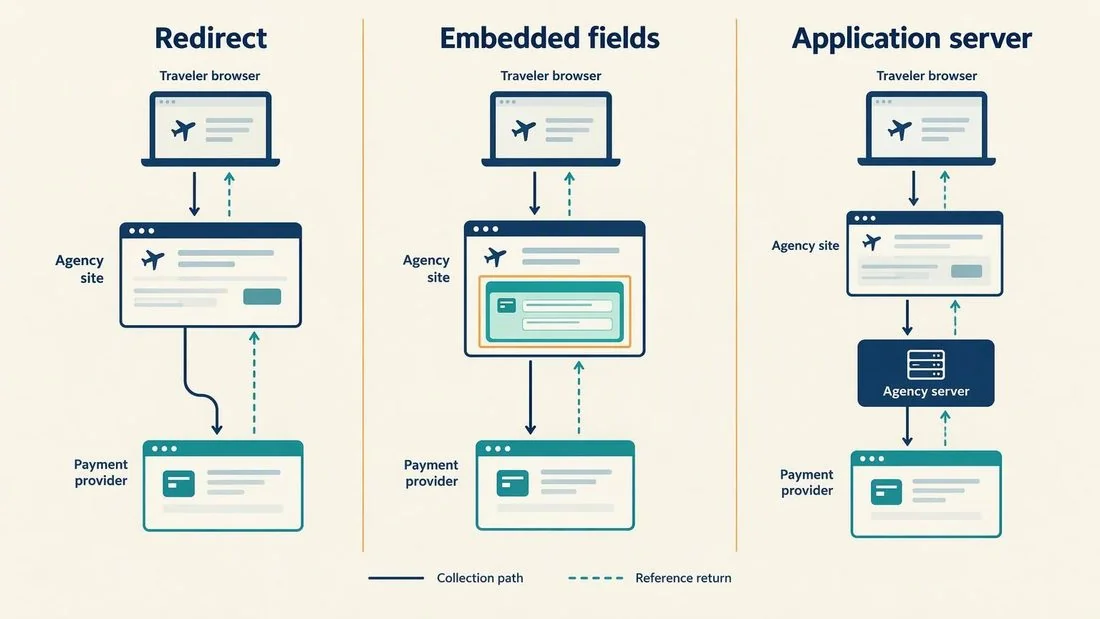
A hosted payment page, embedded payment fields, and a form that sends card details through your server are different designs. The word "hosted" does not tell you which design is being proposed, what your application can access, or which parts you control.
Compare the actual route, not the label. For an embedded component, examine where the sensitive fields originate and where submissions go. For a redirect, examine the handoff and return path. For a server-side integration, establish whether your server receives card details or only a payment reference.
The trade-off is real: a more customized checkout can give you more control over the traveler experience, but it may also introduce implementation and maintenance work. A provider-controlled experience may limit customization. Neither choice should be declared compliant merely because it looks simpler.
Use this comparison to select the design for further review, not to select a self-assessment questionnaire. Your acquiring bank or a qualified payment-security specialist should establish the appropriate validation route for the complete implementation.
Payment collection designs to distinguish during procurement
| Proposed design | Boundary to establish | Buying trade-off |
|---|---|---|
| Redirect to a provider-controlled page | What leaves your site and what returns after payment | Less control over the payment-page experience |
| Provider-hosted fields embedded in your page | Who supplies the fields and whether your application can access card details | An integrated experience with page-level dependencies to review |
| Card collection through your application server | Whether raw card details reach your infrastructure | More implementation control with additional handling to assess |
3. Reviewing checkout while ignoring logs and support tools
A payment integration review should cover the information retained around a transaction, not only the transaction itself. Debugging tools, error reports, customer messages, and exports are places to inspect for unintended copies of payment details.
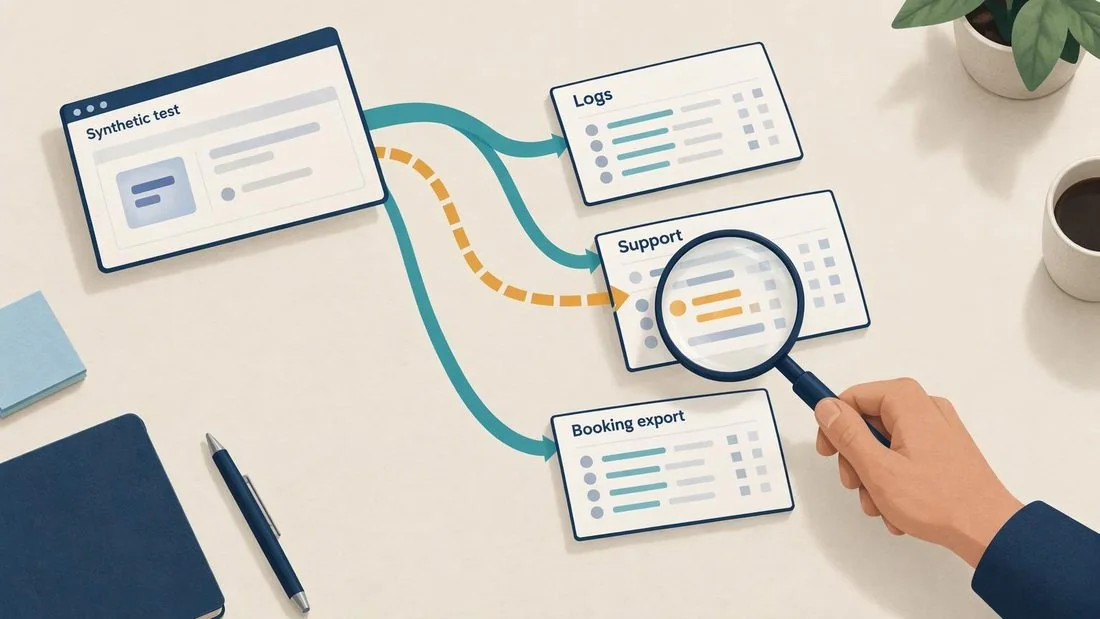
Request a demonstration using synthetic payment data in the designated test environment. Follow a successful payment and a failed attempt, then inspect the resulting application logs, integration logs, support records, and booking exports. The purpose is to see what was recorded and who can access it.
A reassuring checkout screenshot is weak evidence if the failure path records an entire request elsewhere. Examine logging settings and redaction behavior at the point information enters each tool. Also distinguish restricted technical diagnostics from records available to ordinary agents.
Travel workflows need particular attention around payment failures and booking changes. An agent may want to attach a screenshot to a support request or paste a response into a reservation note; the process should provide useful transaction references without encouraging copies of card details.
Do not accept a demonstration that uses a real customer's card information to prove this point. Synthetic test records can reveal the data path without creating another sensitive record to manage.
4. Assuming a token removes every card-data question
A token or payment reference is useful only after you understand what it represents and how the proposed system uses it. Receiving a token after payment does not, by itself, show that card details never passed through your application earlier.
Follow the sequence: where are card details collected, which component converts them into a reference, and what reaches your booking system? Then establish whether that reference identifies a single transaction, supports later payment activity, or connects to stored payment credentials.
Keep payment references separate from display information. A limited card display can help an agent recognize a payment, but it does not explain whether another system retains the underlying details.
For a travel purchase, examine the intended later actions. If the proposal includes refunds, additional charges, or another payment after a booking change, understand how each action is authorized and which component performs it. Do not infer those capabilities from the word "token."
The buying decision should account for both exposure and access: avoiding raw card details is valuable, while references that permit payment actions still need appropriate access controls. Choose a design whose permissions match the work your agents actually need to perform.
5. Accepting a compliance badge instead of service-specific evidence
A company name beside a PCI statement does not establish that every product, integration, or customer configuration is covered. Match the evidence to the legal entity, payment-related service, and deployment proposed in your purchase.
Ask for the applicable compliance evidence and an explanation of its coverage. An Attestation of Compliance, often abbreviated AOC, is one document to discuss with the provider and your reviewer. Do not treat a logo, sales slide, or general security certificate as a substitute for understanding the relevant service.
Check the date and the service description, then compare them with the architecture you intend to operate. A document for one payment component should not silently stand in for evidence about a separate integration or your own application.
Different credentials also answer different questions. A travel-industry credential and a payment-card security assessment should not be treated as interchangeable. Our compliance certifications FAQ is a starting point for that discussion; the purchase review still needs to address your proposed configuration.
The appropriate conclusion is specific: the identified evidence applies to the identified service. It is not a blanket assurance that every connected system or working practice has been assessed.
6. Leaving security responsibilities between organizations
Avoid a proposal in which every party describes its own component but nobody owns the connections. Separate the travel software provider, payment provider, implementation team, and your business rather than referring to all of them as the vendor.
Build a responsibility record around actual work. Identify who configures collection, controls agent access, maintains the integration, reviews data handling, and responds to a suspected incident. For shared tasks, identify the handoff and the person responsible for verifying completion.
Ownership and commercial liability are different questions. Your operations team needs to know who performs a task; legal review needs to establish what the agreement promises and how obligations are allocated. A responsibility record helps both discussions without replacing either.
- Assign an owner for each payment-related component and integration.
- Identify who can change checkout code, scripts, and settings.
- Document access approval and removal for agents and administrators.
- Set out incident contacts and escalation between organizations.
A statement that the provider manages payments is too broad to resolve these details. Proceed when the parties agree on the work and its boundaries, not when the same vague assurance appears in several documents.
7. Budgeting for launch but not ongoing operation
The final mistake is pricing the integration as a launch-only project. Your buying comparison should include the effort needed to keep the payment design understood and maintained as your business changes.
A new support tool, checkout customization, logging setting, or agent-assisted process may change the information path you reviewed before purchase. Plan a review trigger for those changes rather than assuming the original demonstration remains representative.
Include access reviews, integration maintenance, evidence renewal, and staff training in the operating plan. Ask who handles changes when a payment component is updated or replaced, and who decides whether a new implementation needs specialist review.
There is no useful universal PCI budget or completion time for this decision. The work depends on the proposed architecture, existing systems, validation expectations, and the responsibilities your business retains.
Compare proposals on ongoing workload as well as setup cost. A lower launch quote can be less attractive if it leaves your team with work it cannot reliably perform. Conversely, a simpler configuration may be worth accepting even if it gives you fewer customization choices.
Before signing, make sure the people expected to maintain the system have the access, knowledge, and budget to do so.
Apply the seven checks to a travel software purchase
Say you run a travel agency and want a branded booking experience with agent support for failed payments. You are comparing a provider-controlled payment page with a custom application that collects card details before sending them to a payment provider.
The custom application gives you more control over collection. That advantage matters only if your team can assess and maintain the resulting data path, including logs and support tools. If your main need is branding outside the payment screen, collecting card details yourself may add work without solving a necessary business problem.
The provider-controlled route is the better starting point when its documented boundaries meet your needs and its limitations are acceptable. It still needs review: an agent workaround that copies card details into a support ticket would undermine the intended operating process.
If neither proposal explains failed-payment handling, choose neither yet. The decisive issue is the uncertainty around that workflow, not how many bookings you expect to process.
Where Xeni fits in the decision
When you evaluate us for travel software, keep booking functionality and payment responsibility as separate purchase questions. An API-based or no-code proposal needs the same configuration-specific explanation: which payment-related components are included, what information crosses each boundary, and which tasks remain with your business.
Use our Contact Us page to request clarification for the configuration you are considering. Include your intended traveler checkout, agent-assisted workflow, and any custom integration so the discussion concerns the system you plan to operate rather than a general product label.
Seven checks before committing
- Map traveler and agent-assisted card collection paths.
- Establish hosted component boundaries and application access.
- Inspect logs, support records, and exports using test data.
- Trace token creation and permissions for later payments.
- Match compliance evidence to the proposed service and setup.
- Assign component owners, access duties, and incident contacts.
- Plan maintenance, access reviews, training, and change reviews.
Bring the proposed payment flow into your Xeni evaluation
Request clarification of payment-related components, data boundaries, and responsibilities before committing to the configuration.
Explore more from Xeni
Frequently Asked Questions
Choose the payment design you can operate responsibly
A sound purchase decision connects the payment flow, applicable evidence, and named responsibilities. If those agree, compare the configuration's functionality and ongoing workload. If they do not, resolve the specific gap before signing rather than relying on a general compliance claim.