
Hotel room mapping is a buying decision about data responsibility, not simply a cleaner list of room names. A shared field structure can make supplier responses easier to process without proving that similarly named rooms represent the same room category.
Your choice should turn on what happens when descriptions conflict, records change, or a match is wrong. The checks below separate initial matching quality from the work of maintaining it.
1. What exactly is being mapped?
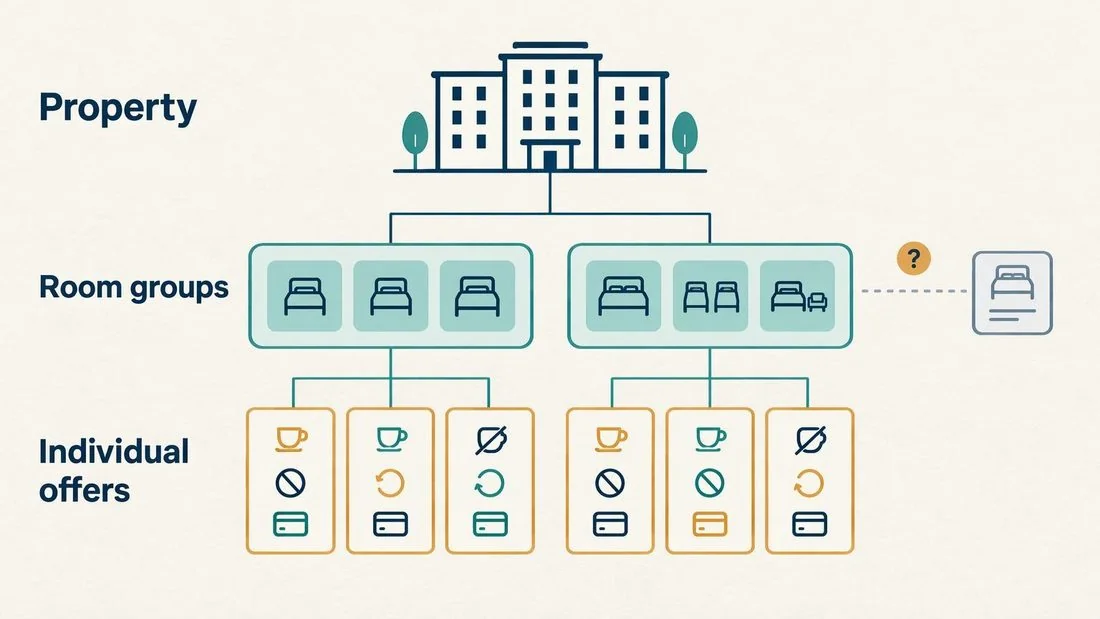
Start by separating property identity, room identity, and the offer attached to a room. Matching hotel records does not establish that their room records are equivalent, and grouping equivalent rooms does not make their rate conditions interchangeable.
For procurement, define the output you need. Do you want standardized labels, cross-supplier room groups, or room groups with distinct bookable offers underneath them? These are different deliverables, even if a demonstration makes them look similar.
A useful acceptance test starts with rooms at the same verified property. Compare bed type, occupancy, view, and any supplied accessibility information. Treat missing information as unknown rather than silently assuming agreement.
Keep breakfast inclusion, cancellation terms, and payment conditions attached to the individual offer. A traveler should not lose those differences just because the interface places offers under a common room heading.
Ask the provider to demonstrate its boundary using conflicting records, not only tidy examples. The deliverable should explain what it standardizes, what it matches, and what it leaves unchanged. If it only changes labels, buy it as label normalization rather than accepting a broader room-matching promise.
2. Can you trace a match back to supplier data?
Require a path from the displayed room group back to the supplier record and the bookable offer. A normalized label alone is insufficient for investigating why an offer appeared in that group.
Request sample output that preserves supplier identity, original property and room identifiers where supplied, original descriptions, and the mapped room identifier. Also ask how mapping revisions are recorded. These are procurement requirements, not assumptions about what every provider returns.
The explanation should distinguish supplied information from inferred information. If the input says only "double room," a normalized output should not turn that into a guaranteed king bed without supporting evidence.
For an integration involving Xeni, the documentation on retrieving hotel details and room availability is useful context for the data discussion. Retrieval and normalization should still be evaluated separately; access to room information does not by itself establish cross-supplier matching behavior.
Prefer a provider that can reconstruct a decision from the relevant input and mapping version. If a support investigation cannot identify which record was grouped and why, your team will have less information for correcting the display or explaining a booking dispute.
3. What happens when room descriptions are ambiguous?
Test whether the system can leave a room unmatched. For your buying decision, an explicit unknown can be safer than a confident group built from incomplete descriptions.
Use examples with a missing bed type, conflicting occupancy, or a view stated in one record but omitted in another. Ask which differences block a match, which reduce confidence, and which need review. Do not accept a confidence score without an explanation of the decision it triggers.
Separate false matches from missed matches. A false match groups different room categories; a missed match leaves equivalent categories apart. Both matter, but a cleaner screen is not a sufficient reason to accept the former.
The provider should also distinguish unknown from incompatible. An omitted view is not evidence of a different view, but it is not proof of the same view either. Your display policy needs to account for that difference.
Agree on what travelers see while a record is uncertain. Options include separate entries, a less specific label, or withholding an unsupported attribute. Choose a fallback that preserves bookable offer details without presenting an inferred room characteristic as guaranteed.
A conservative policy may leave more duplicate-looking entries. That is a real trade-off, and it should be visible in the evaluation rather than concealed inside a headline match rate.
4. Does validation measure the errors you care about?
Evaluate the provider against a labeled sample from the feeds you intend to use. A demonstration built around complete descriptions will not answer how the system handles your abbreviated or incomplete records.
Build a sample that includes clear equivalents, clear differences, and cases your reviewers cannot resolve from the available information. Keep those categories separate. Otherwise, a provider can appear effective by matching easy records while its difficult decisions remain unexamined.
Ask for the denominator behind every accuracy claim. Does the calculation include all submitted records, only accepted matches, or only cases selected for review? Does it measure property matching or room matching? Without those definitions, the figure cannot support a purchasing comparison.
Record false matches, missed matches, and abstentions separately. Also inspect the attributes that reached the traveler-facing output. Correctly grouping a room does not excuse adding an unsupported bed or view description.
Use a held-back evaluation set that was not used to tune the demonstration. Have disagreements reviewed, and retain the reasoning behind the final labels. The goal is not to demand certainty where the input lacks it; it is to learn whether the provider recognizes that limit.
Set acceptance criteria before reviewing results. Include unacceptable error types and the treatment of uncertain records, rather than choosing whichever provider produces the most groups.
5. Who owns refreshes after supplier data changes?
Buy the maintenance process as carefully as the initial mapping output. Ask what triggers a refresh when a supplier renames a room, changes an identifier, or sends a description that conflicts with an earlier version.
Distinguish changed room content from changing availability and price. A room identity mapping is not evidence that a particular offer remains available. Your integration needs a separate path for current bookable offer information.
Write down who detects each change and who applies it. If the API supplier sends revised content, does the mapping service receive it automatically, or must your team submit a new batch? If your team owns that transfer, it also needs monitoring for failed or incomplete submissions.
Ask how revised matches reach your application. A refreshed provider record is not enough if your cached room groups still use the old decision. Agree on update delivery, version handling, and the behavior of records waiting for refresh.
Test a changed record during the pilot. Inspect both the new output and the transition from the previous output. Your acceptance criteria should cover stale mappings, not just the quality of a freshly processed dataset.
Do not infer a refresh schedule or support commitment from the phrase "automatic mapping." Put the required timing and responsibilities into the proposed agreement.
6. Can a bad match be corrected without losing control?
Require an exception workflow that can separate a wrong room group and keep the correction from being immediately overwritten. Error detection has limited value if nobody can change the active output.
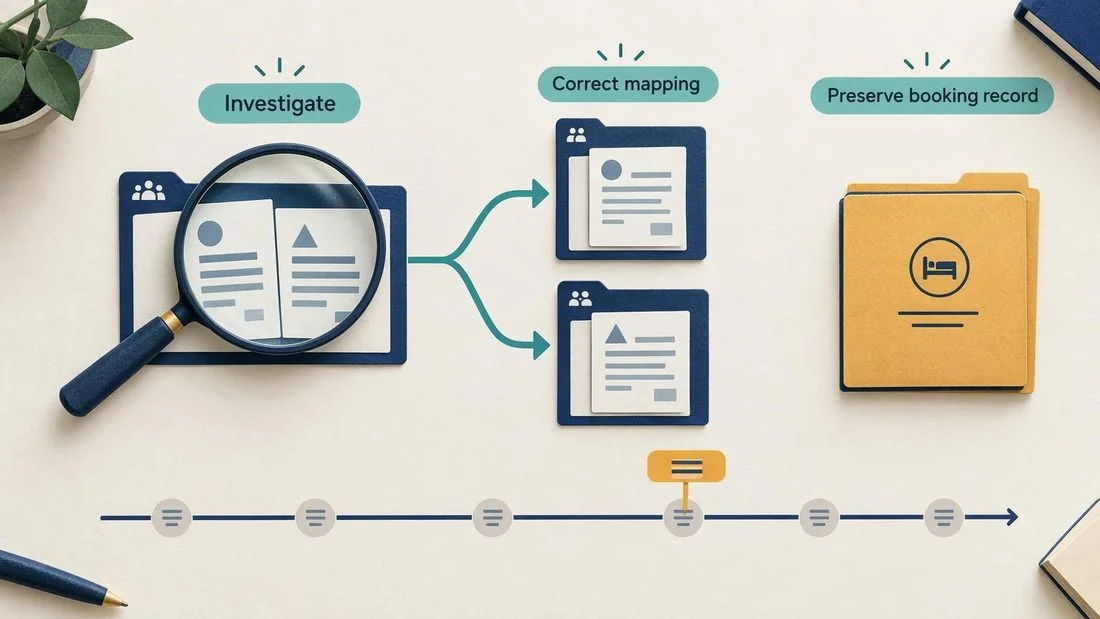
Walk through a reported mismatch with the provider. The investigation should identify the affected supplier records, inspect the input, decide whether to split or remap them, and communicate the correction to your application.
Ask whether your team can submit evidence and track the decision. Clarify who has authority to override a match and whether a manual correction persists through the next automated refresh. Preserve the history so that a later reviewer can distinguish a deliberate override from an unexplained inconsistency.
Separate correcting future search results from handling an existing reservation. Changing a normalized room label does not change the terms or identity of an offer already booked. Keep booking records intact and assign customer-service responsibility separately.
Also test service interruption behavior. If the mapping service is unavailable, decide whether your application uses a previous mapping version, presents supplier records separately, or pauses the affected display. Each choice has a cost: stale information, duplicate-looking results, or reduced availability in your interface.
Finally, establish what records and mapping history you can retain or export when the relationship ends. A buying decision should include the ability to move, not only the ability to launch.
Six checks before committing
- Define what is standardized, matched, and left unchanged.
- Trace matches to supplier records and mapping versions.
- Test unmatched, unknown, and conflicting room records.
- Measure false matches, missed matches, and abstentions.
- Assign refresh detection, delivery, and cache updates.
- Confirm correction authority, override history, and exports.
Which ownership model fits your platform?
Use the six checks to compare operating models, not just vendor presentations. The deciding factor is who has the information and authority to maintain correct groups across the feeds your application actually uses.
An API supplier can be a practical owner if its delivered mapping meets your tests and covers your required feeds. A separate provider deserves consideration when normalization must span feeds outside that API relationship. An internal implementation makes sense only when you are prepared to own validation, updates, and exception work after launch.
None of these models removes your responsibility for how the application presents room attributes and rate conditions. Put that display boundary in writing alongside the matching boundary.
Room-normalization ownership choices
| Model | Choose it when | Main trade-off | Evidence to request |
|---|---|---|---|
| API supplier | Its output passes your tests across the feeds you need | The mapping boundary may follow that supplier's integration scope | Mapped output, provenance, update behavior, and correction ownership |
| Separate mapping provider | You need one normalization layer across independently sourced feeds | You must coordinate feed delivery, mapping updates, and application changes | Feed compatibility, ambiguous-case handling, revision delivery, and export terms |
| Internal implementation | Your team can maintain matching rules and review difficult records | You retain the recurring engineering and operational workload | A validation set, monitored refresh process, exception workflow, and accountable owner |
Work through the dependency, not the booking count
Say you operate a booking platform using an API feed and a separately contracted hotel feed. Both return similarly named rooms, but the second feed frequently omits bed details. Your goal is a common room display without implying that every similarly named offer is equivalent.
If the API supplier's mapping covers both feeds and passes your ambiguous-case tests, keeping normalization there avoids a separate mapping handoff. If its mapping covers only its own data, it cannot resolve your cross-feed display on its own; a separate provider or internal layer becomes relevant.
Choose the separate provider if it can consume both feeds, expose its decisions, and maintain corrections with a manageable handoff. Choose the internal route if your team has the data access and capacity to do that work. Missing bed information remains missing whichever owner you choose, so preserve the uncertainty in the display.
Clarify Xeni's room-data boundary before assigning ownership
For an integration involving Xeni, separate the room-data retrieval discussion from the room-normalization decision. The useful outcome is an agreed boundary between the platform's delivered data and the matching, maintenance, or display work your implementation will own.
Through our Contact Us page, ask which room-data responsibilities would sit with Xeni and which would remain with your team. Bring sample supplier records and the acceptance criteria developed above so the discussion addresses your actual integration.
Do not assign standalone mapping-provider responsibilities to Xeni by assumption. Establish whether the proposed integration includes cross-supplier normalization, what evidence supports any matching output, and where correction authority sits. If a separate mapping layer is needed, define that handoff before committing to the architecture.
Make room-data ownership explicit before you commit
Discuss the handoff for mapping updates and corrections across your feeds.
Explore more from Xeni
Frequently Asked Questions
Buy an accountable mapping process
Choose the ownership model that can explain matches, preserve uncertainty, deliver updates, and correct errors across your feeds. Carry those requirements into the agreement, along with your validation criteria and exit terms. A tidy demonstration is useful; a maintainable decision trail is what your team will need after launch.