
Your traveler selects an itinerary, submits payment, and sees a timeout instead of a confirmation. The purchasing question is what the platform does next: retrieve the original result, continue checking, or send another booking request.
A travel booking platform demo should cover that interrupted path, not only successful checkout. The tests below help you distinguish duplicate prevention from a screen that merely discourages another click. They also separate traveler-facing behavior from the records your staff need to resolve an uncertain booking. Run them in an agreed test environment, with the provider responsible for inducing failures safely.
Trap 1: treating a disabled button as duplicate prevention
Disabling the booking button addresses a visible action. It does not, by itself, demonstrate what happens when the same purchase reaches the booking service again through a refresh, another browser tab, or a network retry.
For buying purposes, focus on the identity of the intended purchase. Does a repeated submission refer to the existing attempt, or does the platform treat it as permission to create another reservation?
Test the repeat outside the original screen
Have the provider delay a booking response, then repeat the same intended purchase through an agreed test path. Include a refreshed session or another tab if those actions are supported. Inspect the underlying booking records, not only the confirmation page.
The acceptance result should be one intended booking with repeated submissions linked to it. If the platform rejects the repeat instead, the traveler should still have a way to find the original attempt and its status.
Find the boundary of the protection
Idempotency means repeating an operation does not create an additional effect. An idempotency key is an identifier used to recognize those repeats, but the label alone tells you little about where protection applies.
Ask which layer retains that identity, how long it remains usable, and what happens if the same identifier arrives with changed trip details. Your acceptance test should also permit a genuinely separate purchase; blocking everything that looks similar would prevent legitimate bookings.
Reject a demonstration that ends at a grayed-out button. You need to see how the receiving service handles the repeated request and whether that protection extends to the proposed booking path.
Trap 2: interpreting a lost response as a failed booking
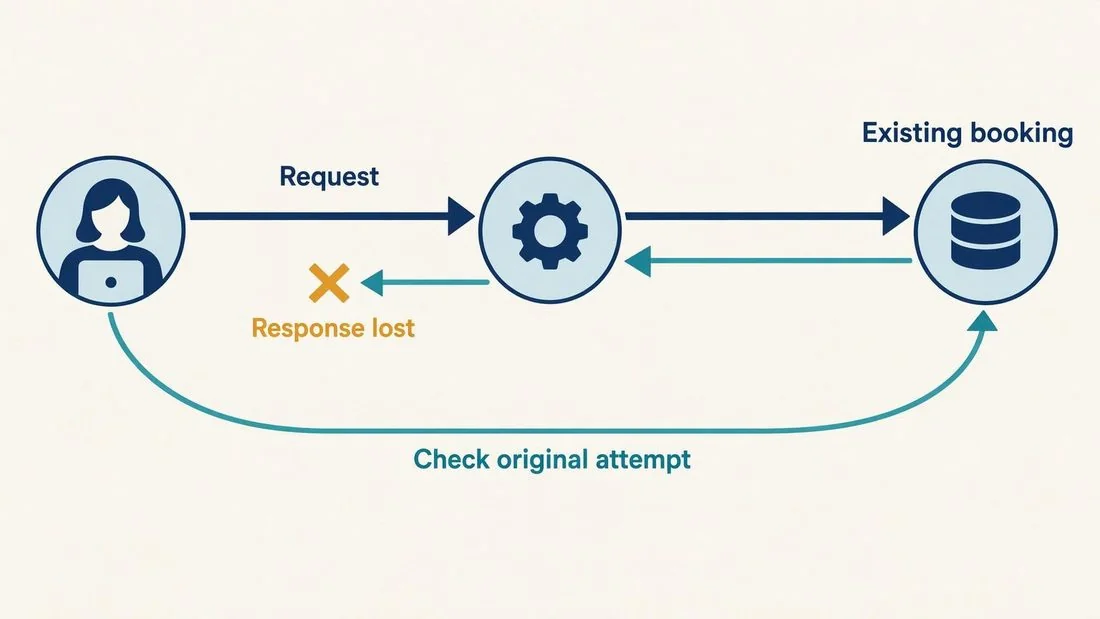
A timeout describes what the caller received, not necessarily what the booking service completed. The important distinction is between a request that never reached the service and a booking that completed but whose response did not reach the caller.
Your evaluation should cover both. Otherwise, a demonstration of retrying a request that never arrived can leave the more difficult lost-confirmation case untested.
Lose the response after the booking completes
Ask the provider to complete a test booking, then suppress or interrupt the response before it reaches the purchasing interface. Return to the checkout and follow the action the traveler is shown.
A passing result retrieves or reconciles the existing booking without creating a replacement. Check that the recovered confirmation belongs to the original itinerary and traveler, and that the records show how it was matched.
Do not accept a newly successful booking as proof of recovery. Inspect whether the earlier attempt also produced a reservation.
Separate safe retries from status checks
A status check asks what happened to an existing attempt. A booking retry requests that an operation be performed again. Those actions should be distinguishable in the demonstration and in the operational record.
Automatic retries are useful only within their documented safety boundaries. Require the provider to explain when the system can repeat the operation, when it must retrieve the original outcome, and when staff must intervene.
If you are comparing architectures, the travel API integration guide provides related context. Keep this purchase test focused on the complete path you plan to deploy, including any application layer your business controls.
Trap 3: collapsing an uncertain order into success or failure
An interrupted purchase needs a status that reflects the evidence available. Showing failure before the outcome is known can encourage another purchase. Showing success without a booking confirmation can give the traveler confidence the system has not earned.
Evaluate what the traveler sees and what your staff can retrieve during that interval. A useful pending state preserves the attempt, explains the next action, and does not silently authorize a fresh booking.
Keep the original attempt visible
In the test, delay the final outcome and leave the checkout page. Reopen the account or booking-management view, if available, and have a staff member search for the attempt through the proposed operational interface.
Require a durable reference that connects the intended purchase to its request history and eventual reservation. A temporary browser message is insufficient if the session disappears before anyone can investigate.
Inspect how the pending record becomes confirmed or failed. The later result should update the original attempt rather than leave contradictory records that staff must interpret without guidance.
Evaluate the waiting experience honestly
Holding a purchase while its outcome is checked adds friction. That is a real downside, especially when a traveler wants to try another itinerary immediately.
Judge whether the interface explains what remains uncertain, how to retrieve an update, and where to get help. Ask the provider to distinguish its checking interval from a promised resolution time; repeated checking does not guarantee that a final answer will arrive by a particular deadline.
The acceptance criterion is not instant confirmation. It is an accurate status and a usable next step without an unapproved second purchase.
Trap 4: checking the reservation but ignoring payment retries
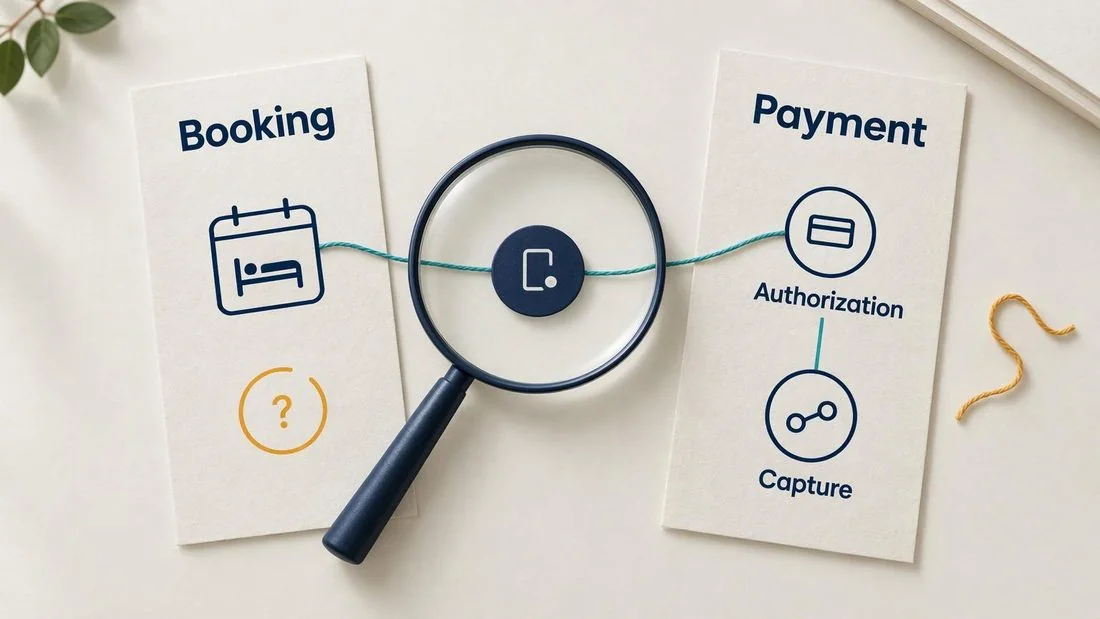
Evaluate booking and payment as separate records that must be reconciled. A reservation count cannot establish whether the payment path handled a repeated submission correctly, just as a payment record cannot establish that the intended travel was booked.
For this test, have the provider interrupt the handoff at an agreed point around payment and booking, then follow the recovery path. Use test payment methods rather than a traveler's live card.
Trace each payment attempt to its purpose
Inspect the payment references associated with the original purchase and any repeat. Ask the provider to distinguish authorization, capture, reversal, and refund in the records shown; a pending authorization and a completed charge are not interchangeable.
Your acceptance result should explain every payment action and connect it to the intended booking. If another payment attempt is necessary, require a documented rule for when it is permitted and how the earlier attempt is handled.
Require a reconciliation outcome, not a reassurance
Have the demonstration cover a payment outcome that is known while the booking outcome is still being checked. Show how staff identify the mismatch and who owns the next action.
A promise that duplicate charges can be refunded is not equivalent to preventing unintended payment actions. Recovery may still be necessary, but the provider should explain the process, applicable responsibilities, and how its progress becomes visible.
Do not assume that canceling a reservation resolves its payment record. Your purchase criteria should require the booking and payment outcomes to agree, or a documented recovery process that explains the remaining difference.
Trap 5: letting manual recovery start the purchase again
Manual recovery should resolve the original attempt before it creates a replacement. Test the moment when a traveler asks for help while the platform is still checking the booking outcome.
The risk to evaluate is overlapping action: a staff member submits again while an automated process continues handling the first request. A helpful support interface must make that overlap visible or prevent it within its documented boundaries.
Run the support handoff during a pending purchase
Leave the test booking pending, then have an authorized staff member open its record. Ask that person to retrieve the outcome, escalate it, or perform the permitted recovery action while the original processing path remains active.
Watch what happens if an automated result arrives during the staff action. The demonstration should leave one coherent history, not competing confirmations or a replacement whose relationship to the original attempt is unclear.
Require role permissions and a record of who did what. Staff should be able to distinguish checking an existing attempt from initiating a new purchase.
Make replacement an explicit decision
Where replacement is permitted, ask what evidence releases the original attempt from further processing. The procedure should identify who authorizes the replacement and what happens if a late confirmation subsequently arrives.
Also evaluate the traveler communication. A staff note that says the issue is handled should correspond to a booking and payment outcome the team can verify.
Manual review can be an acceptable trade-off for exceptional cases. It is less useful when the provider cannot define ownership, show the necessary records, or explain how staff avoid recreating the same purchase.
Five retry tests: proposed acceptance criteria
| Retry trap | Test action | Required outcome |
|---|---|---|
| Repeated submission | Repeat after a delayed response | One booking; repeats linked to it |
| Lost confirmation | Suppress response after booking completes | Recover original, not a replacement |
| Uncertain status | Leave checkout; retrieve pending attempt | Durable reference; accurate next step |
| Payment retry | Interrupt payment-booking handoff | Explain and link every payment action |
| Manual recovery | Act while original processing continues | One coherent history; actions recorded |
Turn the test results into a buying decision
Compare evidence quality rather than the number of reliability labels in a sales presentation. A controlled demonstration, the supporting records, and documented limits answer different parts of the purchasing question.
Use the same intended purchase and failure point across candidates where their test environments allow it. Preserve the results so your operational and technical reviewers can assess the same behavior.
How to weigh retry-handling evidence
| Evidence offered | What it establishes | Buying implication |
|---|---|---|
| Successful checkout demonstration | The ordinary purchase path works in the demonstrated setup | Insufficient evidence for timeout handling |
| Retry demonstration with booking and payment records | The tested failure path has a traceable outcome | Useful evidence within the tested scope |
| Documented behavior without an executable test | The provider defines its intended behavior and limits | Require verification before relying on the claim |
| Demonstrated recovery with named operational ownership | Staff can resolve the tested exception through a defined process | Assess workload and acceptability alongside automation |
Work through the choice
Say you are choosing a checkout for an agency whose staff can handle exceptions during its operating hours. One candidate demonstrates automatic retrieval of a lost confirmation. Another pauses the purchase and routes it to staff with linked booking and payment records.
The automatic path is preferable for that failure only if the demonstration covers the supplier route and payment setup you intend to use. The staff-assisted path may be acceptable if the agency can own the work and the platform prevents another purchase while staff investigate.
If neither candidate can connect the original attempt to the final supplier and payment outcomes, defer acceptance. A polished confirmation screen does not settle the missing evidence.
Record the scope of acceptance
Attach each test result to the configuration demonstrated: booking route, payment path, traveler interface, and staff recovery process. Separate verified behavior from any limits that remain outside the test.
Then decide which gaps block purchase and which can be addressed before launch. An agreed manual process may cover an exception; it should not substitute for evidence that the process can actually retrieve and reconcile the original attempt.
Turn test evidence into acceptance
- Compare fairlyUse the same purchase and failure point.
- Preserve evidenceRetain results for operational and technical review.
- Record scopeRecord route, payment path, interface and recovery process.
- Decide on gapsIdentify purchase blockers and pre-launch fixes.
What to discuss for your proposed Xeni setup
If you are evaluating Xeni, bring these failure tests into the discussion of your proposed setup. For an API-based approach, identify which request and recovery steps your application would own. For a no-code approach, establish which actions the configured interface and staff workflow would expose.
Keep the discussion tied to the booking and payment paths you intend to use. Ask for a demonstration of their timeout behavior, repeat-submission handling, and recovery boundaries rather than treating a general product description as acceptance evidence.
Use Contact Us to discuss timeout and resubmission handling, with the tests you need demonstrated and the operational ownership you expect.
Bring the interrupted purchase into your evaluation
Request a discussion of timeout and resubmission handling for your proposed Xeni setup.
Explore more from Xeni
Frequently Asked Questions
Accept the recovery path, not only the checkout
A purchase-ready platform should demonstrate how an interrupted request becomes a traceable booking and payment outcome. Base acceptance on the tested configuration, retain the evidence, and assign ownership for exceptions before travelers depend on the system.