

A maintenance window outside your office hours may still overlap with customer bookings. A release that leaves search available may still affect checkout or access to existing reservations. Your supplier comparison should account for those differences before you select a travel portal.
The best travel portal for your business is not necessarily the one with the shortest maintenance statement. Look for terms that let operations staff prepare, technical staff assess changes and customers understand what they can do. Keep the review focused on the configuration you intend to use, rather than a general platform description.
What maintenance notice will your team actually need?
Work backward from the preparation required before a maintenance window. If your team must notify customers, adjust a booking campaign or coordinate an integration change, the notice needs to arrive early enough for that work. An advance email has little practical value if it reaches an unattended inbox.
Request terms that identify the notice recipient, delivery channel and information included. A useful notice should state the affected configuration, scheduled start and end, time zone, expected functional impact and any action required from you.
Distinguish an announced schedule from a scheduling commitment. A supplier might notify you about a window without giving you the right to request another time. Decide whether notification alone fits your operation or whether some changes require consultation.
Compare the window with customer activity
Use the hours when customers book and staff service reservations, not just office opening hours. Include deadlines that matter to your operation, such as a customer approval cutoff or a planned booking campaign. Specify the time zone rather than relying on phrases such as overnight maintenance.
If you need protected periods, describe which activities must remain available during them. Keeping reservation lookup accessible may matter more than keeping a reporting screen available. This gives suppliers a concrete requirement to address rather than a broad request to avoid busy times.
Make schedule changes part of the notice terms
Define how you will receive postponement, cancellation and overrun notices. Include a route for urgent exceptions when normal advance notice cannot apply, with an explanation of the affected functions and the next update. A planned window and an emergency intervention should not share an indistinguishable notification process.
Which booking functions must remain usable?
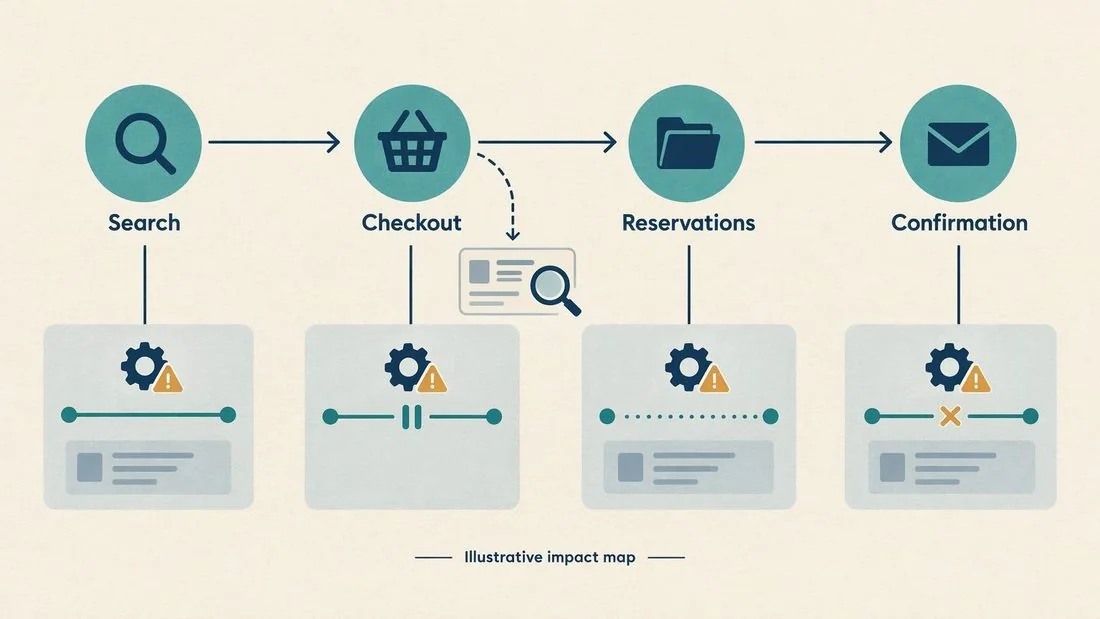
Compare maintenance impact at the point where a customer or agent completes work. Homepage availability does not answer whether someone can submit a booking, retrieve a confirmation or service an existing reservation.
Build the review around the functions your proposed configuration includes. For each relevant function, distinguish normal availability, read-only access, delayed processing and complete unavailability. These states call for different staff actions and customer messages.
- For search and price checking, establish whether displayed results remain actionable during the window.
- For checkout and payment, define what happens to a submission already in progress.
- For existing reservations, establish whether lookup and servicing remain available.
- For confirmations and downstream records, identify whether delivery is immediate, delayed or interrupted.
Do not assume these functions are included in every proposal. The purpose is to map maintenance terms to the workflows you are buying, including any separate services those workflows depend on.
Treat an interrupted submission differently from a failed search
A customer who cannot search needs to know when to return. A customer who submitted a booking but did not receive a clear result needs a way to establish whether it completed before trying again. Require an agreed process for checking booking and payment status, including who performs that check.
Ask the supplier to explain what happens to work in progress when maintenance begins. Your operating procedure should follow that documented behavior. Avoid writing a blanket instruction to retry if the original transaction's status could be uncertain.
Make dependencies visible
Separate the portal's maintenance from maintenance affecting connected booking or payment services. The proposal should explain which notices the supplier passes on, which issues you monitor directly and who investigates a disruption involving more than one component.
How do different maintenance arrangements compare?
Use the following arrangement types to classify proposals, not as assumptions about any particular supplier. Their value depends on how much control your operation needs and who can act on the notices.
A recurring window can be a sensible choice when affected work can wait. Coordinated scheduling is more suitable when a release depends on your own preparation, but it creates work for your team as well as the supplier. Do not require approval for every routine action if nobody in your organization can reliably provide it.
A proposal may combine these approaches. Evaluate routine maintenance, customer-impacting releases and emergency work separately, then decide whether each arrangement fits the activity it governs.
Maintenance arrangements evaluated against operating needs
| Arrangement | Potential fit | Main trade-off | Term to establish |
|---|---|---|---|
| Recurring published window | A team that can plan around a consistent schedule | A fixed window may still overlap with customer activity | Time zone, affected functions and exception handling |
| Event-specific advance notice | A team that can adapt when each event is announced | Preparation depends on notice reaching the right people | Notice period, recipients and change notifications |
| Coordinated change window | An operation needing preparation or approval before specified changes | Coordination requires staff availability and clear decision rights | Which changes need agreement and how approval works |
Separate maintenance notices from release communication
A window tells you when work happens. Release communication tells you what changes and whether your team must act. Require both where relevant; a schedule alone cannot tell an agent whether a booking workflow will behave differently afterward.
For user-facing changes, request a description of affected screens, changed steps and any preparation needed for staff. Separate optional improvements from changes that alter an existing workflow. Your operations lead should be able to identify whether training or customer instructions need updating.
For integration-related changes, technical reviewers need enough detail to assess compatibility before implementation. That review belongs alongside your travel API integration planning, rather than being left to whoever receives a general maintenance email.
Set different review paths for different changes
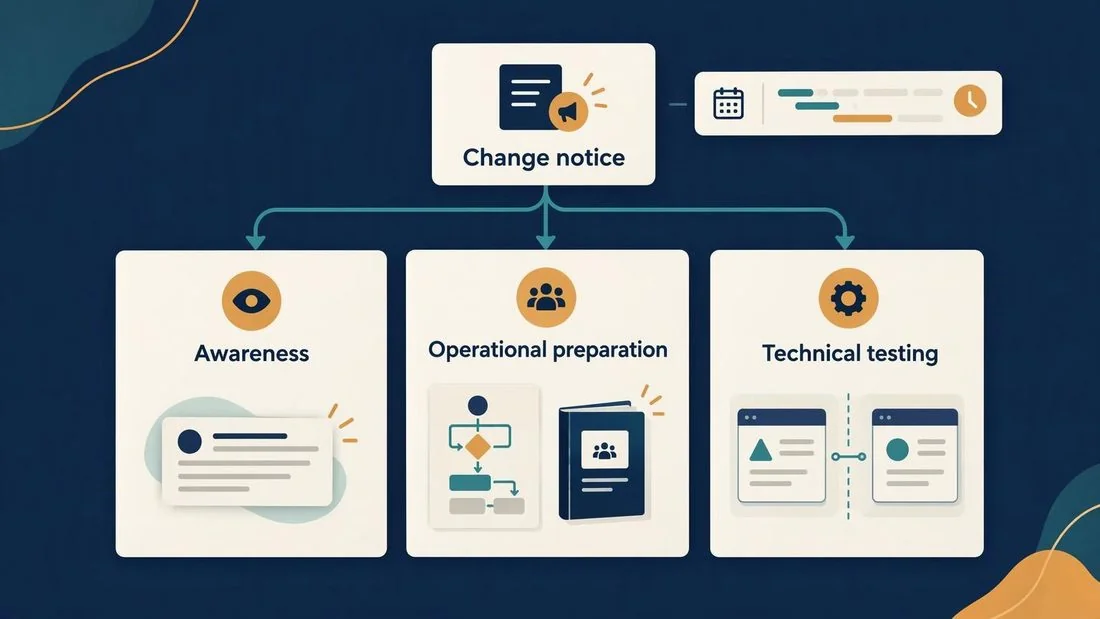
Define which changes require awareness only, operational preparation or technical testing. Keep the decision tied to impact: a wording adjustment and a change to a booking submission are different review tasks.
Where your business needs pre-release testing, establish whether a suitable test environment is part of the proposal, how changes are announced there and who signs off your own readiness. Do not assume a preview, approval right or rollback option exists without an applicable commitment.
Agree on the response to a problematic release
The release terms should identify who decides whether to restore the previous behavior, correct the change or provide a temporary operating procedure. Your team also needs a route to report the specific workflow failure. Describe the evidence staff should collect without sending unnecessary customer or payment data.
Who owns customer messages during maintenance?
Assign the supplier responsibility for technical status information and assign your business an owner for customer-facing instructions. If the proposal includes supplier-operated customer notices, define that scope explicitly. Otherwise, do not treat a technical maintenance email as a message your customers will automatically receive.
Agree on who drafts, approves, publishes and removes each message. Include the channels your customers actually use and a backup owner if the primary person is unavailable. Message ownership matters most when a window changes or a booking result is unclear.
Keep customer copy functional. Explain which actions are unavailable, whether existing reservations can be accessed and how customers should seek help. Do not publish an alternative booking route unless it exists and is appropriate for the affected transaction.
Prepare distinct messages for distinct outcomes
A planned interruption notice should explain the expected impact and scheduled return. An overrun notice should acknowledge the delay and provide the next update point. A booking-status message should direct the customer to establish the result before submitting again.
For an advance notice, wording could follow this pattern: "New booking submissions will be unavailable during the announced maintenance window. Existing reservation access will remain available only if confirmed in the notice. Contact the designated support channel if you need help with a booking already submitted." Replace the conditional details with the actual arrangement before publishing.
Restoration deserves its own message. Name who confirms that affected workflows are usable and who removes temporary notices, so customers are not left following an outdated instruction.
Work through a supplier choice using your actual workflow
Say you run a travel business whose customers submit bookings after staff have finished for the day. Your team also reviews reservations the next morning. You are comparing a proposal with a recurring maintenance window against one with event-specific notices.
If the recurring window leaves existing reservation lookup available and clearly explains the handling of interrupted submissions, it may fit your operation. Your team can prepare the appropriate customer message and check affected work afterward. The recurring schedule's value comes from its fit with those activities, not merely its predictability.
If that same window blocks reservation review during your morning work, the fit changes. An event-specific arrangement may be preferable if its notices give your team enough time to reorganize that work. But it is weaker if the supplier identifies only the schedule and leaves booking impact unspecified.
Now add an API-connected checkout that your technical team must test before certain changes. A maintenance notice alone no longer meets the requirement. You need a release communication path and an agreed review process for changes affecting that connection.
The choice follows the dependency: customer access, staff servicing or technical readiness. Booking volume alone does not determine the maintenance arrangement you need.
Apply the comparison to your proposed Xeni configuration
When evaluating Xeni, connect the maintenance discussion to the proposed platform configuration. For a no-code configuration, focus on user-facing workflows and operational preparation. For an API-connected configuration, include the boundary between supplier changes and your own integration work.
Those are different purchasing questions, not reasons to assume a separate managed-maintenance service. Establish which components are included in the proposal and which responsibilities remain with your business or another provider.
Bring a short description of your active booking hours, essential servicing functions and release approval process. Request the applicable notice arrangements, function-level impact descriptions, release communication process and customer messaging responsibilities together, so you can judge the operating fit.
Use Xeni's Contact Us page to request the maintenance arrangements applicable to the configuration under consideration. Evaluate the written response against your workflows rather than treating a general product discussion as a maintenance commitment.
Terms to confirm before choosing
- Notice timing, recipients and delivery channel
- Window time zone and fit with active booking hours
- Impact on essential booking and servicing functions
- Handling of interrupted bookings and payment status
- Release communication, testing and approval requirements
- Customer message owners and restoration responsibilities
Make maintenance part of the configuration discussion
Request the applicable maintenance notices, release communication and responsibility arrangements before selecting your platform.
Explore more from Xeni
Frequently Asked Questions
Select terms your team can operate
Before signing, compare each proposal against a real booking workflow and a change your team would need to prepare for. Record the arrangement you are accepting, the responsibilities your team will carry and any remaining issue that requires a written answer.