
A flight booking engine should make the result of a purchase understandable, not merely produce a reassuring message. Your buyer decision is whether the proposed solution can show what has happened, deliver the appropriate documents, and leave your team able to investigate a missing confirmation.
This matters whether you are evaluating a hosted booking experience or an integration your team will operate. Keep the evaluation focused on the handoff after booking: what the traveler receives, what your staff can verify, and what happens when those views disagree. Search quality and fare comparison belong in a different evaluation.
What should count as confirmation?
Start with the evidence behind the word confirmed. A proposal should explain whether that label means the request was received, a reservation can be located, or ticket issuance has been verified. Those meanings should not be interchangeable in your acceptance criteria.
An attractive itinerary is useful to a traveler, but its layout does not establish the booking's status. Require the provider to identify the underlying record that supports each customer-facing status and explain how your staff can inspect it.
Use these distinctions when reviewing sample messages and documents. The goal is to understand what each artifact establishes, rather than impose one identifier format on every proposed flight workflow.
Separate the evidence carried by each confirmation artifact
| Artifact | What it helps establish | What to verify separately |
|---|---|---|
| Booking acknowledgment | The platform received or recorded a request | Whether the reservation and ticketing steps are complete |
| Airline locator or reservation reference | Which reservation record to look up | Whether the required issuance evidence exists |
| Issued-ticket evidence | The proposed workflow's evidence of ticket issuance | Which passenger and itinerary it covers, and its current status |
| Payment receipt | The payment information recorded for the transaction | Reservation status, ticket status, and document access |
Require labels that match the evidence
Ask for a plain-language definition of every status visible to travelers and staff. If a message says ticketed, the demonstration should show the issuance evidence behind that statement, not just the checkout success screen.
Also define what the traveler sees while a step remains pending. A booking acknowledgment can still be helpful if it accurately describes the next step and gives a route to assistance.
Which details must the delivered document connect?
Evaluate the connection between the document and the booking, not just whether a PDF exists. Your team should be able to identify the traveler, the relevant itinerary, and the record used to verify issuance without reconstructing the purchase from separate inboxes.
For your required document set, define the passenger name, flight details, reservation reference, and ticket identifier or equivalent issuance evidence. Have the provider explain any workflow that uses a different artifact, including how staff verify its meaning.
Payment details deserve their own treatment. Decide whether a financial receipt belongs in the traveler document, in a separate message, or only in an authorized account view. A document can be complete for travel purposes without satisfying your accounting requirements.
Check every passenger, not just the booking header
A group-level success label should not be your only evidence that all requested documents are available. Require a clear mapping from each passenger to the issuance evidence and itinerary coverage relevant to that passenger.
In the demonstration, inspect the documents rather than stopping at a summary screen. If an artifact is missing, your team should be able to name the affected passenger and determine which part of the requested delivery is incomplete.
Make references understandable
Require labels that distinguish the platform's order reference from the reservation reference used for airline lookup. If the proposed itinerary has additional references, the document should explain which one the traveler or support agent should use for a particular action.
A field called reference is too vague for your acceptance test. Clear labeling helps prevent staff from searching with the wrong identifier when a traveler needs help.
Which delivery model fits your operating team?
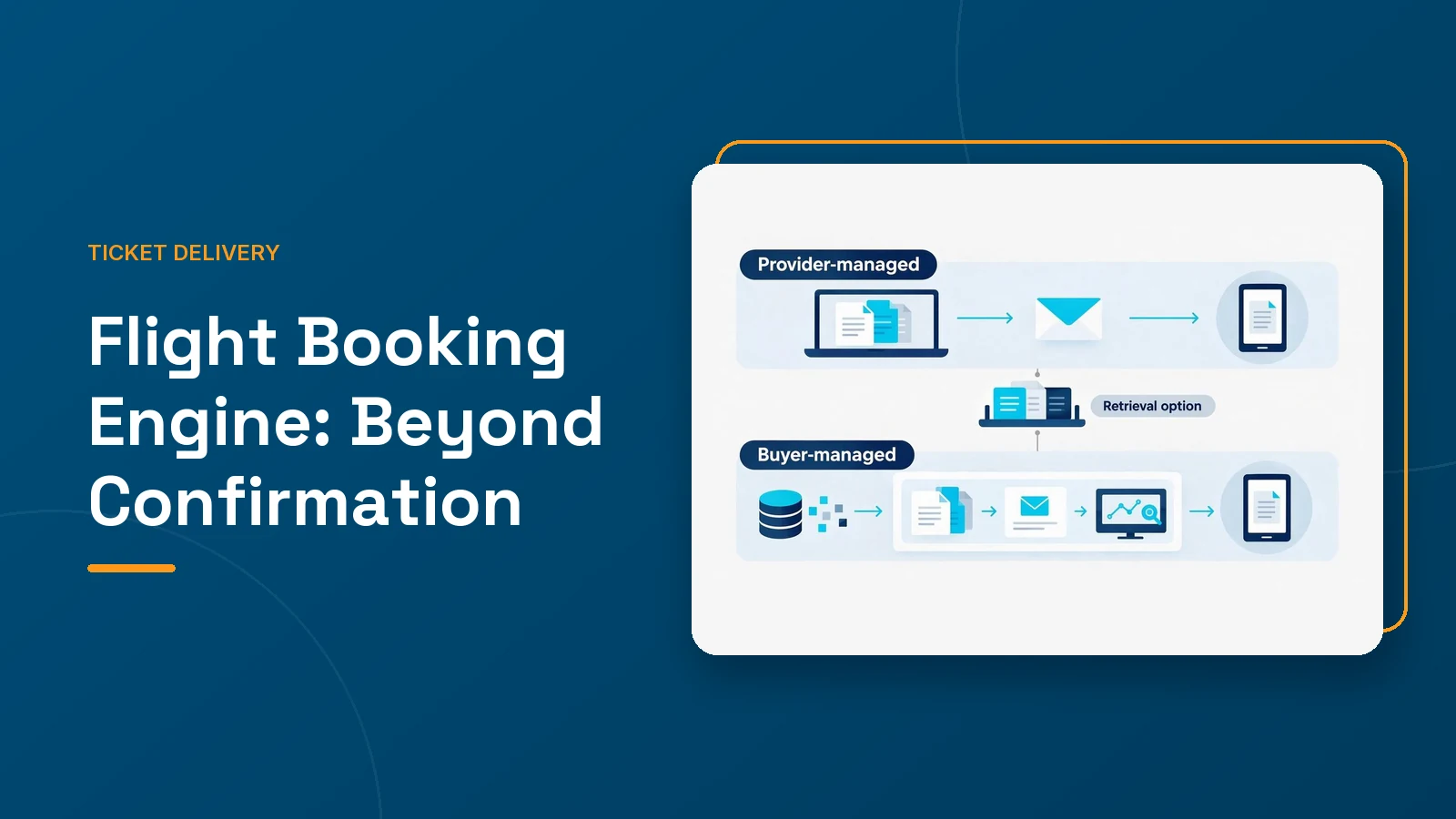
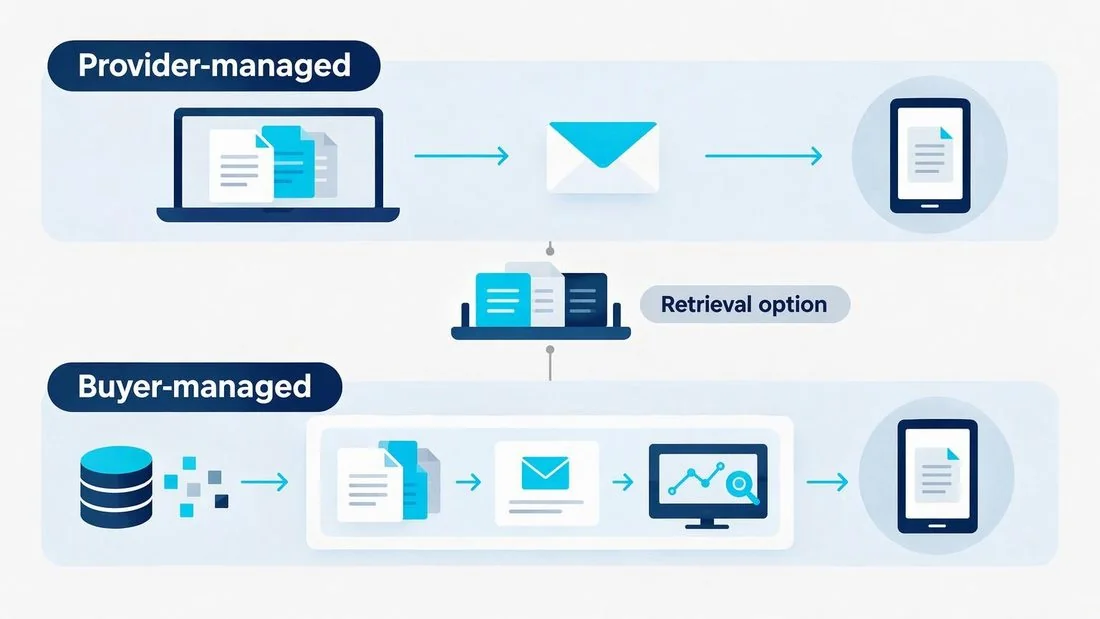
The best flight booking engine for your document requirements is the one whose delivery responsibilities fit your operating model. Compare how the proposed solution puts information in the traveler's hands, where the current document remains available, and who owns a failed handoff.
These are models to evaluate, not assumed capabilities of any particular provider. Require a demonstration of the channels included in the actual proposal.
Provider-managed delivery is worth considering if your team does not intend to operate a messaging service. Buyer-managed delivery may fit a product with established communication infrastructure, but you must account for monitoring and exception handling as well as message design.
A retrieval view can complement either approach. Its value depends on whether an authorized traveler or staff member can find the current document when the original message is unavailable.
Compare delivery models by ownership and recovery
| Proposed model | Useful when | Buyer responsibility | Trade-off to examine |
|---|---|---|---|
| Provider-managed email | You want the provider to assemble and send traveler documents | Approve message content, recipients, and escalation ownership | Determine how much delivery visibility and branding control you receive |
| Account or portal retrieval | Travelers or staff need a persistent place to access documents | Define access permissions and explain the retrieval route | An available document still needs a clear notification path |
| Buyer-managed delivery using integration data | Your product needs its own messages and document experience | Operate data mapping, message generation, delivery, and recovery | More presentation control comes with more operational responsibility |
How should missing or delayed documents be handled?
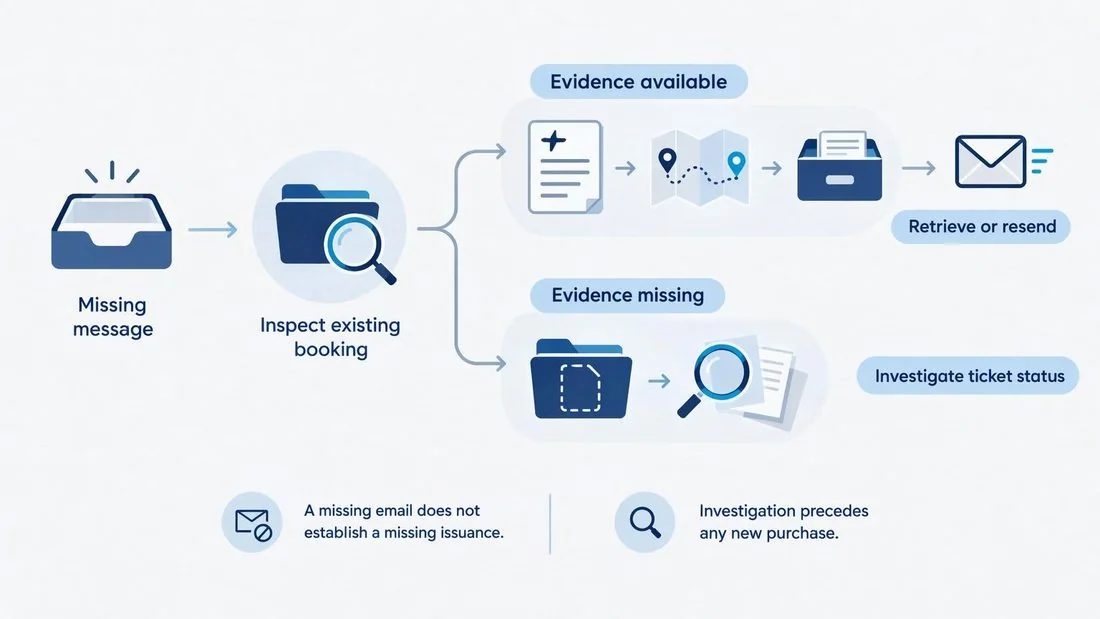
Separate a document-delivery problem from a ticket-status problem before choosing a remedy. A missing email leaves several possibilities open: the document may be available elsewhere, delivery may have failed, or the required issuance evidence may still be absent.
Your proposed workflow should make those possibilities distinguishable. Require separate visibility into the booking's status, the document's availability, and the delivery attempt.
Use retrieval before repeating the transaction
When a message is missing, the first operational step should be to retrieve and inspect the existing booking. Do not make another purchase the default response to an empty inbox.
If issuance evidence is available and matches the intended itinerary, the next action concerns document access or delivery. If that evidence is missing, the case needs ticket-status investigation rather than a resend button that sends another acknowledgment.
Set a clear handoff for investigation
Define who investigates, what identifiers accompany the case, and which status update the traveler receives while the investigation continues. Include departure information so the responsible team can assess urgency.
Do not accept a vague promise of instant delivery as a substitute for an exception process. Get the proposed timing commitments and escalation arrangements in writing, including any distinctions between an initial response and resolution.
Keep an inspectable delivery history
Require enough history to distinguish document creation, attempted sending, a delivery failure, and a later resend. Ask what any delivered label actually measures and avoid presenting it to travelers as proof that they read the message.
The history should support a practical next action. Staff need to know whether to correct a recipient address, retrieve an existing document, or investigate the underlying booking.
How do you prevent outdated documents from causing confusion?
Make current-document identification part of the purchase decision. If a booking is changed through a supported servicing workflow, your team needs a way to distinguish the current traveler document from an earlier copy.
Require the proposal to explain how revised documents are identified, where staff retrieve them, and whether the traveler receives a new notification. Evaluate only the servicing actions included in the proposed solution; a delivery feature does not establish change or cancellation capability.
Keep an accessible history for investigation without giving every historical copy equal prominence. The traveler-facing view should make the current information easy to identify, while authorized staff can inspect prior records when needed.
Also decide how cancellation information is communicated. Your message design should not imply that a cancellation request, a completed cancellation, and a financial outcome are the same event. Require labels and documents that accurately reflect the supported process.
What does a useful delivery demonstration look like?
Say you are choosing a booking solution for a travel business whose staff help travelers after purchase. Your team can answer booking questions, but it does not operate its own email infrastructure or document-generation service.
A buyer-managed integration would give you more control over presentation, yet it would also assign those operating duties to your team. Provider-managed delivery with staff retrieval is the better fit if the demonstration proves both functions and the written scope assigns recovery responsibility clearly.
Now change the situation: your product already has an account inbox, notification monitoring, and staff responsible for failed messages. Buyer-managed delivery may fit better, provided the integration supplies the evidence and document access your product needs. The choice follows operational ownership, not the number of reservations.
Use a controlled test booking to trace the complete handoff. Observe the acknowledgment, locate the reservation evidence, inspect the issuance artifact, and retrieve the traveler document through the proposed access route.
Then test an exception: make the original notification unavailable and require staff to recover the document without initiating a new booking. Also inspect how an incomplete passenger document set is presented and how a supported update affects the current copy.
Record what passes, what requires your own development, and what remains outside scope. A polished success path is useful, but the recovery demonstration tells you whether your team can operate the solution.
Ticket-delivery acceptance checks
- Trace acknowledgment and reservation evidence
- Inspect issuance evidence for each passenger
- Retrieve documents through the proposed access route
- Recover a missing notification without a new booking
- Inspect how missing passenger documents are shown
- Verify the current copy after a supported update
- Record what passes, what needs your own development, and what is out of scope
Where does Xeni fit in this evaluation?
If you are evaluating Xeni, use our flight-ticketing guidance as a starting point for discussing the proposed process. Keep the delivery review separate: your decision also depends on the confirmation artifacts, traveler documents, and retrieval options included in your solution.
Bring a redacted example of the document your travelers need, along with the distinction between traveler-facing and staff-only information. That gives the discussion a concrete output to evaluate rather than a broad request for booking functionality.
Use our Contact Us page to request clarification of supported flight-booking scope and the confirmation artifacts available in the proposed solution. Include your preferred delivery model so the response can address who would assemble, send, retrieve, and maintain the documents.
Match the proposed solution to the evidence your travelers need
Request clarification of flight-booking scope, confirmation artifacts, and document-delivery responsibilities.
Explore more from Xeni
Frequently Asked Questions
Accept the handoff, not just the success screen
Make your final acceptance depend on a demonstrated document set, accurate status labels, and a working recovery path. Put delivery ownership and supported outputs into the written scope before treating the proposed workflow as ready for your travelers.