
The flight API buying decision has two layers: who supplies the connection, and how each request reaches the supply you need. A simple interface can conceal a complicated sourcing arrangement, while several direct connections can still depend on shared upstream systems.
Your choice should follow the gap you need to solve. That might be an offer unavailable through your current connection, a contractual sourcing requirement, or a defined search-continuity goal. Compare architectures against that need, then establish who owns routing decisions, offer comparison, and recovery when a request does not finish as expected.
What are you routing: flight data or purchasable offers?
For this decision, routing means choosing which provider receives a flight shopping or transaction request. It does not mean calculating an aircraft's flight path, displaying schedules, or tracking a flight's position.
Start with the action your product must complete. Displaying flight information and selling a ticket have different requirements. A route or schedule response alone does not establish that your application can price an offer, create a reservation, issue a ticket, or service the resulting booking.
Define the boundary in your purchase specification: what enters the connection, what comes back, and which subsequent actions the proposed integration must support. This keeps an attractive search demonstration from standing in for an entire selling workflow.
Also separate your application-facing provider from its upstream suppliers. An endpoint count describes your integration surface, not necessarily the number of underlying supply channels. The architecture discussion should identify both, without assuming that either arrangement is better.
Which connection model matches your sourcing need?
The useful comparison is between responsibility models. You can send requests through one provider, manage several connections yourself, or evaluate an intermediary that manages multiple connections under an agreed scope.
These are architectural choices, not promises about any named supplier. In particular, an intermediary should not be assumed to aggregate offers, choose providers, or recover failed requests unless those functions are part of the proposal.
Connection models and the responsibilities to establish
| Model | When it fits | Responsibility to establish | Main trade-off |
|---|---|---|---|
| Single-provider connection | The demonstrated workflow meets your sourcing needs | Who handles upstream selection and exceptions | Fewer integration boundaries, with reliance on that connection |
| Buyer-managed multiple connections | An additional provider solves a defined sourcing or control requirement | Your ownership of selection, normalization, monitoring, and recovery | More control, with more integration and operating work |
| Intermediary-managed multiple connections | You need broader sourcing without managing every adapter directly | Which routing functions the intermediary actually owns | Delegated work, with dependence on its controls and visibility |
Choose added complexity only for a demonstrated benefit
A second connection has a clear purpose when it gives your product something the first cannot provide under the relevant commercial arrangement. Define that benefit as a usable outcome, such as access to a required offer or an alternative search path during a specified failure.
If another connection mostly returns equivalent offers, its value depends on differences in terms, reliability, or control. Provider count alone is not a purchasing justification.
How should requests select a provider?
Once multiple connections have a purpose, choose when they receive traffic. Sending every request everywhere, selecting a provider before search, and using a backup after a defined failure solve different problems.
A parallel search design sends the same shopping request to selected providers. It can compare their responses within that search, but needs a deadline and a policy for late results. It also needs a clear distinction between a complete search and a response built from only some providers.
Selective routing chooses a connection using agreed rules before sending the request. Those rules should follow documented eligibility or sourcing requirements, rather than assumptions about which provider is always cheaper or better.
Primary-and-backup routing uses an alternative after a specified trigger. Define that trigger precisely: a transport error, a timeout, and a successful response with no offers are different outcomes. An empty result should activate another search only if that is an intentional product rule.
Keep the selection decision observable. Record the rule applied, the connection chosen, and whether the search was complete. Otherwise, a buyer cannot tell whether a missing offer reflects supply, routing, or a failed request.
How should you handle overlapping offers?
Matching flights are not enough to establish matching offers. Before combining results, define what your product treats as equivalent and what differences the traveler must see.
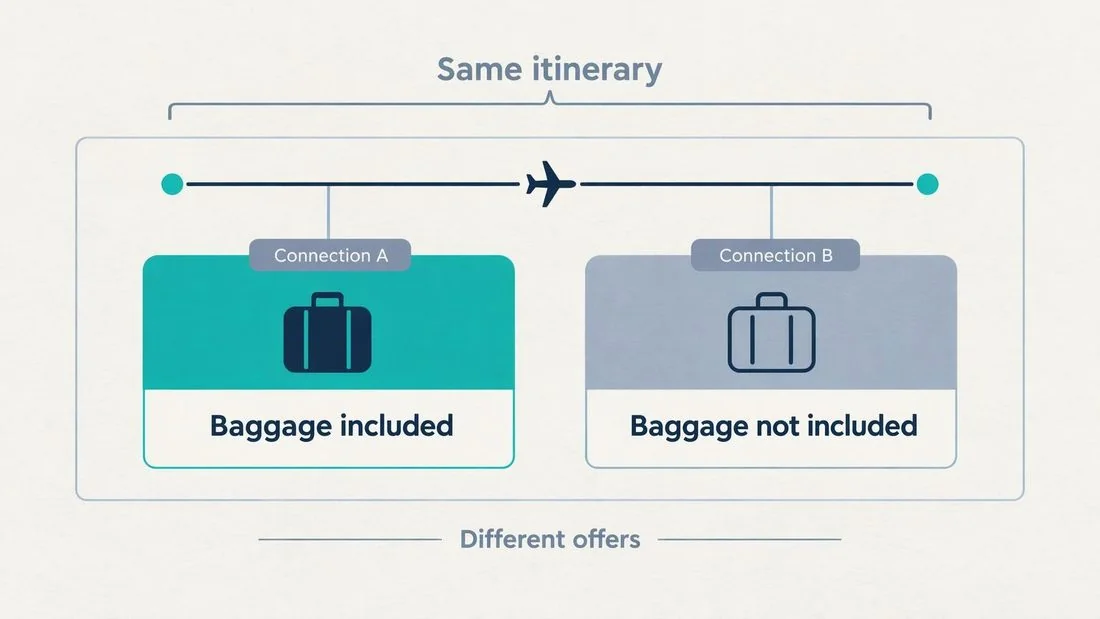
Say you receive offers for the same itinerary through different providers. One includes checked baggage, while another does not. Collapsing them into a single result based only on flight segments would remove information that affects the purchase.
Separate itinerary grouping from offer equivalence
Group results by itinerary for presentation, then compare the purchase attributes available in the responses. Relevant fields can include cabin, fare conditions, baggage, passenger eligibility, currency, and the total payable amount.
Missing information is not proof of equivalence. If a response omits a condition needed for comparison, preserve the difference until your workflow can resolve it. A tidy display should not hide uncertainty about what the traveler is buying.
Preserve the selected offer's provider identity
Retain the original provider and offer reference alongside your normalized display fields. Treat the selected offer as belonging to that connection unless the documented workflow explicitly supports another arrangement.
If the offer becomes unavailable, an alternative result is a new purchase choice. Recheck its terms and amount rather than silently substituting a visually similar itinerary. Your routing architecture should preserve that distinction through checkout.
What is safe to fail over, and what needs recovery?
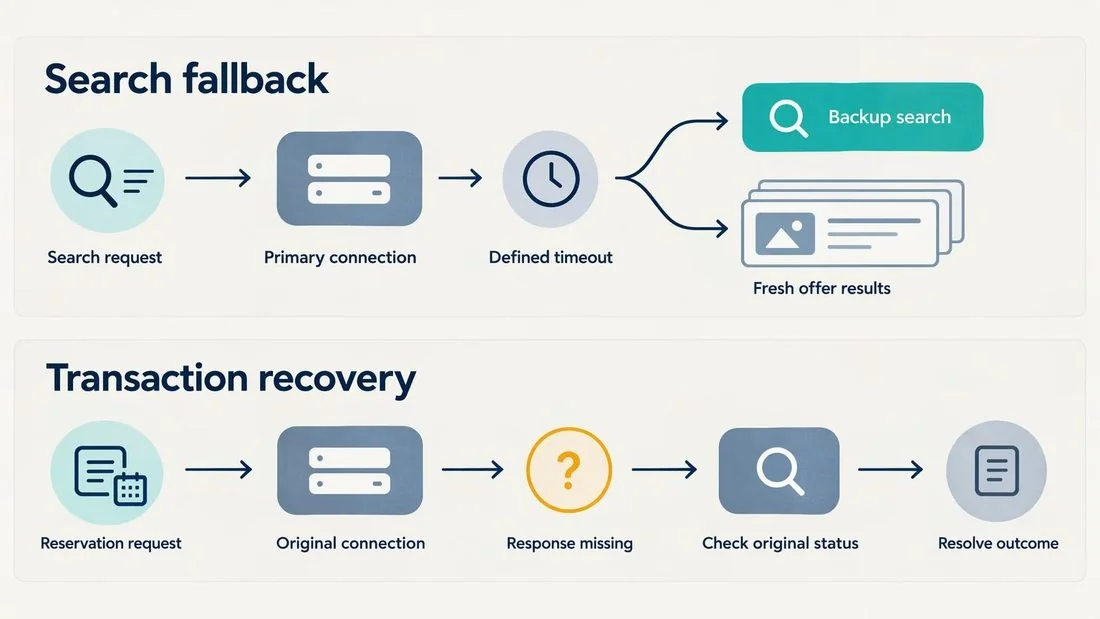
Search fallback and transaction recovery need separate rules. A replacement search can produce fresh offers; a timed-out reservation or ticketing request may have changed state even though your application did not receive confirmation.
For search, specify the deadline, the failure trigger, and whether partial results are acceptable. If you present partial results, do not describe them as a completed comparison across all intended providers.
For a state-changing request, first establish what happened. A timeout means the response did not arrive within your waiting period. It does not establish that the provider rejected the request or created nothing.
Do not treat a backup provider as a transaction retry
Automatically sending the purchase to another provider before resolving the first attempt can create duplicate commitments. The safer design is to use the original provider's documented status, retrieval, and retry mechanisms before starting a separate purchase.
Specify who investigates an uncertain outcome and how the customer is informed while it is checked. Evaluate reservation creation, ticket issuance, payment, and cancellation separately wherever your proposed workflow includes them.
Examine shared dependencies
A backup connection supports a resilience goal only to the extent that it avoids the dependency responsible for the failure. Different application endpoints may still share an upstream supplier, credential arrangement, or transaction service.
Define the failure you want to withstand before buying redundancy. Continuing search during an adapter outage is a different objective from completing ticketing when an underlying service is unavailable.
Separate search fallback from booking recovery
- Define search deadlines, triggers, and partial-result rules
- Do not label partial results as a complete comparison
- A transaction timeout does not prove nothing was created
- Use original-provider status and retry mechanisms first
- Assign uncertain-outcome investigation and customer updates
- Check whether the backup shares the failed dependency
How does routing change flight API cost?
Compare flight API cost using the same expected customer workflow for each proposal. A headline access fee cannot tell you the total purchasing impact if the architectures perform different amounts of work.
Describe the traffic generated by an ordinary journey: initial shopping, revised searches, offer checks, and any transaction or servicing actions in scope. Then have each supplier map that workload to its actual charging terms.
A parallel-routing design sends requests to several connections where a single-provider design sends them to one. Whether that changes your bill depends on the contracts. Establish the treatment of retries, unsuccessful requests, backup searches, and upstream charges rather than assuming they are included.
Include the work you will own: adapting response formats, maintaining comparison rules, investigating failures, and testing changes. An intermediary may take on some of that work, but the proposal needs to identify which responsibilities transfer.
The deciding measure is useful value for the added expense. Compare unique purchasable offers, completed workflows, and operational effort. A larger raw result set can include duplicates or results your checkout cannot use.
A worked decision: does another connection solve the gap?
Say you are building a flight-selling product. Your preferred provider demonstrates the required shopping and transaction workflow, but your product also needs an offer type that has not been demonstrated through that connection.
First, distinguish a supply gap from an integration gap. If the offer exists under your agreement but your request or response mapping excludes it, another connection may add work without solving the underlying problem. Correcting the existing integration is the more direct choice.
If an additional provider demonstrates the required offer and a usable purchase workflow, selective routing becomes worth evaluating. You could use that connection for the relevant searches instead of sending every search to every provider, subject to the documented eligibility rules.
Parallel search would make more sense if your product needs to compare overlapping eligible offers on each search. That choice adds comparison and response-deadline work, so the benefit must be more specific than wanting extra results.
If your concern is service continuity instead, evaluate a backup against a named failure. A connection that depends on the same unavailable transaction service would not solve that problem, even if it can return alternative search results.
The choice follows the actual dependency. Keep the single connection when it meets the need; add another when it demonstrably fills the gap and you can own or delegate the resulting work.
How does Xeni fit the architecture evaluation?
Review our Travel API Integration page as a starting point for your connection-model discussion. If you are considering an API or no-code approach, establish how the proposed model would address your sourcing requirements and which routing responsibilities you would retain.
Bring the sourcing decision into that discussion before committing to an integration. The useful outcome is a proposal that connects your required workflow to named responsibilities, rather than a general statement about ease of connection.
For a single-provider proposal, establish how your required offers reach the application and who handles exceptions. For a multiple-provider proposal, establish who selects connections, compares overlapping offers, and resolves uncertain transaction outcomes.
Do not assume that the proposed integration includes automatic aggregation, fallback, or no-code routing controls. Evaluate those capabilities if they matter to your product, with a demonstration tied to your intended workflow.
Once you have identified the sourcing gap and preferred responsibility model, contact us to discuss the proposed connection architecture. Ask how the model would address your sourcing requirements, including the workflow you need to support and the routing work you expect to retain or delegate.
Have a sourcing requirement that changes the connection decision?
Discuss how the proposed integration model would address it and where routing responsibility would sit.
Explore more from Xeni
Frequently Asked Questions
Choose the model that solves the sourcing requirement
Commit to an architecture when you can explain what each connection contributes, how selected offers retain their identity, and who resolves failures. If an additional provider cannot demonstrate a useful difference, keep it out of the launch design. If it can, assign the routing and recovery work before signing the integration proposal.