

Flight API cost is not fully described by a charge per request or ticket. If a proposal includes a spending floor, your bill may stay above actual usage during a slow launch or a weak booking month.
The decision depends on how that floor works: what spending counts toward it, when it starts, whether unused value survives, and what happens at settlement. Keep airfare funding separate from API service fees, then compare proposals against the same booking forecast. A commitment that fits steady demand may be a poor fit while customer adoption is still uncertain.
What obligation does the proposal actually create?
Read the payment clause before comparing unit rates. A minimum-spend provision creates a required level of spending over a defined period, but the wording determines whether usage satisfies that obligation or gets charged separately.
A subscription is a charge for access or an included service package. A prepaid balance is money paid before use. Neither label, by itself, establishes whether you must spend a minimum amount or whether unused money is refundable.
Use the distinctions below to classify the proposal. These are possible structures to identify in a contract, not terms to assume any provider uses.
Possible pricing structures and their low-usage effects
| Structure | How payment works if specified | What matters during low usage |
|---|---|---|
| Usage-only pricing | Pay for defined billable activity without a spending floor | Whether separate fixed charges still apply |
| Inclusive minimum spend | Eligible usage satisfies the floor; a shortfall may be payable | Which charges qualify and when the floor resets |
| Subscription plus usage | An access charge and usage charges are payable separately | Included allowances and possible double counting |
| Prepaid service credits | Pay upfront and draw down an eligible balance | Expiry, rollover, refunds, and replenishment rules |
| Conditional volume discount | A rate benefit depends on meeting a stated threshold | Whether missing the threshold changes rates, triggers a charge, or both |
Keep ticket funding outside the service-fee comparison
If a proposal requires funds for ticket purchases, track that money separately from API fees. A balance used to pay airfare has a different purpose from a commitment to buy integration services.
Only count ticket value toward a service minimum when the agreement explicitly allows it. Otherwise, a large ticket-funding balance could make usage look sufficient while eligible service spending remains below the floor.
Define the activity that counts toward the minimum
A booking forecast cannot test a commitment until you know the billing unit. Search requests, confirmed reservations, issued tickets, and post-booking actions are different events; a proposal may attach charges to some and not others.
Map the commercial definition to the integration's actual workflow. If the proposal charges for requests, count the requests the contract treats as billable, rather than treating each customer search as a single charge.
If the charge is tied to ticket issuance, use expected issued tickets as the starting point. Search traffic may help predict sales, but it does not satisfy a ticket-based commitment unless the agreement says it does.
Separate billable usage from eligible spend
An action can be billable without its fee counting toward the minimum. Put each charge into an eligible or excluded category, including setup, support, search, ticketing, and any servicing fees that appear in the proposal.
Also define the treatment of failed requests, retries, test activity, and cancellations. Do not presume that an unsuccessful action is free, or that a cancellation reverses the original API charge.
Use a metric your team can reconcile
Choose a forecast metric that finance and engineering can trace to the same records. For example, a ticket-based charge needs a shared definition of issuance, including how later voids or refunds affect the count.
Match billing timestamps to the commitment period. Activity near a reset date can land in a different period from the customer payment, so revenue reports alone may not explain the API invoice.
How do you calculate the bill when usage falls short?
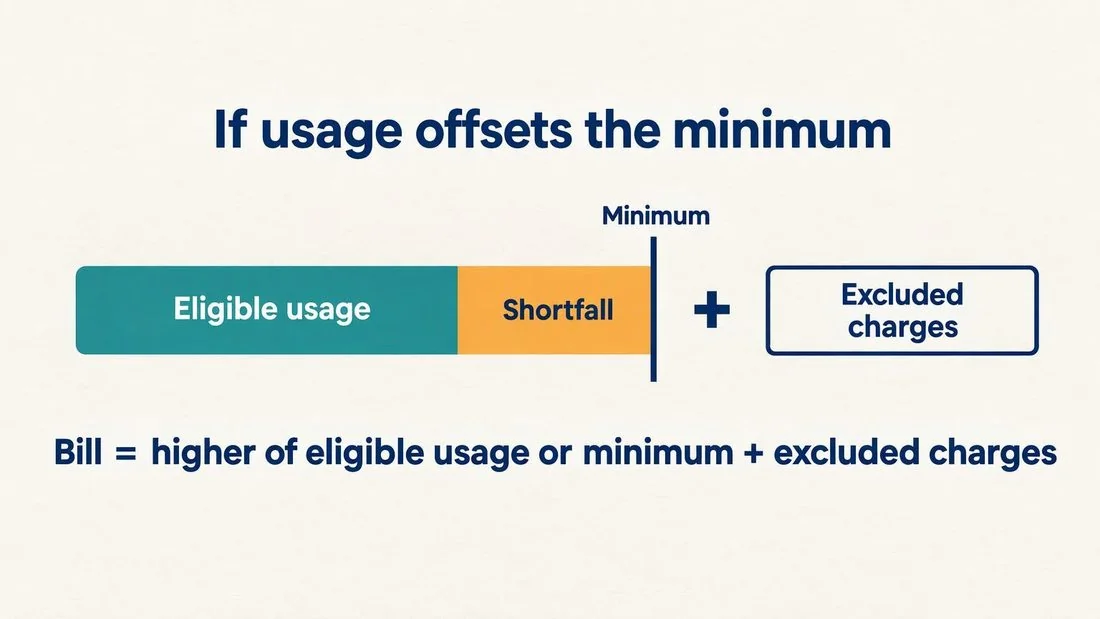
For an inclusive spending floor, the basic calculation is the higher of eligible usage charges or the minimum, plus excluded charges. This formula applies only when usage offsets the floor; it does not apply to a subscription charged in addition to all usage.
For a top-up clause, calculate the shortfall as the minimum minus eligible spending, with no shortfall when eligible spending reaches the minimum. Then check whether the top-up purchases usable credits or is simply a payment with no future service value.
If a volume discount is conditional, model the rate adjustment separately. A missed threshold might affect future pricing, pricing for the completed period, or a shortfall payment, but only the written clause determines which calculation applies.
Compare cash due and effective service cost
Keep separate totals for cash payable, credits remaining, and charges with no remaining service value. An upfront payment can put pressure on cash even when it remains available for later use.
To compare effective cost per issued ticket, divide API service costs for the same period by issued tickets. Keep airfare outside that numerator, and identify search or support charges included in it.
In a period with no issued tickets, a per-ticket calculation is not useful. Show the absolute amount due instead; that is the obligation your business must fund.
Use low usage as the decision test
Run the calculation against a conservative booking forecast, then compare it with your expected forecast. A proposal should remain acceptable when demand is weaker, rather than depending entirely on the most optimistic sales case.
A lower unit rate can justify a commitment when eligible usage reliably absorbs the floor. The downside is that the same rate becomes less meaningful when unused minimum payments dominate the bill.
What value survives in unused balances and true-up clauses?
Unused value matters only if you retain a practical way to spend or recover it. Rollover helps when later eligible demand consumes the balance before expiry; it offers little protection if restrictions prevent that use.
Distinguish prepaid credits from a shortfall payment. Paying a true-up does not automatically create a credit balance, and a credit balance does not automatically qualify for a refund.
Read rollover as a spending right
Check the eligible services, expiration rule, and order in which balances are consumed. If newer credits are used before older ones, an expiring balance may remain untouched despite continued activity.
Also determine whether later usage can draw on earlier credits while satisfying a later minimum. Without clear treatment, you could retain credits yet still owe fresh cash to meet the next commitment.
Separate the measurement period from settlement
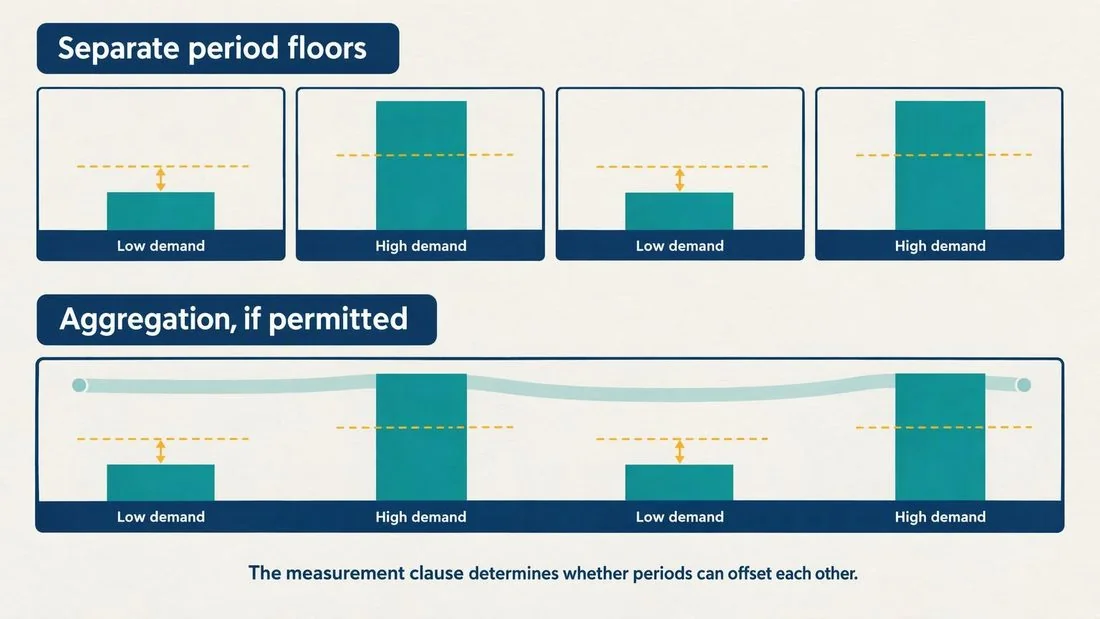
A true-up reconciles actual eligible activity with the agreed obligation. The measurement period determines the shortfall; the settlement date determines when payment becomes due.
A longer measurement period can allow high-usage and low-usage periods to offset each other if the agreement permits aggregation. Merely delaying the invoice does not create that benefit if each shorter period is still tested independently.
For a conditional discount, identify whether under-use removes the discount, creates a shortfall charge, or produces both effects. Review the combined exposure rather than evaluating each clause in isolation.
Test launch timing and the cost of leaving
A commitment can be affordable after launch and expensive before customers can book. Identify the event that starts the obligation: contract signature, production access, acceptance, or another defined milestone.
Build the first-period forecast around that event. If billing begins before commercial launch, development and testing time may consume part of the paid period without generating eligible bookings.
For a staged launch, calculate usage from the customers actually included in the first release. Do not use the full future audience to justify a commitment that starts while only part of the platform is live.
Separate billing relief from technical recovery
If launch is delayed or service is interrupted, technical assistance and billing relief address different problems. A fix does not by itself change the minimum-spend obligation.
Look for an explicit adjustment, suspension, or credit provision if that protection matters to the purchase. Include its conditions in the model rather than assuming every interruption reduces the amount due.
Calculate the obligation after termination
The monthly payment does not tell you the full exit exposure. Review the commitment term, notice requirements, renewal trigger, and treatment of remaining payments or credits after cancellation.
Compare the amount still payable if the integration stops with the value you can still use. A proposal can have manageable operating bills but remain unattractive if leaving creates a substantial payment obligation.
Work through a seasonal booking example
Say you operate a travel platform whose flight sales rise during established booking seasons, but demand between those periods is uncertain. You are comparing a usage-only proposal with a proposal that has a lower unit rate and a spending floor.
Under the usage-only proposal, service spending follows the defined billable activity, subject to any separate fees. Under an inclusive monthly floor, a quiet month can require a shortfall payment even if a later busy month generates substantial usage.
If the committed proposal instead allows eligible spending to aggregate across the full season, stronger periods may absorb weaker ones. That changes the comparison, but only if the measurement clause permits it.
Now add prepaid rollover. It helps if later demand can consume the credits before expiry and the later minimum does not force duplicative funding. If those conditions are absent, rollover may preserve a nominal balance without reducing near-term payments.
The usage-only option follows when your low-demand forecast leaves a material shortfall and you cannot use or recover its value. The committed option may follow when conservative eligible demand absorbs the obligation and its pricing benefit exceeds the remaining risk.
This choice depends on the timing and eligibility of spending, not simply the total number of reservations. Strong annual sales do not solve a monthly reset that prevents spending from moving between periods.
Apply the comparison to a Xeni integration proposal
When evaluating our travel API integration, keep the commercial commitment separate from the technical scope. Do not assume a minimum applies, and do not interpret a proposed access fee or funding balance as one without checking its purpose.
The useful outcome is a proposal that lets you calculate the amount due during lower usage. If there is a commitment, its eligible charges, starting event, reset period, under-use treatment, and exit terms should support that calculation.
Use Contact Us to confirm whether your proposed integration carries any minimum spend and how under-use would be treated. Frame the discussion around your billing metric and conservative demand forecast so the answer addresses the actual purchase decision.
Confirm these terms with Xeni before acceptance
- Confirm whether any minimum-spend obligation applies
- Define the billing metric and eligible charges
- Confirm the obligation's start event and reset period
- Calculate the bill using conservative demand
- Clarify shortfall charges, credits, or rate adjustments
- Check credit expiry, rollover, refunds, and later use
- Review exit terms and remaining payments or credits
Resolve the low-usage bill before accepting the proposal
Confirm whether a minimum commitment applies and whether any shortfall becomes a charge, usable credit, or rate adjustment.
Explore more from Xeni
Frequently Asked Questions
Make the decision on the weak-period bill
Before acceptance, calculate what the proposal requires when eligible spending falls short. If that amount fits your budget and the remaining service value is usable, the commitment may be reasonable; if it relies on optimistic demand or credits you cannot consume, the lower unit rate is not enough.