
A flight booking affiliate API can mean different things: flight search that sends travelers to another seller, an embedded referral tool, or an integration that supports booking inside your product. Those differences matter more than the label because they change what you build, what earns money, and who helps the traveler afterward.
For referral sales, start with the earning agreement and work backward to the technology. A technically capable flight connection is a poor fit if your referrals cannot be attributed or the transactions your audience makes do not qualify for payment. The useful comparison is between operating models, not feature counts.
Which operating model fits your referral business?
If your main job is recommending flights, a referral arrangement is the logical starting point. You direct the traveler to a booking destination and earn according to the partner's terms, rather than building a checkout solely to monetize a recommendation.
If your product depends on presenting flight results in a particular way, an API may be worth investigating. Still, access to flight data answers a technical question. Permission to monetize referrals answers a commercial one.
Separate where search happens from where booking happens. An on-site search experience can still send the traveler elsewhere to pay, while a branded checkout does not by itself establish who sells or services the ticket.
Operating models to compare before selecting technology
| Model | Traveler journey | Commercial requirement | Main trade-off |
|---|---|---|---|
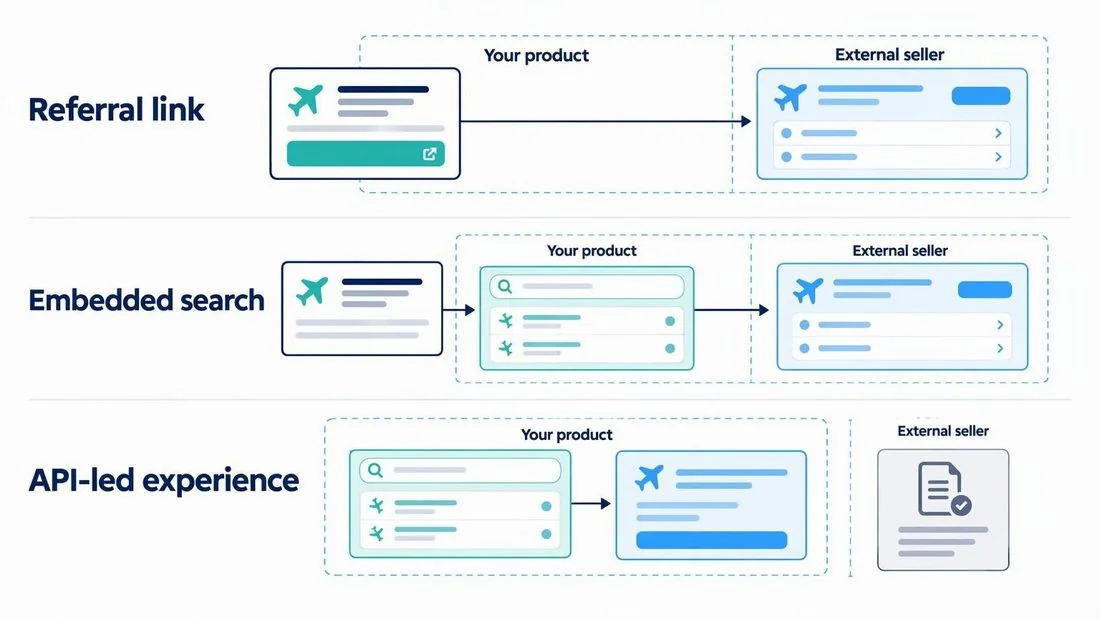
| Tracked referral link | Leaves your content to search or book elsewhere | Agreement covering eligible referrals and payment | Less integration work, less control after departure |
| Embedded search with booking handoff | Searches within your product, then moves to a seller | Referral agreement plus permission to use the search tool | More search control; attribution must survive the handoff |
| API-led booking experience | Searches and may book within your product | API agreement plus explicit earning and booking arrangements | More product control, more implementation and responsibility decisions |
Buy only the control your product needs
A flight booking engine API becomes useful when its capabilities solve a specific product problem. That might be carrying a traveler's search into a booking flow or fitting flight selection into an existing application, subject to the provider's supported functions.
If a tracked link already delivers the journey your audience needs, a custom integration adds work without necessarily adding earnings. If leaving your product interrupts an essential workflow, deeper integration deserves evaluation. Neither model is automatically the better business.
What transaction actually qualifies for payment?
Write down the earning event before comparing commission rates. A search, an outbound click, a reservation, an issued ticket, and completed travel are different events; the agreement must identify which one qualifies.
Flight availability on a travel platform does not establish that its affiliate program pays on flights. Likewise, a rate advertised for another travel category cannot be carried over to airfare. Require flight-specific eligibility rather than treating all travel sales as interchangeable.
The transaction's later status matters, too. Establish whether a canceled, refunded, changed, or disputed booking remains eligible and whether an initially recorded earning can be reversed.
Identify the calculation base
A percentage is incomplete without its denominator. Payment might be calculated from an eligible sale amount, a fee, or the partner's revenue; those bases produce different earnings even when the displayed percentage looks similar.
Ask for a worked calculation using the proposed agreement. It should identify included amounts, excluded amounts, any deductions, and when the earning becomes payable. Do not estimate flight booking API commission by multiplying a headline rate by the entire ticket price unless the terms explicitly permit that calculation.
Keep eligibility separate from attribution
A referral can be tracked correctly yet earn nothing because the transaction does not qualify. Conversely, an eligible booking may fail to earn for you if the referral cannot be credited under the attribution rules.
Keep those explanations separate in your evaluation. Otherwise, a report showing visits and bookings can create a misleading impression of revenue potential.
Will attribution survive the traveler's actual journey?
Evaluate tracking against how your audience buys, not just a successful click in a demonstration. A traveler might follow a recommendation, compare options elsewhere, return later, or switch devices before booking.
The agreement should explain when attribution begins, how long it remains valid, and what happens if another referral intervenes. A long attribution window is not enough if the journey your audience uses falls outside the supported tracking method.
For an API-assisted handoff, establish whether a referral identifier travels from your application to the seller and then appears in the transaction report. Search activity in your own analytics does not prove that a booking has been credited.
Test the boundary between your product and the seller
Use approved test methods to follow a search through its redirect and inspect the resulting attribution record. Then test a return visit and any mobile or app handoff your product intends to support.
Device switching, blocked tracking, and consent choices deserve explicit treatment rather than assumed coverage. Server-side tracking may change how an event is transmitted, but the partner's agreement still determines whether that event earns credit.
Require a report you can reconcile
A useful report connects your referral identifier to a transaction status and earning amount without requiring unnecessary passenger information. It should distinguish activity awaiting validation from approved earnings and explain rejected or reversed entries.
Compare that report with your outbound referral records. If a transaction is missing, you need a defined investigation route and an identifier both parties can use, not only a dashboard total that cannot be traced.

Who owns the booking and helps the traveler?
Define booking ownership through responsibilities, not branding. Identify who takes payment, issues the ticket, sends the confirmation, handles changes, and manages refunds or payment disputes.
For a referral-led product, the cleanest customer journey clearly names the destination where the traveler books and where booking support begins. Your own role can remain focused on content or search, provided the partner arrangement supports that separation.
For a flight ticket booking API, map each step of the journey before committing to implementation. An API response or booking reference should not be treated as proof that every downstream task is covered.
Match the interface to the responsibility
Travelers should be able to tell whether they are viewing a recommendation, leaving for another seller, or buying within your product. Put the relevant seller and support information where the decision happens, rather than relying on a distant explanation.
If your interface looks like the place that sold the ticket, travelers may bring booking problems to you even when another party handles them. That creates support work you should include in the operating model.
Resolve the difficult handoffs
Walk through an accepted payment without a confirmed ticket, a requested cancellation, and a passenger detail correction. For each, identify the party that acts and the information your product must show.
These questions do not make an API unsuitable. They reveal whether its supported booking arrangement matches the service your business is prepared to deliver.
How should you compare earnings, costs, and payout conditions?
Compare expected net earnings using the same audience and traffic assumptions for each option. The highest advertised percentage is not necessarily the strongest offer if its calculation base is smaller, fewer transactions qualify, or costs absorb the difference.
A useful working model is approved referral earnings minus attributable operating costs. Keep recorded earnings, approved earnings, and cash received separate so you can see both profitability and payment timing.
For flight booking API cost, obtain the actual pricing structure rather than assuming access is free because a referral program exists. Evaluate any applicable setup charges, recurring fees, usage charges, booking charges, development work, and support costs.
Model searches separately from bookings
If a proposed API charges for usage, model the searches your audience performs as well as the bookings it completes. Repeated searches can increase integration cost without creating additional qualifying sales.
Use your own traffic records where available. Keep any forecast visibly separate from observed results, and test whether the model still works when more visitors browse but fewer finish booking.
Treat payout timing as a business decision
Establish the validation event, payout schedule, payment method, currency, and any minimum payment threshold. Also determine how reversals affect an unpaid balance or a payment already received.
An earning recorded today may not be available to fund today's acquisition costs. A referral model funded by paid promotion therefore needs a cash-flow comparison as well as a commission comparison.
Confirm the economics before committing
- Compare approved earnings minus operating costs.
- Obtain setup, recurring, usage and booking charges.
- Include development work and support costs.
- Model search usage separately from completed bookings.
- Confirm validation, payout timing, currency and threshold.
- Establish how reversals affect unpaid or paid earnings.
A worked example: a publisher adding flight referrals
Say you run travel content that helps readers choose flights. Readers need a clear next step to book, but your business does not intend to take payment or handle ticket changes.
A tracked referral link fits that initial job if the agreement pays for eligible flight transactions. It lets you evaluate audience response without first building a custom booking experience.
An embedded search tool could become worthwhile if readers need to compare flights without leaving your content. The deciding issue is whether that search experience improves their task and carries attribution into the seller's booking flow.
A booking API is a different investment. If on-site checkout is not necessary and you do not want booking responsibilities, implementing it merely to earn referrals is difficult to justify.
Now picture your product changing: flight selection becomes part of an application workflow that must preserve a user's choices. API integration becomes more relevant because it solves a product dependency, but the commercial agreement still has to explain how your business earns.
The choice changes because of the required journey, not the number of reservations. Begin with the simpler model that meets the reader's need, then consider deeper integration when it solves a demonstrated problem.
Where does Xeni fit in this comparison?
Review our API integration page to frame a discussion around the experience you want to create.
Keep the referral arrangement separate from the integration choice. API access should not be treated as automatic enrollment in an affiliate program or as a promise of commission on flight bookings.
For a useful discussion, describe where the traveler searches and pays, the event you want credited, and the booking responsibilities you intend to retain. Include the reporting you need to reconcile referrals with approved earnings.
Then ask our team whether your proposed referral model is supported. The decision should rest on a compatible user journey and explicit commercial terms before you commit development effort.
Connect the integration discussion to your earning model
Review the API integration options, then ask whether your planned referral journey and commercial arrangement are supported.
Explore more from Xeni
Frequently Asked Questions
Choose the earning agreement before the implementation
Make your final choice with a documented qualifying event, a tested attribution path, assigned booking responsibilities, and a net-earnings comparison. Those details tell you whether a referral arrangement is enough or whether API integration solves a real product need.