

For an activities API buyer, the important question starts after checkout: what can you truthfully tell the traveler? A request may have reached the booking system while the reservation outcome still needs verification, or a reservation may be confirmed while its admission document is not yet available.
Your evaluation should follow the booking all the way to the entrance or meeting point. That means understanding the status evidence, preserving the selected activity details, and deciding who handles delivery failures. The goal is a connection that supports the customer promise your business wants to make.
What should each booking state prove?
Evaluate the connection against distinct business outcomes, rather than a single success label. Your customer interface needs to know whether the system received a request, whether the supplier has confirmed the reservation, and whether the traveler has the required admission material.
The labels below are evaluation categories, not prescribed API field names. A provider may use different terminology, so the important evidence is the documented meaning of its responses and the customer message each response supports.
A connection can meet these needs without completing every step in the initial response. The trade-off is that a delayed step needs an owner and a visible pending state; otherwise your checkout page may promise more than the booking evidence supports.
Business outcomes to distinguish during an integration evaluation
| Outcome | Evidence to request | Appropriate customer message |
|---|---|---|
| Request accepted | A request identifier and a definition of what acceptance means | Your request has been received; confirmation is pending |
| Reservation confirmed | A reference documented as a confirmed reservation, linked to the booked option and schedule | Your reservation is confirmed |
| Admission ready | The required document or admission instructions, plus evidence that they are available to the traveler | Your admission details are ready |
What evidence establishes a confirmed reservation?
Look for a reservation outcome that is tied to the actual purchase. A reference is useful only when its meaning is clear: it could identify the submitted request, your internal order, or the supplier's reservation.
Ask for a response example and its field definitions together. A sample containing a booking reference does not, by itself, explain whether supplier acceptance has occurred or whether that reference is usable when resolving an admission problem.
Your acceptance criteria should require enough information to match the confirmed reservation to the selected activity option and participant selection. Keep payment evidence separate: a receipt should not be treated as reservation evidence unless the documented process explicitly establishes that relationship.
Keep the identifiers connected
Your order reference, the connection's request identifier, and any supplier reservation reference should remain associated. This gives customer support a way to trace the same purchase without assuming that every system uses the same identifier.
Ask the provider to explain which reference is used for status retrieval and which is used for supplier assistance. The distinction matters when the customer has a confirmation email but the support team needs to investigate the underlying reservation.
Require a defined outcome, not a convincing screenshot
A polished confirmation page demonstrates presentation, not the meaning of the upstream response. During a demonstration, follow the evidence behind that page and identify the exact event that allows the business to call the reservation confirmed.
A useful selection criterion is whether that decision can be explained consistently to product, engineering, and customer support. If those teams interpret the same status differently, the traveler message needs revision before launch.
Which scheduled-entry details must survive checkout?
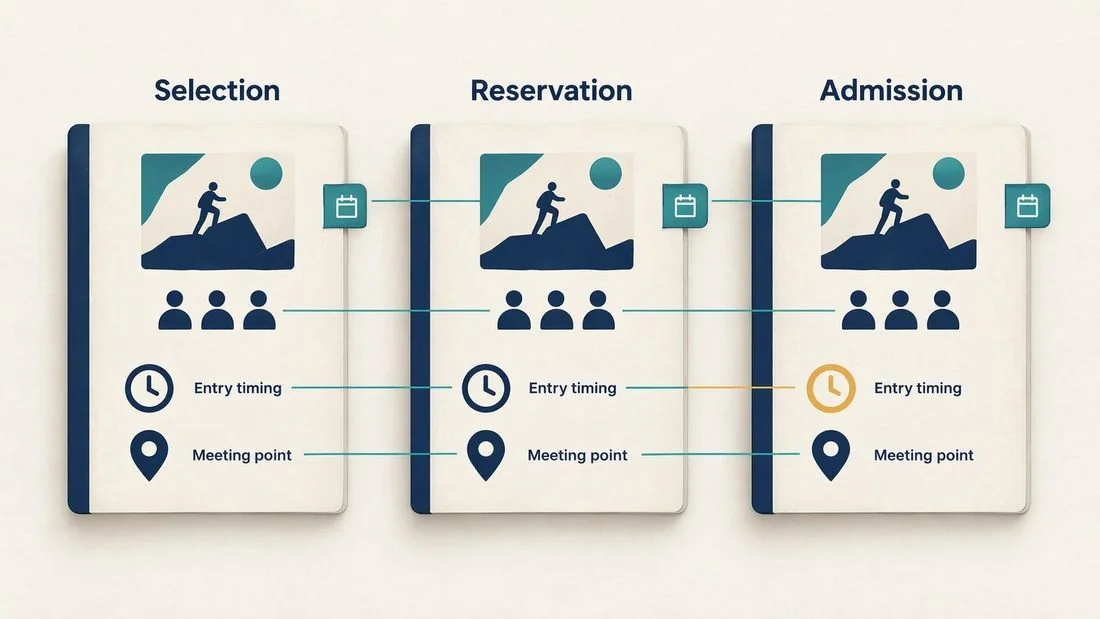
Confirmation should identify the experience the traveler actually selected, not merely repeat a broad activity title. For a scheduled-entry product, require the booked date, entry time, and the time zone or local-time meaning to remain clear through confirmation and delivery.
Keep the activity option distinct from the product name. If the purchase involves a selected language, participant category, or meeting arrangement, your evaluation should establish how those selections appear in the final reservation record.
For an open-date product, evaluate the validity information instead of assuming a timed entry. The connection should support the information relevant to the product you intend to sell; a date field is not automatically a reserved time slot.
Separate entry time from arrival instructions
Entry time, departure time, and required arrival time describe different actions. Your customer message should preserve any distinction in the confirmed booking instructions rather than collapse all of them into a generic start time.
For the same reason, do not substitute a general attraction address for a booking-specific entrance or meeting point. Evaluate how those instructions stay attached to the reservation and how a traveler receives an updated instruction if it changes.
Compare the selected option with the final result
Use an acceptance test that compares the customer's selection, the reservation response, and the admission material. Differences in the date, option, or participant details should stop the system from sending an unqualified ready-to-attend message.
This is a booking-integrity test, not a requirement to expose every technical field to the traveler. The customer needs clear attendance details; your support team needs enough underlying information to explain and correct a mismatch.
Who is responsible for the admission document?
Assign responsibility separately for issuing an admission document and delivering it to the traveler. A reservation can be confirmed without proving that the traveler has received the material needed at the entrance.
Evaluate the actual admission method for the products in scope. Do not assume that a booking reference, voucher, downloadable ticket, or code is interchangeable with another document, or that every activity requires a separate ticket.
The integration agreement should identify who supplies the required material, who sends or displays it, and who assists when access fails. That division makes the difference between a recoverable delivery problem and a traveler who does not know whom to contact.
Distinguish document availability from customer access
A document can exist upstream without being accessible in the customer's account or message. Treat issuance, availability, and delivery as separate evidence when the proposed workflow makes them separate steps.
Test the traveler-facing route, including whether the material is readable on the device your booking flow supports. If access depends on a link, establish how the customer retrieves the material again rather than relying solely on the original message.
Define recovery before choosing the delivery route
Supplier-managed delivery may reduce the document-sending work in your own product, but evaluate how your support team will establish what the customer received. Delivery through your own product may give you more control over the customer experience while adding responsibility for access and recovery.
Neither approach is automatically better. Choose according to the supported workflow, the evidence available to your team, and who can act when the traveler cannot retrieve the required material.
How should uncertain outcomes and changes be handled?
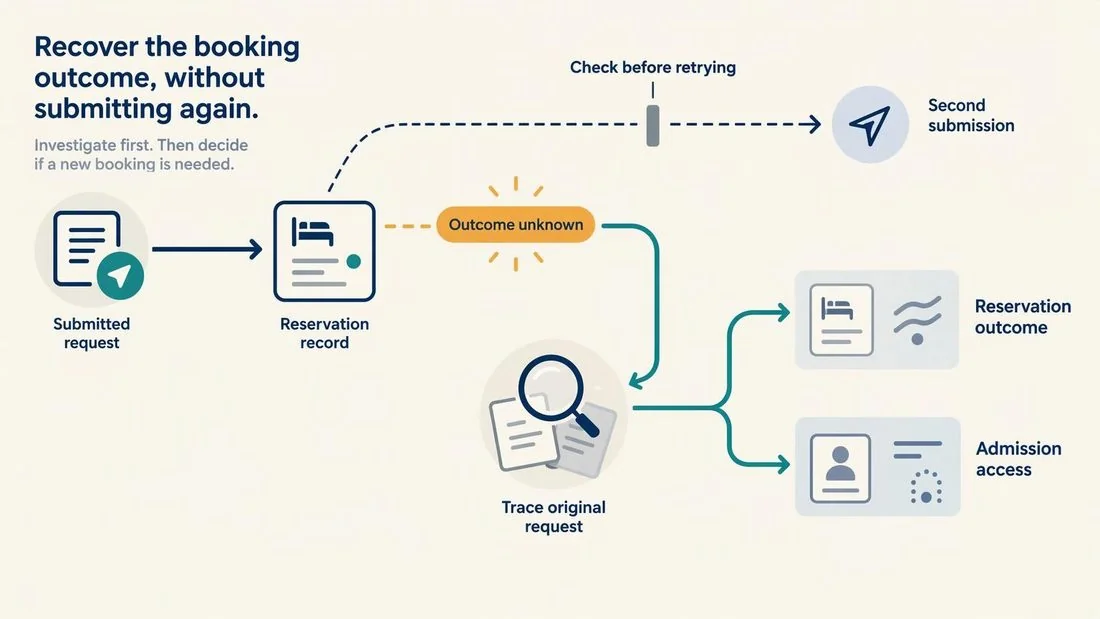
When a booking response does not arrive, treat the outcome as unknown until the connection's documented recovery process establishes it. An absent response is not evidence that a reservation failed.
Before permitting another submission, establish how the original request can be traced and whether the proposed connection supports protection against duplicate reservations. Do not assume retrying is safe simply because the checkout page displayed an error.
Ask for demonstrations of delayed confirmation, a confirmed reservation with missing admission material, and a communication failure after submission. The buying question is whether each case has an accurate customer message and a practical recovery path, not whether the first response always looks successful.
Make pending work visible
A pending state needs a route to its eventual outcome, whether that is a documented status lookup, a notification, or an assigned manual follow-up. Evaluate the method actually supported by the proposed connection rather than specifying an unsupported mechanism.
Agree on when your team takes over if the expected update does not arrive. The timing should come from the operating agreement and product requirements, not an assumed universal confirmation period.
Keep changes separate from their requests
Apply the same evidence standard to amendments and cancellations. A submitted change request should not be displayed as an accepted change until the relevant outcome is established.
If a change affects the entry schedule or admission material, decide how the updated reservation and document replace the earlier information. Your traveler interface should make the current attendance instructions clear without treating an old document as current merely because it remains accessible.
Exception-handling acceptance checks
- Treat an absent response as an unknown outcome
- Trace the original request before permitting resubmission
- Verify duplicate-reservation protection before retrying
- Assign a recovery path and owner for pending bookings
- Recover missing admission material without rebooking
- Establish change outcomes before displaying acceptance
- Replace outdated schedules and admission material
Work through a timed-entry booking before you choose
Say you run a travel storefront that sells scheduled-entry activities. Your intended checkout promise is that customers will know their reservation is confirmed and can retrieve whatever they need for admission before they attend.
One proposed connection returns a documented supplier confirmation with the selected entry details and makes the required admission material available in the same flow. Another accepts the request first, then supplies the reservation outcome and admission information later.
The first approach fits an immediate confirmation promise more directly, provided the demonstration proves those meanings and the traveler can access the material. The second can still fit your business if checkout clearly communicates the pending stage and your team has a supported way to obtain and deliver the final result.
Now introduce a delivery failure after the reservation is confirmed. Do not mark the booking as rejected or encourage the customer to reserve again; the useful action is to recover the admission material while preserving the confirmed reservation.
Then compare the final admission details with the original selection. If the entry time does not match, the booking is not ready for your intended customer message, even if a document has been generated.
The choice follows from the dependency: your promise relies on both reservation evidence and usable attendance information. Select the connection whose demonstrated workflow supports that promise, or change the promise and operating process to match the workflow you can reliably support.
How to scope the requested connection with Xeni
Start with our Activities page to frame your activity use case, then review our API Integration page for context.
For this decision, the useful scope is more specific than access to activity content. Describe the traveler promise you want to make, the reservation evidence it requires, and whether admission material must be available during checkout or can follow through a defined delivery process.
Bring the timed-entry example to the discussion, including the missing-document case. That keeps the evaluation focused on how the proposed connection would handle confirmation, scheduled entry, and delivery responsibilities without assuming a particular status model or ticket format.
Use Contact Us to ask how those requirements would work for your requested connection. Evaluate the proposed workflow against the same acceptance criteria you apply to other options.
Match the connection to your confirmation promise
Review Activities, then discuss reservation evidence and admission-document delivery for the connection you need.
Explore more from Xeni
Frequently Asked Questions
Approve the traveler outcome, not just the response
Before committing to a connection, be able to trace a purchase from the selected activity to its confirmed reservation and required admission information. Record what proves each outcome, who owns the next step, and how the customer gets help when delivery fails.